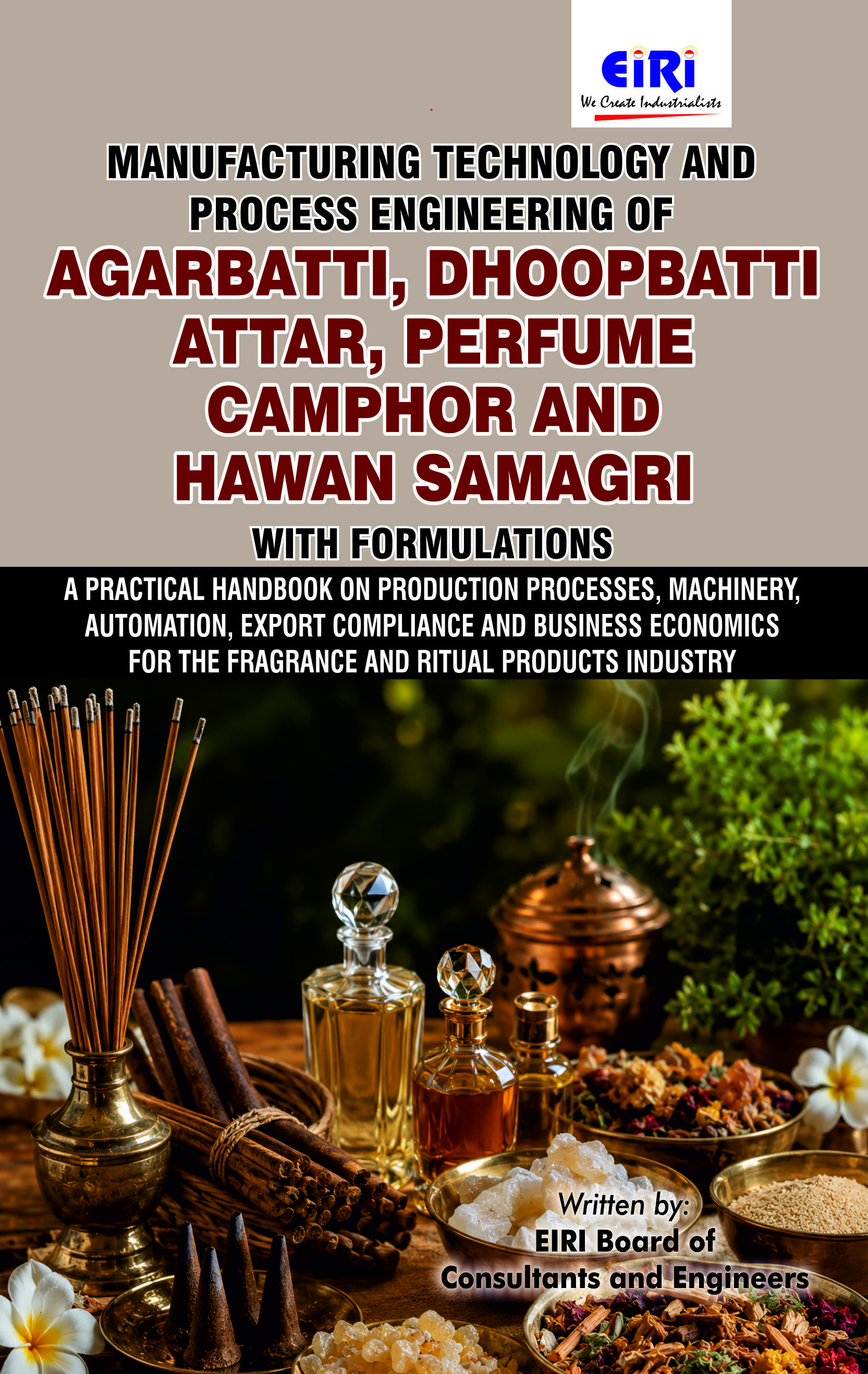
Manufacturing Technology and Process Engineering of Agarbatti, Dhoopbatti, Attar, Perfume, Camphor and Hawan Samagri with formulations
Why Choose Us
- More than 45 years of experience
- Managed by expert industrial consultants
- ISO 9001-2015 Certified
- Registered under MSME, UAM No: DL01E0012000
How We Work
- 24/5 Research Support Get your queries resolved from an industry expert. Ask before you purchase.
- Custom Research Service Speak to our consultants to design an exclusive study for your needs.
- Quality Assurance All reports are prepared by qualified consultants & verified by experts.
- Information Security Your personal & confidential information is always safe and secure.
Product Description
Manufacturing Technology and Process Engineering of Agarbatti, Dhoopbatti, Attar, Perfume, Camphor and Hawan Samagri with formulations (A Practical Handbook on Production Processes, Machinery, Automation, Export Compliance and Business Economics for the Fragrance and Ritual Products Industry)
ISBN 9788168510616
The book contains chapters on Section I: Agarbatti Manufacturing Technology - Raw Material Sourcing and Grading, Masala Dough Formulation and Mixing, Stick Forming Technology, Drying, Curing, and Quality Control, Low-Smoke, Charcoal-Free, and Natural Agarbatti, Packaging, Branding, and Export-Grade Standards, Section II: Dhoopbatti and Incense Cone Technology - Wet (Non-Drying) Dhoopbatti Process, Rigid Dry Dhoop Sticks, Cone and Backflow Cone Manufacturing, Dhoop Cups and Herbal Dhoop, Section III: Attar Distillation Engineering - Traditional Deg-Bhapka Distillation Plant Design, Carrier Base Selection, New Attar Formulations, Section IV: Perfume Compounding - Process and Business Engineering - Solvent and Fixative Chemistry, Dipping and Absorption Technology, Automation and Machinery Directory, Export Compliance nd International Markets, D2C, E-commerce, and Brand Building, Section V: Camphor (Kapur) Technology - Camphor (Kapur): Raw Material and Chemistry, Tablet Punching and Refining Operations, Formulations and Packaging, Section VI: Hawan Samagri and Ritual Herb Blends - Sourcing and Milling of Sacred Herbs, Blending Formulations, Packaging Technology, Section VII: Startup and Financial Blueprint - Factory Layout and Utility Requirements , Machinery Categories and Vendor Selection, Understanding Project Economics and Bank Financing.
SECTION I
AGARBATTI MANUFACTURING TECHNOLOGY
Chapter 1
Raw Material Sourcing and Grading
- Introduction
- Charcoal powder - mesh sizes and physicochemical specification
- Coconut charcoal agarbati powder
- Recommended Mesh Sizes
- Jigat/Joss powder (Litsea glutinosa bark) - binding mechanics and grades
- Binding Mechanics
- Grading System
- White wood powder, T-1
- powder, and bamboo stick grading standards .
- Dimensional and Quality Parameters
- Industry Grading Scale .
- The process of making bamboo sticks by mechanized process
- The machines used for the above processes .
- Bamboo Stick Making Machine Manufacturers and Suppliers
Chapter 2
Masala Dough Formulation and Mixing
- Essential Raw Materials .
- Standard Formulation (By Weight)
- Mixing and Preparation Process.
- Next Steps & Curing
- Wet masala dough base formulation (non-fragrance)12
- Formulation of Standard Wet Masala Dough
- Simple Mixing Instructions
- Preparing Agarbatti Masala Dough
- Combination I
- Combination II
- Combination III
- Combination IV
- Combination V
- Combination V
- Combination V
- Combination VI
- Ingredients of masala agarbattis
- Amber Chandan Bathi .
- Ambri Heena
- Kasturi Chandan Bathi
- Chandan Bathi
- Organic Raw Materials & Chemical-Free Formulation
- Step-by-Step Organic Manufacturing Process
- Preparing the Chemical-Free Dry Mix
- Kneading Organic Dough
- Rolling the Eco-Friendly Sticks
- Natural Sun and Shade Drying
- Natural Perfuming (No Synthetic Dips)
- The Eco-Friendly Final Product
- Water-to-dry-powder ratios for consistent extrusion
- Why the Ratio Matters for Extrusion
- Best Practices for Mixing and Extrusion
- Kneading, hydration checkpoints, and dough consistency control
- Kneading Process and Consistency Control
- Dough Consistency Check:
- Consequences of Poor Hydration
- Agarbatti Dough Control Guide
- Core Formulation Ratios
- Consistency Troubleshooting & Corrections
- Mixing and Preparation
Chapter 3
Stick Forming Technology
- Technologies in Agarbatti Production
- Bamboo Stick Making (Substrate Preparation)
- Hand-rolling technique versus mechanised extrusion
- Hand-Rolled Agarbatti
- Key Characteristics of Hand- Rolled Agarbatti
- Machine-Made Agarbatti
- Key Characteristics of Machine- Made Agarbatti:
- Hand-Rolled vs Machine-Made Agarbatti: A Detailed Comparison
- Fragrance Quality
- Burn Time & Smoke Quality
- Ingredients & Safety
- Craftsmanship & Authenticity
- Price & Value for Money
- Bambooless (core-free) stick extrusion technology
- Bambooless Agarbatti vs. Traditional Agarbatti
- Ingredients Used in Bambooless Incense Sticks
- Step-by-Step Manufacturing Process
- Why Choose Bambooless Incense Sticks?
- Key Features of Bambooless Incense Sticks
- Future of Incense: Why Bambooless is Trending
- Automatic and semi-automatic agarbatti-making machine operation & throughput
- Machine Operations
- Throughput and Production Capacity
- Operating Differences and Power Requirements
- Understanding Automatic Agarbatti Making: What It Means
- Key features of an automatic agarbatti production line
- Raw Materials & Machine Requirements
- Raw Materials
- Machine & Automation Requirements
- Production Process: Step by Step
- Understanding the Semi Automatic Agarbatti Making Machine
- Key Features
- Manufacturing Process Using the Machine
- Raw Material Preparation
- Paste Feeding
- Extrusion & Coating
- Drying
- Fragrance Application & Packing
- Advantages for Small & Medium Manufacturers
- Applications
Chapter 4
Drying, Curing, and Quality Control
- Tray drying versus tunnel/ conveyor drying systems
- Agarbatti Tray Drying System
- Agarbatti Tunnel/Conveyor Drying System
- Quick Comparison
- Humidity control and warp/ crack prevention
- Warp/crack prevention
- Optimize Your Binding Agents
- Control the Moisture & Mixing
- Implement Controlled Drying
- Use Controlled Equipment
- Breakage-rate reduction and batch quality testing
- Agarbatti Breakage-Rate Reduction
- Batch Quality Testing Standards
- Fully Automatic Incense Stick Dryer Machine
- Key Features
Chapter 5
Low-Smoke, Charcoal- Free, and Natural Agarbatti
- Herbal and clean-label base development.
- Common Ingredients Used
- Melloow Luxury
- Key Benefits of Using Herbal Agarbatti
- Panchagavya-Based Agarbatti
- Why Clean-Label Base Development Matters
- Core Ingredients in a Clean- Label Base .
- Typical Formulation Process
- What Makes a Base Agarbatti “Clean-Label”? .
- Top Clean-Label Brands
- Charcoal-free formulation approaches for the ecoconscious segment
- Personal Care & Cosmetics
- Home Fragrance & Aromatherapy
- Combustible Biomass (The “Charcoal” Alternative)
- Plant-Based Binders (The “Jigat” Substitute) .
- Natural Fragrances (The “Chemical Dip” Substitute)
- Zero-Waste Processing Techniques
- Environmental Impact of Charcoal-Free Incense Sticks .
- Best Practices for Using Charcoal-Free Incense Sticks
Chapter 6
Packaging, Branding, and Export-Grade Standards
- Export-Grade Standards & Compliance
- Packaging Materials & Methods
- Branding for Global Markets
- Key Export Documentation
- BIS and export quality parameters for agarbatti
- BIS Quality Parameters: IS 19412:2025
- International Export Quality Parameters
- Essential Export Documentation
- IS 19412:2025
- Which Products Does IS 19412:2025 Cover?
- What IS 19412:2025 does not yet cover .
- The Core Technical Requirements — What Your Product Must Now Meet
- Raw Material Standards
- Burning Performance Requirements
- Fragrance Performance
- Chemical Safety and Emissions
- Documents Required for the Agarbatti BIS Licence
- Statutory and Business Documents
- Technical and Manufacturing Documents
- Quality Control Documents
- Step-by-Step Process to Get Your Agarbatti BIS Licence
- Step 1 - Application Submission on Manak Online
- Step 2 - Scrutiny and Query Resolution
- Step 3 - Preliminary Factory Inspection
- Step 4 - Laboratory Sample Testing
- Step 5 - Grant of Licence
- Step 6 - Marking and Labelling
- Geographical Indication (GI) cluster .
- The Mysore Agarbathi Cluster
- Beyond the Mysore GI Tag
SECTION II
DHOOPBATTI AND INCENSE CONE TECHNOLOGY
Chapter 7
Wet (Non-Drying) Dhoopbatti Process
- Understanding Dhoop: The Sacred Smoke
- The Spiritual Significance of Dhoop
- Modern Alternatives and Additions
- Wet Dhoop: Characteristics and Uses
- Binder science: natural gums, starch, and fruit pulp
- BondEX
- AgarBind
- CMS (Carboxy Methyl Starch)
- Yeltrin (yellow Dextrin)
- Whitrin (White Dextrin)
- Guar Gum
- Binding Properties: How Guar Gum Acts as a Natural Binder
- Why Use Guar Gum as a Binder?
- Improving Burning Time and Fragrance Release
- Eco-Friendly and Natural Advantages
- Challenges and Solutions in Using Guar Gum
- Market Trends and Demand
- Starch
- Science and Functionality
- Types of Starch Binders
- Sourcing & Manufacturers
- Formula for Starch based Binder
- Preparation Steps
- Formula for Common Casein Binder
- The Incense Dragon .
- Step-by-Step Preparation
- Traditional Sourcing & Alternatives
- Modern Manufacturing Techniques
- Core Dhoop Formulas
- Essential Raw Materials
- Formulating for the Latest Market Trends
- Rolling and shaping for soft/ wet dhoop
- Production Workflow & Equipment
- Sourcing & Machinery
- Post-Shaping & Drying
Chapter 8
Rigid Dry Dhoop Sticks
- Bambooless dry dhoop extrusion
- Standard Raw Material Composition (Per 10 kg Mix)
- The Extrusion Process Step-by- Step
- The Science of Extrusion and Usage
- Raw Material Mixing
- Extrusion and Shaping
- Automated Cutting
- Drying
- Advantages of Bambooless Extrusion
- Step-by-Step Manufacturing Process
- Key Tips for Quality Control
- Hydraulic extruder operation and die design
- Hydraulic Extruder Operation
- Die Design
Chapter 9
Cone and Backflow Cone Manufacturing .
- How They Work and How to Use Them
- For the best waterfall effect:
- Ingredients & Tools
- Step-by-Step Creation
- Standard cone die adjustment
- Core Die Adjustments
- Typical Dimensions for Standard Dies
- Hollow backflow cone technology and smoke-flow balance .
- How the Technology Works
- Visuals & Usage
- Incense Burner vs. Spray Nozzle
- How the Technology Works
- Key Components Needed
- Usage and Best Practices .
Chapter 10
Dhoop Cups and Herbal Dhoop
- Benefits and Uses of Herbal Dhoop
- The Base
- Resins and Binders
- Aromatic Herbs and Roots
- Enhancers
- Making cow dung-based herbal dhoop
- Essential Materials
- Step-by-Step Process
- Safety and Use
- Machinery for Cow Dung Stick Production
- Formula for Coe dung dhoop
- Base Formula and Ingredients
- Step-by-Step Preparation
- Panchagavya-based herbal dhoop .
- Benefits and Ingredients
- Manufacturing Process .
- Business Considerations & Equipment
- Gathering the Materials
- Preparing the Cow Dung
- Mixing the Ingredients
- Shaping the Dhoop Sticks
- Drying the Sticks
- Testing and Packaging
- Benefits of Cow Dung Dhoop Sticks
- Safety Precautions
- Charcoal-molded dhoop cup manufacturing
- How It Works
- Organic Havan Cups
- Ingredients Used in Organic Havan Cups
- Step-by-Step: How Havan Cups Are Made
- Popular Variants and Scents
SECTION III
ATTAR DISTILLATION ENGINEERING
Chapter 11
Traditional Deg-Bhapka Distillation Plant Design
- Step by Step Guide to Making of Rose Attar using
- Traditional Distillation Method
- Copper deg, connecting chonga, and water-cooled bhapka receivers
- The Components of the System .
- Insights from Attar Artisans
- Traditional Equipments Used .
- The daily cycle
- Multi-day continuous distillation and temperature control .
- The Mechanics of Attar Distillation & Temperature Control
- Temperature as a Selective Filter
- Masantara Oud
- Modern Distillation Alternatives
- Traditional Maturation & Sedimentation
- The Art of the Master Distiller .
- Traditional Craft and Expertise in Kannauj
Chapter 12
Carrier Base Selection
- Choosing the right carrier
- Diethyl Phthalate (DEP)
- Dipropylene Glycol (DPG)
- Natural Carrier Oils
- Genuine sandalwood oil versus IPM
- Best Carriers for Sandalwood Agarbatti
- Formulation & Dipping Tips
- Sandalwood oil versus IPM
- Liquid paraffin alternatives
- Top Alternatives
- How to Substitute
- Genuine sandalwood oil versus IPM/liquid paraffin alternatives
- Genuine Sandalwood Oil (Santalum)
- Isopropyl Myristate (IPM)
- Key Differences at a Glance
Chapter 13
New Attar Formulations .
- Perfume Ingredients
- Current Trends and Popular Blends
- DIY Modern Formulation Example
- Khus (Vetiver) attar .
- Scent Profile and Characteristics
- Traditional Distillation
- Therapeutic and Practical Benefits
- Traditional Formulation Method (Deg-Bhapka)
- Heritage and Sourcing
- Commercial/Modern Blending Approach
- Mitti (baked-earth) attar
- Heena attar
- The Traditional Deg and Bhapka Process
- Steap-by-step manufacturing Process
- Step 1: Raw Material Preparation
- Step 2: Traditional Hydro- Distillation
- Step 3: Gentle Heating and Trapping .
- Step 4: The Base Infusion
- Step 5: Sedimentation and Aging
- Kesar (saffron) synthetic attar
- Key Materials Used
- Step-by-Step Manufacturing Process
- Regulations in Attar Manufacturing
- Quality Control Standards
- Good Manufacturing Practices (GMP)
- Labeling and Certification .
- Environmental and Ethical Considerations
SECTION IV
PERFUME COMPOUNDING - PROCESS AND BUSINESS ENGINEERING
Chapter 14
Solvent and Fixative Chemistry
- Solvent
- Different Types of Solvents Used in Perfumery
- The Key Polar Solvents used in Fragrance Creation
- Acetone
- Alcohol
- Isopropyl Myristate (IPM)
- Water
- The Key Non Polar Solvents Used In Fragrance Creation
- Carbon Dioxide .
- Ethyl Acetate
- Ethyl Alcohol
- Common Perfume Solvents
- Fixative Chemistry
- The Evaporation Challenge
- Fixative Mechanisms
- Types of Fragrance Fixatives
- Natural Fixatives
- Synthetic Fixatives
- Specialty Fixative Systems
- Application Techniques and Best Practices
- Concentration Guidelines
- Selection Criteria
- Regulatory Considerations
- Compliance Requirements
- Safety and Environmental Considerations .
- Future Trends and Innovations .
- Sustainable Fixatives .
- Smart Release Systems
- Common Fixatives
- Solvent Capabilities and Use Cases
- Regulatory Status and Consumer Perception
- Isopropyl Myristate (IPM) .
- Key Advantages in Formulation
- Usage & Sourcing Tools
- Denatured Ethanol
- Why Denatured Ethanol is Preferred
- What to Look For .
- Typical Formulation
- Scent Development
- How They Work Together
- Fixatives: Galaxolide, Benzyl Benzoate, and natural resins
- Fixative in Perfumery
- The Key Fixative Types and What Each One Does
- Ambroxane The Premium Skin Fixative
- Galaxolide The Clean Musk Fixative
- Benzyl Benzoate: The Workhorse Fixative
- ISO E Super The Woody Fixative and Skin Amplifier
- Coumarin: The Soft Fixative
- How to Use a Fixative Correctly in a Fragrance Formula
Chapter 15
Dipping and Absorption Technology
- Dipping & Absorption in Manufacturing
- Dipping and Delivery Technologies in Manufacturing
- Automated Pump Dip-Tube Insertion .
- Agarbatti (Incense) Perfuming
- Raw Material Compounding and Dilution
- Microencapsulation and Delivery
- Advanced Carriers and Fixatives
- Scent Release & Absorption Technology (Microencapsulation)
- Historical Absorption (Enfleurage) .
- Standard 1:3 and 1:4 perfumeto- solvent ratios
- Key Industry Ratios .
- The Math Behind the Ratios
- Practical Applications
- The Exact ml Breakdown for a 30 ml Batch
- Mixing order matters
- Building the Formula: The Note Pyramid in Practice
- Packaging: That Protects What the Formula Earned
- Safety Inserts: The Most Overlooked Protective Element
- Box Shape Should Follow Bottle Shape
- Soaking duration, draining racks, and centrifugal spinning
- Soaking duration
- Standard Soak Durations
- Draining racks
- Purpose and Functionality
- Key Features of Industrial Draining Racks
- Sourcing and Purchasing .
- Centrifugal spinning
- What does a Centrifuge do and What is a Centrifuge used for?
- Centrifugal Extraction
- Spinning Cone Columns (SCC)
- Centrifugal / Force Spinning for Fragrance Delivery
- Fragrance Encapsulation via Centrifugal Atomization
- Steps in Centrifuge Separation
- Benefits of Using a Centrifuge in Industrial Applications
- Infrastructure Required to Use Centrifuge in a Plant
Chapter 16
Automation and Machinery Directory
- Vendor comparison for mixers, extruders, and dipping lines
- Essential Oil Extraction Equipment .
- Steam Distillation Units
- Solvent Extraction