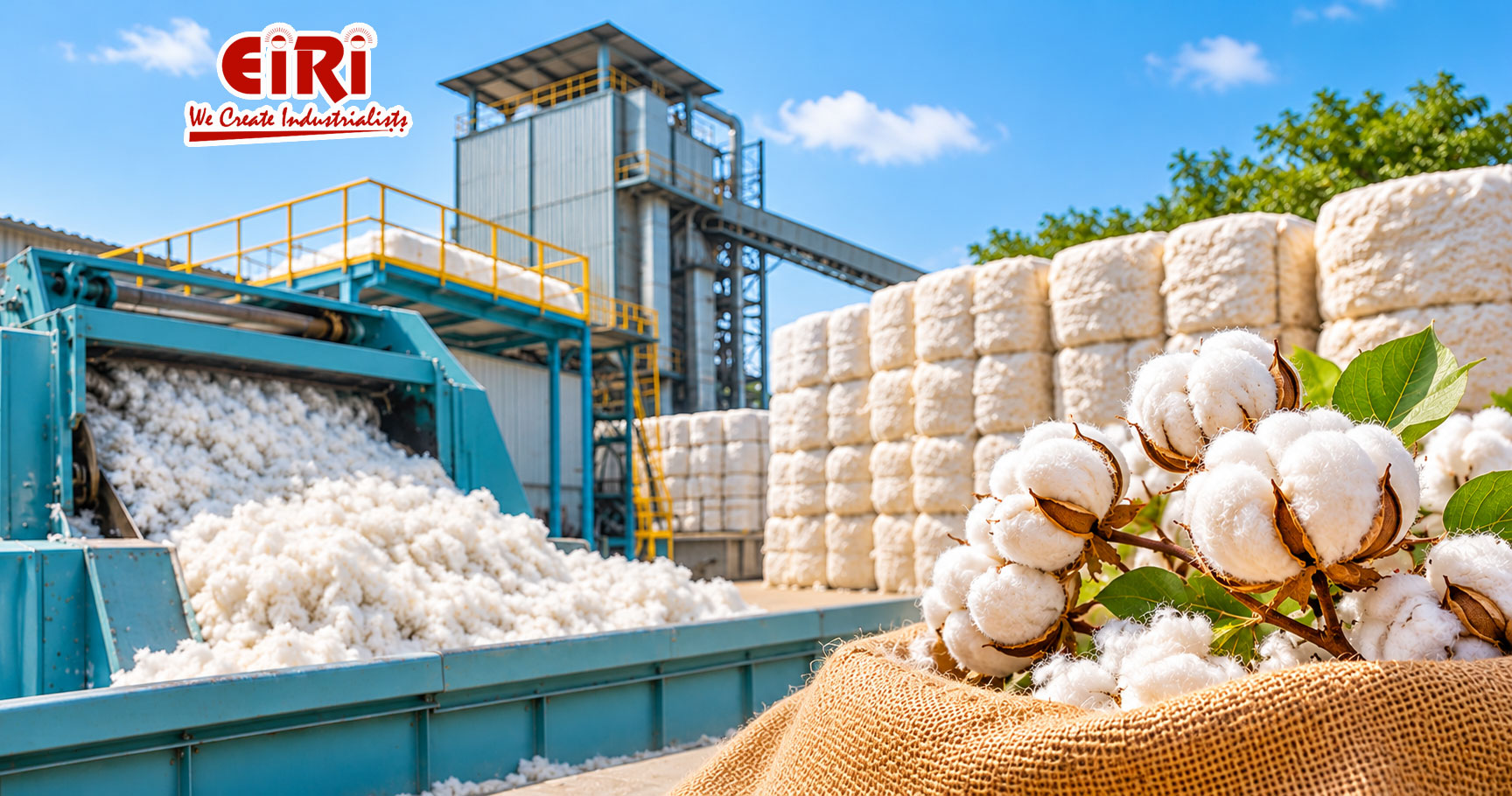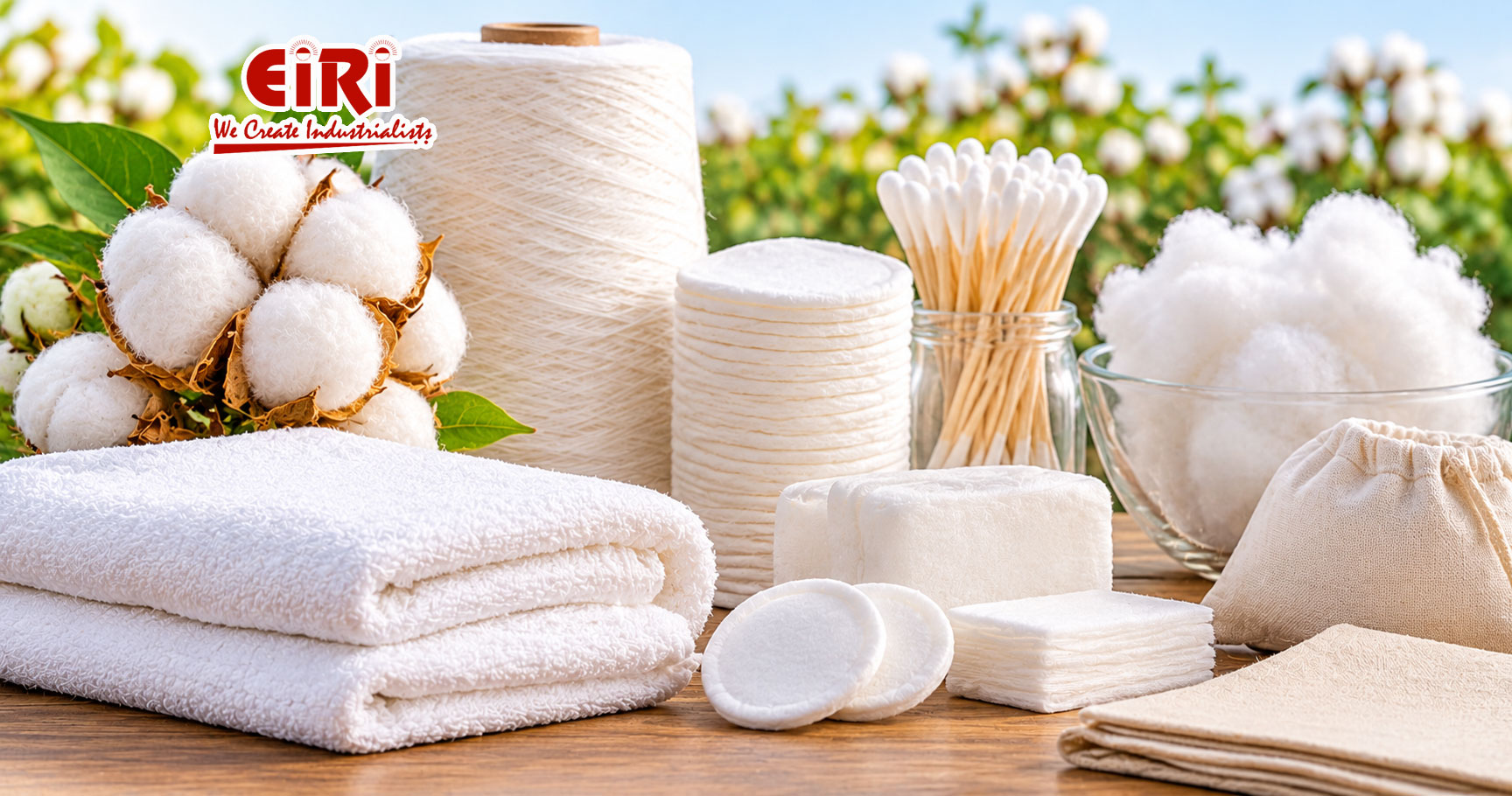
When most people think of cotton manufacturing, they think of cloth. But fabric is only the most visible part of what cotton supports. The crop is a remarkably complete raw material: every part of it — lint, seed, linter, even the stalk — feeds a different product and a different industry. For an entrepreneur, that means a cotton-growing region offers far more manufacturing options than a spinning mill.
That breadth matters more in 2026 than it has for years, because the economics along the chain have pulled apart. India now consumes considerably more cotton lint than it grows, so anything made directly from lint competes for a contested raw material. Meanwhile the seed, the linter and the waste streams face demand pressures of their own — some of them backed by explicit government missions. This article walks through the cotton-based products you can manufacture beyond fabric, with an honest read on where each one stands today and which have the strongest tailwind behind them.
The Cotton Economy in 2026: Why Position on the Chain Matters
Start with the number that shapes everything downstream. For the 2025-26 season the Cotton Association of India put the crop at 337 lakh bales of 170 kg against domestic consumption of 348 lakh bales. The gap was filled by imports, which rose to around 60 lakh bales — a jump of over 360 per cent on the previous year — while exports fell to 15 lakh bales. The 2026-27 season that began in October has started under a weaker monsoon, with industry estimates putting output below consumption again.
Two consequences follow for anyone planning a cotton-based venture.
First, lint is contested. Spinning mills, which have grown their consumption sharply, are bidding for the same fibre as every other lint-based converter, and the government has repeatedly waived the usual 11 per cent duty on raw cotton imports to relieve them — most recently extending the exemption to the end of December 2026. If your product is made from lint, you are buying into that competition and into the policy decisions that govern it.
Second, the non-lint streams are a different business. Cottonseed, linter and processing waste are not bid up by spinning demand in the same way. Their economics depend on edible oil policy, on hygiene-product demand, on recycling regulation — drivers that have nothing to do with the lint price. For an entrepreneur with modest capital, that independence is often more valuable than proximity to the glamour end of the chain.
Behind both sits the sector's growth target: India's textile and apparel industry was worth roughly USD 190 billion in FY26 and the stated national goal is USD 350 billion by 2030, with exports rising toward USD 100 billion. Even partial achievement pulls demand through every one of the products below.
1. Surgical and Absorbent Cotton
Absorbent cotton wool — the familiar medical and cosmetic cotton — is made by cleaning, bleaching and processing raw cotton fibre into a highly absorbent, sterile product. Demand is steady and essentially recession-proof, driven by hospitals, clinics, pharmacies and the cosmetics trade. Surgical cotton manufacturing is a well-defined, mid-scale opportunity with clear quality standards, and it sits close to the raw material in any cotton belt.
Because it is a medical and hygiene product, it carries the medical and disposable surgical regulatory requirements, but it remains one of the more approachable value-added cotton businesses. Two practical notes for 2026. It is a lint-based product, so it sits inside the raw-material competition described above and the input cost should be modelled against a firm lint price rather than a cheap one. And it is a well-trodden MSME category with established project templates, which means the entry barrier is low for competitors too — differentiation comes from consistent quality, certification and reliable institutional supply contracts rather than from the product itself.
2. Cottonseed Oil
After ginning separates lint from seed, the cottonseed becomes a feedstock for edible oil. Cottonseed oil is a widely used cooking oil, and the extraction process also yields cottonseed cake — a valuable animal feed — and hulls. This is a genuine agro-processing business that turns what some treat as a ginning byproduct into a primary product line.
Of the six products here, this has the clearest policy tailwind, and the reason is India's edible oil deficit. Domestic output covers only about 40 per cent of consumption: roughly 9.6 million tonnes produced in 2025-26 against imports of about 16.7 million tonnes, with the import bill running near Rs 1.61 lakh crore. Closing that gap is explicit national policy through the National Mission on Edible Oils — Oilseeds, approved with an outlay of about Rs 10,103 crore for 2024-25 to 2030-31.
Cottonseed is named directly in that effort. NITI Aayog's analysis of pathways to edible-oil self-reliance identifies cottonseed as capable of contributing an additional 1.4 million tonnes of edible oil, which would cut India's demand-supply gap by close to 10 per cent. That is an unusual position for an entrepreneur to be in — building a business the state has publicly costed as part of its own strategy.
One caution belongs alongside it. NITI Aayog also notes that existing oil processing capacity is substantially underused, with refineries running at roughly 30 per cent of capacity. The opportunity is real but it is not empty space, and a project should be sized against actual local seed availability rather than against the national gap. The economics of oilseed crushing, refining and packaging are covered in our oils, fats and derivatives business books, and it remains the most natural forward-integration step for a ginning operator.
3. Cotton Linter Products
Linters are the short fibres that remain on the cottonseed after ginning — too short for spinning, but valuable for other uses. They are a raw material for cellulose products, high-quality and specialty paper, personal care and hygiene formulations, and pharmaceutical applications, as well as a feedstock for further chemical processing into dissolving pulp.
Cotton linter is a genuine industrial input with its own buyers, and recovering and selling it adds another revenue stream to seed processing. The demand direction is favourable: cellulose from natural sources is pulled along by the broader move toward biodegradable and plant-derived materials, and by demand from viscose and specialty paper manufacturing.
We would treat published market-size figures for this segment with caution — the estimates in circulation vary by an order of magnitude and several fail a basic sanity check against the size of adjacent markets. The sensible way to assess linter is not through a headline number but through the specific buyers reachable from your location and the grade of linter your delinting process can produce. It is also rarely a standalone venture: linter recovery generally makes sense as an addition to a seed-processing operation rather than as a business built from scratch.
4. Non-Woven and Hygiene Products
Cotton and cotton-blend fibre feeds the growing non-woven sector — the material behind wipes, medical textiles, and hygiene products. Feminine hygiene products such as sanitary napkins, in particular, combine strong and growing demand with government programme support, and they draw on cotton and non-woven fibre technology.
The numbers support the case. India's sanitary napkin market was estimated at roughly USD 894 million in 2025 and is projected to approach USD 1.8 billion by 2034, growing at around 8 per cent a year — comfortably faster than the cotton economy as a whole. The structural driver is penetration rather than population: National Family Health Survey data puts sanitary napkin use at about 70 per cent among urban women but only around 48 per cent in rural areas, and closing that gap is the explicit aim of government and NGO distribution programmes. Within the category, biodegradable products are forecast to grow faster still, at close to 11 per cent, which is where a new entrant can differentiate rather than compete head-on with established brands.
These products sit within the broader textiles and garments category and represent some of its higher-margin, higher-growth opportunities. They also carry hygiene-product regulatory requirements and significant marketing and distribution demands — this is a branded consumer business as much as a manufacturing one, which is a different skill set from the rest of this list.
5. Cotton Yarn and Thread
Between raw lint and finished fabric sits spinning — converting cotton fibre into yarn and thread. Yarn is itself a traded product sold to weavers and knitters, so a spinning operation does not need to go all the way to cloth to have a market. Sewing thread, embroidery thread and specialty yarns are defined product lines with their own demand.
Spinning is the most capital-intensive option here, and it deserves the most careful reading of current conditions, because the sector has just been through a shakeout. Roughly 10 to 12 million spindles — about 20 per cent of installed capacity — were phased out, leaving something in the range of 40 to 44 million. That contraction is now working in favour of the survivors: CareEdge Ratings expects cotton yarn spinners' operating margins to expand by 150 to 200 basis points in FY27 on roughly 10 per cent revenue growth, with yarn spreads having recovered from about Rs 95-100 per kg in FY26 to Rs 120-125 per kg by April 2026.
Export demand has been the swing factor. Cotton yarn exports rose about 3 per cent in FY26 to 11.83 lakh tonnes, but shipments to China jumped 121 per cent over the year as Chinese cotton output fell and importing yarn became cheaper than spinning domestically. That is a genuine opportunity and a genuine concentration risk in the same sentence — the same analysis notes that sustaining these margins beyond FY27 depends on Chinese demand holding, on cotton prices, and on geopolitics. Entering spinning on the strength of a recovery driven largely by one export market requires the balance sheet to survive that market changing its mind.
6. Cotton Waste and Recycled Products
Cotton processing generates waste at every stage — and that waste has value. Cotton waste is used in wiping cloths, low-grade yarn, mattress and upholstery filling, and recycled fibre products.
This segment needs a correction that the usual framing misses. It is often described as turning an untapped disposal problem into a product, but India's textile waste is already heavily worked. The Ministry of Textiles' mapping of the textile waste value chain puts annual generation at about 70.73 lakh tonnes, of which over 70 per cent is already recovered for recycling, upcycling, downcycling or reuse — and close to 100 per cent of spinning waste is reused within production itself. An existing informal ecosystem of collection and sorting supports an estimated 40 to 45 lakh livelihoods. Panipat has emerged as the major mechanical recycling hub.
So the opportunity is not collecting waste nobody wants. It is moving up the value ladder from downcycling into higher-value recovery, where the market is genuinely growing: India's textile recycling market is projected to reach USD 3.5 billion by 2030, with around one lakh new jobs attached, and the direction of technology is from established mechanical recycling toward chemical routes that recover fibre at molecular level and enable true textile-to-textile recycling. Demand is being pulled by international brand commitments and tightening circularity rules in export markets, which make verified recycled content a procurement requirement rather than a marketing claim.
For a low-capital entrant, waste-based products remain among the more accessible options and fit the broader waste-based industry logic. But the plan should be clear about whether it is competing with an efficient informal sector at the bottom of the ladder, or investing to sit above it.
Which Opportunities Have the Strongest Tailwind?
Six options with different drivers are hard to compare, so it is worth stating plainly how they currently rank on demand signal — separately from how much capital each needs.
Strongest policy backing: cottonseed oil. No other product on this list is named in a national mission as a quantified part of the solution. A 60 per cent import dependence in edible oil is a problem the government is actively spending to fix, and cottonseed is explicitly part of that arithmetic.
Fastest consumer growth: hygiene and non-wovens. Around 8 per cent annual growth with a large, policy-supported penetration gap still to close, and a faster-growing biodegradable niche inside it for a differentiated entrant.
Strongest structural shift: recycled and waste-based products. Growth here is driven by regulation in export markets and brand commitments rather than by domestic consumption, which makes it less sensitive to the Indian cycle — but it rewards moving up the value chain rather than entering at the bottom.
Best recovery story, highest risk: yarn and thread. Margins are expanding after a capacity shakeout, but on a base built substantially on one export market.
Steadiest, most crowded: surgical and absorbent cotton. Reliable demand, low differentiation, and lint input costs exposed to the national supply gap.
Best as an addition, not a standalone: linter products. Real industrial demand, but it belongs alongside seed processing rather than as a business of its own.
Why This Breadth Matters for an Entrepreneur
The practical lesson is that "getting into cotton" does not mean competing with large textile mills. It means choosing the right point on a wide value chain to match your capital, your local raw material and your market. A ginning byproduct to one operator is a primary product to another. Surgical cotton, cottonseed oil, linter products and hygiene products are all genuine standalone businesses, often more accessible and more profitable per rupee invested than trying to enter volume fabric production.
The 2026 context sharpens that argument rather than weakening it. When domestic lint is in deficit and imported to fill the gap, the products that depend on seed, linter and waste are insulated from the competition that defines the fibre end of the chain. EIRI's handbook on cotton production and cotton-based products maps this full range with processes and project profiles, which is a useful way to compare options before committing.
Choosing and Planning the Right Product
Each of these products has its own machinery, licensing and economics — surgical cotton carries medical-grade requirements, cottonseed oil needs food-safety compliance, hygiene products demand brand and distribution capability, spinning is capital-intensive, waste products are lighter but competitive. The right choice depends on a clear-eyed assessment of your resources and market, which is exactly what a feasibility study provides.
Given current conditions, two tests belong in any cotton-based project document. The first is an input-cost sensitivity appropriate to where your product sits: lint-based products should be stressed against a firm or rising fibre price given the national supply gap, while seed-based products should be stressed against seed availability in your specific catchment rather than national figures. The second is a competitive check on who already serves your intended market — several of these segments are growing precisely because they are visible, and visibility attracts entrants.
Engineers India Research Institute — 45+ years, ISO 9001-2015 certified, MSME-registered — prepares Detailed Project Reports for cotton-based ventures across this range, each matched to the specific product, capacity and location.
Frequently Asked Questions
What products can be made from cotton besides fabric?
Beyond fabric, cotton supports surgical and absorbent cotton wool, cottonseed oil and cake, cotton linter products (cellulose, specialty paper, pharmaceutical and personal care applications), non-woven and hygiene products such as sanitary napkins, cotton yarn and thread, and recycled products from cotton waste. The crop is a near-complete raw material where lint, seed, linter and waste each feed a different industry with its own demand drivers.
Which cotton-based product has the best outlook right now?
On policy support, cottonseed oil is the strongest. India produces only around 40 per cent of the edible oil it consumes, and NITI Aayog has identified cottonseed as capable of adding about 1.4 million tonnes of edible oil, closing close to 10 per cent of the national gap, with the National Mission on Edible Oils backing the effort. On consumer growth, hygiene and non-woven products lead, growing at roughly 8 per cent a year with a large rural penetration gap still to close. The right answer for any individual depends on capital and local raw material, not on the national ranking.
Is surgical cotton manufacturing a good business?
Surgical and absorbent cotton has steady, essentially recession-proof demand from hospitals, pharmacies and cosmetics. It is a well-defined mid-scale business that sits close to raw cotton, and it carries surgical and medical-grade quality and licensing requirements. Two current caveats: it is made from lint, so input costs are exposed to India's cotton supply deficit, and it is a well-established MSME category with low differentiation, so competitiveness comes from consistent certified quality and institutional supply relationships rather than from the product itself.
What is cottonseed used for?
Cottonseed is crushed for cottonseed oil, a widely used cooking oil, and the process also yields cottonseed cake used as animal feed, plus hulls and linters. It turns what some treat as a ginning byproduct into a primary agro-processing product line, and it is one of the sources the government has identified for reducing India's heavy dependence on imported edible oil.
Is cotton waste recycling still an untapped opportunity?
Not in the way it is often described. The Ministry of Textiles estimates India generates about 70.73 lakh tonnes of textile waste a year, of which more than 70 per cent is already recovered, and nearly all spinning waste is reused within production. An established informal sector supports an estimated 40 to 45 lakh livelihoods. The genuine opportunity is moving up from downcycling into higher-value recovery and fibre-to-fibre recycling, where the market is projected to reach USD 3.5 billion by 2030 and where export-market circularity rules are creating demand for verified recycled content.
Is now a good time to enter cotton spinning?
Conditions have improved but carry concentration risk. About 10 to 12 million spindles, roughly 20 per cent of installed capacity, were phased out, and the survivors are seeing margins recover — CareEdge Ratings expects operating margins to expand 150 to 200 basis points in FY27 on around 10 per cent revenue growth. However, much of that recovery rests on cotton yarn exports to China, which rose 121 per cent in FY26. Spinning remains the most capital-intensive option among cotton-based businesses, and a project should be able to withstand that single export market weakening.
Do I need to compete with large textile mills to enter cotton manufacturing?
No. Entering cotton manufacturing means choosing a point on a wide value chain to match your resources, not necessarily competing in volume fabric. Surgical cotton, cottonseed oil, linter products, hygiene products and cotton-waste products are all standalone businesses. There is an added argument for the non-lint options at present: with Indian mills consuming more cotton than the country grows and imports filling the gap, products built on seed, linter and waste avoid competing for the contested fibre itself.
Which cotton-based product needs the least capital to start?
Cotton-waste-based products such as wiping cloths and filling are generally among the lower-capital entry points, while spinning is the most capital-intensive. Surgical cotton and cottonseed oil sit in between, and hygiene products require marketing and distribution investment alongside manufacturing. Note that low capital and low competition are not the same thing: the waste segment is lighter to enter but already well served at its lower end. The right choice depends on your capital, local raw material and target market, which a feasibility study can help compare.
Exploring a Cotton-Based Business?
If one of these cotton-based products fits your resources and you want bank-ready documentation, EIRI can prepare a Detailed Project Report for your chosen product and capacity. Send us your requirement and our consultants will respond. To see the full range, browse our textiles and garments and oils and fats business books.
Industry figures cited here draw on the Cotton Association of India, the Ministry of Textiles, NITI Aayog, CareEdge Ratings and published market research, and reflect the position as of November 2026. Cotton estimates are revised through the season and policy on cotton import duty and edible oils changes frequently; confirm current figures before relying on them for investment decisions.