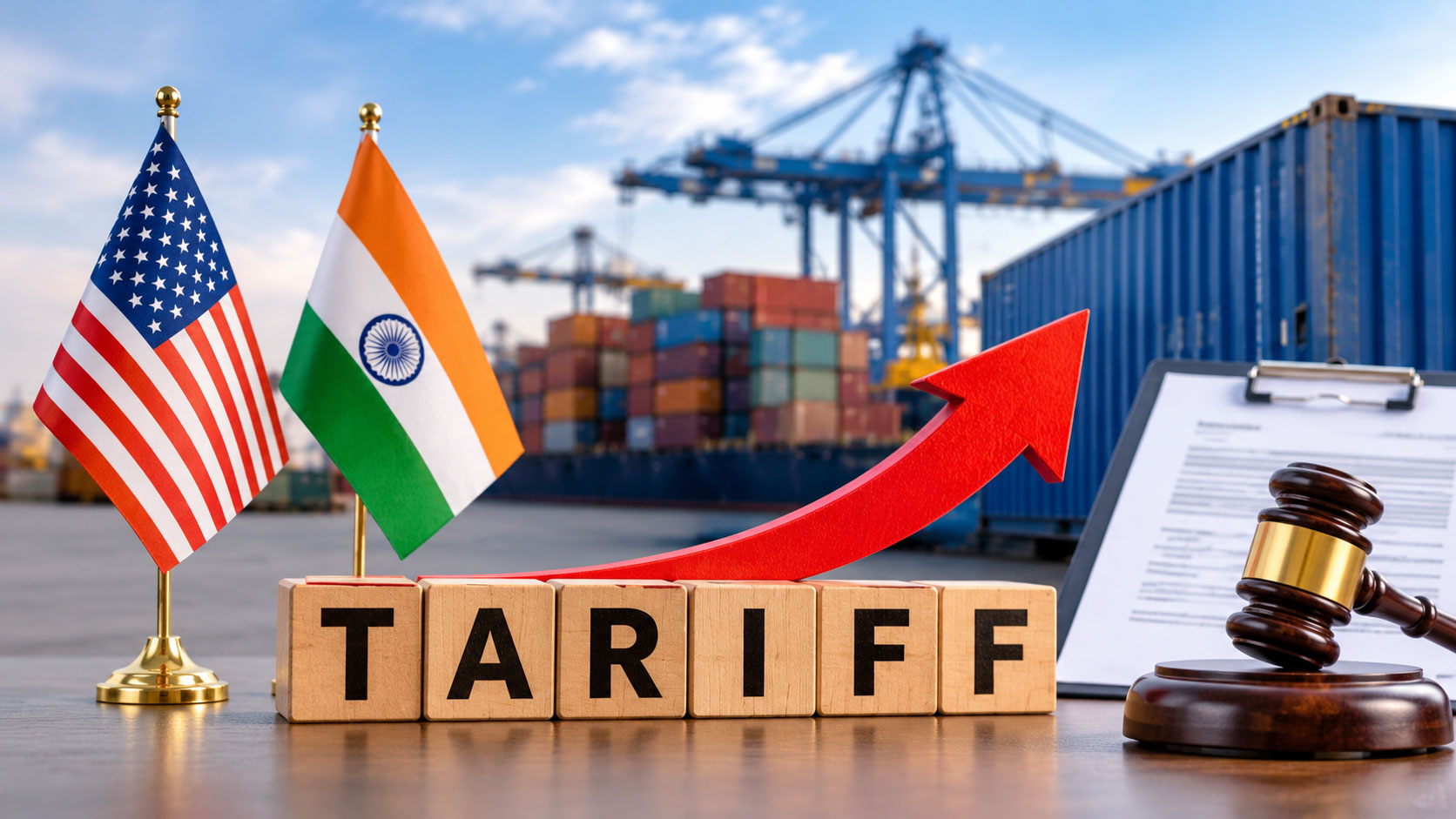
On 25 November 2026 the Office of the United States Trade Representative issued affirmative determinations in its Section 301 investigations into structural excess capacity, proposing new tariffs on 14 economies. For India, USTR proposes duties of up to 25 per cent on all goods, net of existing Section 301 tariffs and subject to exemptions — the second highest rate in the group, behind Vietnam at 35 per cent. It also says it will consider a 17 per cent rate if India concludes an Agreement on Reciprocal Trade with the United States responsive to the investigation's findings.
Nothing has taken effect. Written comments and requests to appear are due by 5 January 2027, with a public hearing on 25 January. For a manufacturer or exporter, that five-week window is the part of this story that actually requires action — and the first thing worth doing is not reading the headline rate but checking your own tariff lines against the annex, because a large share of India's exports to the US appear to fall outside the proposed action altogether.
This article sets out what was proposed, how the rate actually stacks, which sectors are and are not exposed, and what it means for anyone planning a manufacturing project with US-bound sales. A detailed breakdown of the notice itself is available in this summary of the USTR Section 301 excess capacity determination for India, which covers the filing mechanics in full.
What Was Actually Announced
USTR opened these investigations on 11 March 2026, covering 16 economies and examining whether their acts, policies and practices created or contributed to structural excess manufacturing capacity. Determinations were issued for 14 of them; Mexico and Norway received none. USTR found the practices actionable under Section 301(b) of the Trade Act of 1974.
The proposed rates differ by economy, and they are not directly comparable to one another, which is the most common error in coverage of this story. The European Union, Japan, South Korea, Switzerland and Taiwan face up to 15 per cent, but net of both ordinary MFN duties and existing Section 301 tariffs. Bangladesh, Cambodia, Indonesia, Malaysia and Thailand face up to 18 per cent, Singapore up to 20 per cent, India up to 25 per cent and Vietnam up to 35 per cent — all net of existing Section 301 duties only, so ordinary MFN duties still apply on top. China sits under a separate regime with its own annexes.
Most of the economies also have a stated higher alternative if USTR considers their consultations and commitments unsatisfactory — Bangladesh up to 20 per cent, Cambodia, Indonesia, Malaysia and Thailand up to 25 per cent. India's notice states no higher alternative. It states a lower one: 17 per cent, conditional on a reciprocal trade agreement. That is a proposal to consider an adjustment, not a commitment to grant one, and the distinction matters for anyone modelling it.
How the Rate Actually Stacks
This is the technical point that changes the arithmetic, and it is worth getting right before any costing exercise.
India already carries a 10 per cent additional duty from the separate Section 301 forced-labour action finalised in July 2026, under which India was placed in the lower tariff tier. The new proposal is expressed as up to 25 per cent net of existing Section 301 tariffs. That means 25 per cent is a combined ceiling across both actions, not a fresh 25 points on top of the 10 already in place. For goods currently paying the 10 per cent forced-labour duty, the incremental new burden would be up to roughly 15 percentage points, taking them to a combined 25 per cent, with ordinary MFN duties and any anti-dumping or countervailing duties applying separately on top.
That framing produces four quite different positions, and every exporter sits in one of them:
Already paying 10 per cent, and still exempt under the new annex. No change.
Already paying 10 per cent, and not exempt under the new annex. Combined rate rises toward 25 per cent — an incremental increase of up to about 15 points.
Previously exempt, and exempt again under the new annex. No change, and still no additional Section 301 duty.
Previously exempt, and not exempt under the new annex. This is the group facing the largest shock, because the move is from zero to as much as 25 per cent rather than from 10.
Working out which of these four applies to your specific HTSUS lines is a more useful exercise than reacting to the headline number, and it is the substance of what a comment to USTR would address.
Who Is Exposed and Who Is Not
The exemption structure carries over substantially from the earlier action. Across the 13 non-China notices, the exclusions start from the forced-labour universal list, with seven economies receiving additional economy-specific lists on top. Articles already subject to Section 232 tariffs are excluded from the new duty, which covers steel, aluminium and copper articles and their derivatives; passenger vehicles and light trucks and their parts; medium- and heavy-duty vehicles and parts; wood products; patented pharmaceutical articles; and semiconductor articles. Informational materials, donations and accompanied baggage are also outside the action.
India's Annex A runs long. The categories visible in it include a broad range of agricultural and food goods — meat, fruits, vegetables, nuts, spices, coffee, tea, cocoa, sugar — seeds for sowing, energy, minerals and raw materials including coal, petroleum products and many ores and concentrates, and a substantial list of inorganic and organic industrial chemicals, with certain chemical subheadings marked as covering articles for pharmaceutical use.
Context from the earlier action helps calibrate this. When the forced-labour tariff took effect in July, the Indian government reported that the 10 per cent duty applied to roughly 55 per cent of India's exports to the US, leaving about 45 per cent outside its scope — the exempt set then including generic pharmaceuticals, smartphones and products already covered by Section 232 measures such as steel, aluminium and auto parts. Because the new annexes largely overlap with the forced-labour exclusions, a comparable share may well fall outside this action too.
Against India's FY26 exports to the US of about USD 87.31 billion, the sectors with the most at stake are the ones that are neither agricultural, nor raw material, nor covered by a Section 232 action. Readymade garments at USD 4.83 billion and cotton yarn, fabrics, made-ups and handloom products at USD 2.67 billion sit squarely in that space, as do gems and jewellery at USD 5.08 billion and plastics at USD 1.52 billion. Electronic goods at USD 24.41 billion and engineering goods at USD 19.61 billion are the largest categories and the most mixed: significant portions fall under Section 232 or earlier exemptions, while other lines within the same chapters may not. Those are exactly the cases where line-by-line checking, rather than sector-level assumption, decides the answer.
The Competitive Angle: Bangladesh and Vietnam
For garment and textile exporters the absolute rate matters less than the gap against the countries they lose orders to.
On the proposed figures India at up to 25 per cent sits about seven percentage points above Bangladesh at up to 18 per cent, in categories where the two compete directly for the same US buyers. That gap narrows to five points if USTR applies Bangladesh's higher alternative of 20 per cent, and it closes entirely if India secures the conditional 17 per cent through a trade agreement. None of those outcomes is settled.
Vietnam, at up to 35 per cent with a conditional 20 per cent, is proposed to be worse off than India in absolute terms — a point largely absent from Indian coverage, and relevant to anyone whose competition is Vietnamese rather than Bangladeshi.
India's notice does invite comment on one mechanism that would change this picture for textiles specifically: whether a set volume of apparel and textile imports should be allowed to enter at a reduced Section 301 rate, and whether rates for certain textile and apparel products should account for any mechanism created in the separate forced-labour investigation. A textile mechanism was referenced in that earlier action but has not yet been established, and India has been pursuing it within the bilateral trade negotiations. For textile exporters, this is the single most consequential item in the notice open to comment.
India's Position
India's Commerce Ministry responded on 26 November, saying it had taken note of the determination and that the matter was under examination. The ministry rejected the underlying finding directly, stating that India does not have structural excess capacity in any sector, and said India had engaged constructively throughout the investigation. Its position is that trade-related concerns should be addressed within the framework of the ongoing bilateral trade agreement negotiations, and that India remains committed to an early conclusion of that agreement.
Those two positions — USTR's affirmative finding and India's rejection of it — now run in parallel with the negotiation that the conditional 17 per cent rate depends on. For a business, the practical reading is that the outcome is genuinely uncertain in both directions, and planning on either the 25 per cent or the 17 per cent figure as settled would be premature.
What to Do Before 5 January 2027
The window for input is short and the steps are concrete.
Check your HTSUS lines against Annex A. This is the first and most valuable step, and it is specific to your products rather than your sector. Being inside the annex changes the question from how much to nothing at all.
Establish your current position. Determine whether your lines currently carry the 10 per cent forced-labour duty or sit in the exempt share, because that determines whether the proposal represents an incremental 15 points or a move from zero.
File a comment if you are affected. Written comments and requests to appear are due by 5 January 2027 under dockets USTR-2026-0731 for comments and USTR-2026-0741 for hearing requests, through the USTR comment portal, with the public hearing before the Section 301 Committee from 10 a.m. on 25 January 2027 at the US International Trade Commission in Washington. Exporters can file directly or through their export promotion council, and council-level submissions carry weight precisely because they aggregate evidence across firms.
Address the questions USTR actually asked. Comments that respond to the specific items on which input is invited — the textile and apparel volume mechanism, adjustments for existing Section 301 and Section 232 duties, the product scope of the annex — are more useful than general objections to the finding, which is the government's ground to contest.
Model both outcomes. Run your US-bound pricing at the proposed rate and at the conditional rate, with MFN duties and any AD/CVD applied on top, so a decision does not have to wait on an announcement.
What It Means for Project Planning
For entrepreneurs currently evaluating a manufacturing project, this development changes some assumptions and leaves others untouched — and the distinction is worth drawing carefully rather than treating the news as uniformly bad.
Projects aimed at the domestic market are substantially unaffected. India's domestic consumption story, and the policy support behind sectors from textiles to food processing, does not turn on US tariff policy.
Projects aimed at US exports now need a tariff line in the financial model that many did not carry a year ago, along with a sensitivity run across the plausible range. A project whose viability depends on a particular landed price in the US should be stress-tested against the proposed rate, not only the conditional one.
Projects aimed at other export markets look comparatively stronger. India's trade agreements with the UK and the European Union point in the opposite direction to this action, and for a new export-oriented plant the choice of target market is a live decision rather than a given.
Sector choice within export manufacturing also shifts at the margin. Products falling inside Annex A, or under existing Section 232 coverage, carry materially less US tariff risk than garments, made-ups, jewellery or plastics. That is not a reason to abandon a well-founded plan in an exposed sector, but it is a factor that belongs in the comparison when a project is still at the options stage.
Engineers India Research Institute — 45+ years, ISO 9001-2015 certified, MSME-registered — prepares Detailed Project Reports for manufacturing ventures across these sectors, built around your product, capacity and target market, including the market and pricing assumptions a bank or scheme authority will test.
Frequently Asked Questions
Has the 25% tariff on Indian goods taken effect?
No. USTR issued affirmative determinations on 25 November 2026 and proposed tariffs of up to 25 per cent on Indian goods, but nothing is in force. Written comments and requests to appear are due by 5 January 2027, with a public hearing on 25 January 2027 before the Section 301 Committee at the US International Trade Commission. A final decision would follow that process.
Is the 17% rate guaranteed if India signs a trade deal?
No. USTR says it will consider whether the duties should be adjusted to 17 per cent were India to reach an Agreement on Reciprocal Trade with the United States that is responsive to the findings of the investigation. That is a proposal to consider an adjustment, conditional on both an agreement being concluded and USTR judging it responsive. It should not be modelled as a settled outcome.
Would the 25% be added on top of tariffs India already pays?
Not entirely. The proposed rate is net of existing Section 301 tariffs, so the 25 per cent is a combined ceiling across the new action and the 10 per cent forced-labour duty already applying to India since July 2026. For goods already paying that 10 per cent, the incremental increase would be up to roughly 15 percentage points. Goods that were exempt from the forced-labour duty but fall outside the new annex would face a larger jump, from zero. Ordinary MFN duties, and any anti-dumping or countervailing duties, apply separately on top in either case.
Which Indian exports are exempt from the proposed tariff?
Articles already subject to Section 232 tariffs are excluded, covering steel, aluminium and copper and their derivatives, passenger vehicles and light trucks and their parts, medium- and heavy-duty vehicles and parts, wood products, patented pharmaceutical articles and semiconductor articles. India's Annex A additionally lists a wide range of agricultural and food goods, seeds for sowing, energy, minerals and raw materials, and many industrial chemicals. Informational materials, donations and accompanied baggage are also excluded. Because the annex operates at HTSUS line level rather than by sector, exporters should check their own classifications rather than assume their industry is covered either way.
How does India compare with Bangladesh and Vietnam?
On the proposed rates India is at up to 25 per cent against Bangladesh at up to 18 per cent, a gap of about seven percentage points in garments and textiles where the two compete directly. That gap would narrow to five points if Bangladesh's higher alternative of 20 per cent were applied, and would close if India secured the conditional 17 per cent. Vietnam faces the highest proposed rate in the group at up to 35 per cent, with a conditional 20 per cent, so it is proposed to be worse placed than India in absolute terms.
Could textiles get special treatment?
It is an open question on which USTR has invited comment. India's notice asks whether a mechanism should allow a set volume of apparel and textile imports to enter at a reduced Section 301 rate, and whether rates for certain textile and apparel products should account for any mechanism created in the separate forced-labour investigation. A textile mechanism was referenced in that earlier action but has not yet been established, and India has been pursuing it within the bilateral trade negotiations. For textile and apparel exporters this is the most consequential item open to comment before 5 January 2027.
How can an exporter file a comment?
Written comments are filed under docket USTR-2026-0731 and requests to appear at the hearing under docket USTR-2026-0741, both due by 5 January 2027 through the USTR comment portal, with requests to appear accompanied by a summary of proposed testimony. Exporters can file directly or through their export promotion council. Comments that address the specific questions raised in the notice — product scope, the textile volume mechanism, and adjustments for existing Section 301 and Section 232 duties — are generally more useful than broad objections to the determination itself.
Should this change plans for a new manufacturing project?
It depends entirely on the target market. Projects serving the domestic market are substantially unaffected. Projects built on US exports now need an explicit tariff assumption in the financial model, stress-tested across the proposed and conditional rates rather than assuming the better outcome. Projects targeting other markets, particularly those covered by India's trade agreements with the UK and European Union, look comparatively stronger. Within export manufacturing, products falling inside Annex A or under existing Section 232 coverage carry less US tariff risk than garments, made-ups, jewellery or plastics, which is a reasonable factor to weigh while a project is still at the options stage.
Planning an Export-Oriented Manufacturing Project?
If you are evaluating a manufacturing venture and need the market, pricing and sensitivity analysis to hold up against changing trade conditions, EIRI can prepare a Detailed Project Report matched to your product, capacity, location and target market. Send us your requirement and our consultants will respond. To explore sectors, browse our textiles and garments and other industry business books.
This article describes a proposed action as it stood on 29 November 2026 and is general information, not legal, customs or trade advice. Rates, exemptions and deadlines are drawn from USTR's notice of determination, published analyses of it, and Indian government statements. Nothing described here is in force, product classification decides exposure, and terms may change through the comment and hearing process. Exporters should confirm their position against the current Federal Register notice and take professional customs advice on their own tariff lines.