
Hot Melt Adhesives Manufacturing Industry: Complete Entrepreneur Guide










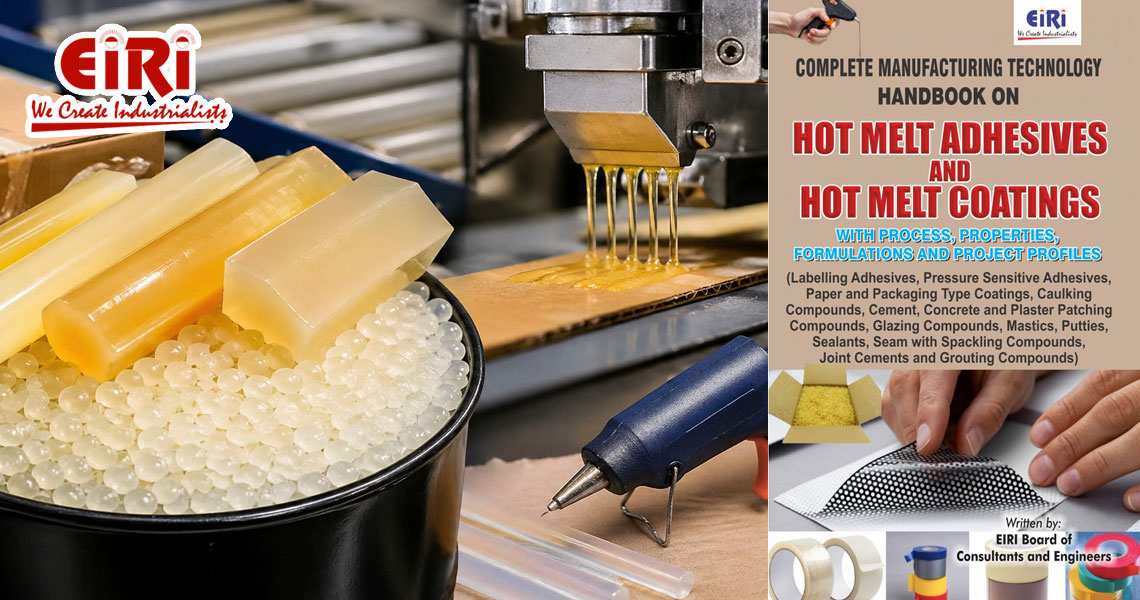
The hot melt adhesives industry is one of the most versatile and commercially attractive segments within the specialty chemicals sector. These adhesives are thermoplastic materials that are applied in a molten state and solidify upon cooling to form a strong bond. Unlike solvent-based or water-based systems, they do not require drying or curing time, which makes them highly efficient for high-speed industrial applications.
For an entrepreneur, this industry offers a wide spectrum of product possibilities ranging from packaging adhesives to industrial bonding, labeling, woodworking, and specialty coatings. The flexibility in formulation allows manufacturers to tailor products for niche applications, giving smaller players an opportunity to compete by focusing on customization rather than scale alone.
Understanding the science behind hot melt adhesives, their raw materials, and manufacturing processes is essential before setting up a production unit. The business is not just about mixing chemicals; it requires a clear understanding of performance parameters, end-use requirements, and process control.
Properties and Performance Fundamentals
The success of any hot melt adhesive depends on how well its properties align with its application. One of the most critical characteristics is pot life stability, which refers to the adhesive’s ability to remain stable in molten form without degradation over time. Poor stability can lead to charring, viscosity changes, and inconsistent bonding.
Open time is another key parameter, defining how long the adhesive remains workable after application. A longer open time is useful in assembly operations, while shorter open time is preferred in high-speed packaging lines. Tack, or the initial stickiness of the adhesive, determines how quickly substrates bond upon contact.
Softening point and hardness influence the temperature resistance and mechanical strength of the bond. Melt viscosity plays a central role in application, affecting flow behavior, wetting, and penetration into substrates. These properties must be carefully balanced during formulation to achieve optimal performance.
Raw Materials and Formulation Strategy
- Hot melt adhesives are essentially blends of polymers, resins, waxes, and additives. The base polymer provides the backbone of the adhesive, determining flexibility, strength, and temperature resistance. Common polymers include ethylene-vinyl acetate, polyamides, and polyolefins.
- Resins act as tackifiers, enhancing adhesion and improving compatibility with different surfaces. Waxes are used to modify viscosity and control open time, while plasticizers improve flexibility and reduce brittleness. Antioxidants are critical for maintaining thermal stability during processing and storage.
Formulation is both a science and an art. The proportion of each component must be adjusted based on the intended application. For instance, increasing resin content improves tack but may reduce heat resistance. Similarly, adding more wax lowers viscosity but can weaken bond strength. Successful manufacturers develop proprietary formulations that offer consistent performance across varying conditions.
Manufacturing Process and Equipment
The manufacturing of hot melt adhesives typically involves melting and blending raw materials in controlled conditions. A standard setup includes jacketed mixing vessels equipped with agitators, heating systems, and temperature control units. The process begins with melting the base polymer, followed by the gradual addition of resins, waxes, and additives.
Uniform mixing is crucial to ensure consistency in the final product. Once the blend reaches the desired homogeneity, it is filtered and discharged into molds or pelletizing systems. The final product may be supplied in the form of blocks, granules, or sticks depending on market demand.
Quality control during manufacturing is essential. Parameters such as viscosity, softening point, and bonding strength must be tested regularly to maintain product standards.
Ethylene-Vinyl Acetate and Polyamide Hot Melts
Ethylene-vinyl acetate (EVA) is one of the most widely used polymers in hot melt adhesives due to its excellent balance of flexibility, adhesion, and cost-effectiveness. EVA-based adhesives are particularly popular in edge veneering, packaging, and general assembly applications.
The formulation of EVA adhesives involves selecting the right copolymer grade, resin type, and additive combination. Fillers may be added to reduce cost, while antioxidants ensure stability during processing.
Polyamide hot melts, on the other hand, are known for their superior heat resistance and strong bonding capabilities. These adhesives are often used in demanding applications such as automotive assembly and electronics. While they are more expensive than EVA systems, their performance justifies the cost in specialized applications.
Application Techniques and Technologies
Hot melt adhesives are applied using various techniques depending on the application. Gravure applicator wheels, slot dies, spray systems, and roller coaters are commonly used in industrial setups. Each method requires precise control of temperature, pressure, and application speed.
In edge veneering and edge banding, adhesives must provide strong initial tack and quick setting to ensure proper bonding. The behavior of adhesives on applicator systems plays a crucial role in achieving uniform coating and minimizing waste.
Proper heating is essential to maintain the adhesive in a workable state without degrading its properties. Overheating can lead to polymer breakdown, while insufficient heating results in poor flow and weak bonding.
General Purpose and Industrial Adhesives
The versatility of hot melt adhesives allows for a wide range of general-purpose formulations. These include combinations of polyamides, resins, polybutenes, and other polymers to achieve specific performance characteristics.
Industrial adhesives are designed for applications such as bookbinding, furniture assembly, metal bonding, and construction. Each application requires a unique balance of strength, flexibility, and temperature resistance.
For example, bookbinding adhesives must provide strong yet flexible bonds to withstand repeated handling. Metal-to-metal adhesives require high الحرارة resistance and durability, while assembly adhesives need fast setting and high initial tack.
Labeling and Packaging Adhesives
Labeling adhesives represent a significant segment of the hot melt market. These adhesives must offer excellent adhesion to various substrates, including glass, plastic, and paper. Pressure-sensitive adhesives are commonly used for labels, providing instant bonding with light pressure.
Packaging adhesives are another major application area, particularly in carton sealing and case sealing operations. These adhesives must perform reliably under high-speed conditions and varying temperatures.
Specialized formulations are used for frozen food packaging, where adhesives must maintain performance at low temperatures. Similarly, adhesives for soap wrappers and flexible packaging require excellent compatibility with films and foils.
Pressure Sensitive Adhesives
Hot melt pressure sensitive adhesives (PSAs) are designed to remain tacky at room temperature, allowing them to bond with minimal pressure. These adhesives are widely used in tapes, labels, and hygiene products.
The formulation of PSAs involves the use of elastomers such as styrene-isoprene-styrene or polybutenes, combined with resins to enhance tack. The balance between cohesion and adhesion is critical to ensure that the adhesive holds firmly without leaving residue.
Sprayable PSAs are used in applications such as mattress manufacturing and upholstery, where uniform coverage over large surfaces is required.
Coatings and Specialty Applications
Hot melt technology is also used in coatings for paper, packaging, and industrial applications. These coatings provide properties such as moisture resistance, heat sealability, and surface protection.
In industrial coatings, materials like cellulose acetate butyrate are used to create strippable coatings for metal parts. These coatings protect surfaces during processing and can be easily removed afterward.
The process of hot melt coating involves precise control of temperature, application rate, and substrate compatibility. Equipment design plays a crucial role in achieving uniform coating thickness and quality.
Construction Chemicals and Allied Products
- Beyond adhesives, the industry extends into construction chemicals such as caulking compounds, joint cements, mastics, putties, and sealants. These products share similar formulation principles but are designed for specific applications in construction and maintenance.
- Caulking compounds are used for sealing gaps and joints, while joint cements are used in drywall finishing. Mastics and sealants provide flexible bonding and sealing solutions for various substrates.
- The manufacturing processes for these products involve blending oils, resins, fillers, and polymers to achieve the desired consistency and performance.
Paper, Packaging, and Coating Integration
The integration of adhesives and coatings in paper and packaging applications offers significant business opportunities. Manufacturers can supply both bonding and coating solutions to packaging companies, creating a more comprehensive product portfolio.
Coatings for corrugated containers, foil packaging, and heat-sealable films require specialized formulations that balance adhesion, flexibility, and barrier properties. High-gloss coatings are used for display packaging, enhancing visual appeal.
Economics and Business Setup
- Setting up a hot melt adhesive manufacturing unit requires careful planning of capital investment, machinery, and working capital. The cost structure includes land and building, mixing equipment, heating systems, and quality testing instruments.
- Raw material costs form a significant portion of the overall expenses. Efficient procurement and inventory management are essential for maintaining profitability. Production capacity must be aligned with market demand to avoid underutilization or overproduction.
- Revenue generation depends on product positioning and market reach. Manufacturers can focus on high-volume products such as packaging adhesives or niche products with higher margins.
Expansion into Latex and Rubber-Based Adhesives
In addition to hot melt adhesives, entrepreneurs can diversify into latex-based and rubber-based adhesives. These products are widely used in footwear, upholstery, and industrial applications.
The manufacturing processes involve emulsion polymerization or solvent-based systems, requiring additional expertise and equipment. However, diversification can reduce dependency on a single product line and open new market opportunities.
Conclusion
The hot melt adhesives manufacturing industry offers a dynamic and scalable business opportunity for entrepreneurs willing to invest in technical knowledge and process optimization. With applications spanning packaging, woodworking, labeling, construction, and industrial assembly, the demand for these adhesives remains consistently strong.
Success in this industry depends on the ability to develop reliable formulations, maintain quality standards, and adapt to changing market requirements. By focusing on product performance and operational efficiency, a new entrant can establish a competitive position and build a sustainable business in this evolving sector.