
Phthalic Anhydride Manufacturing Business: A Complete Guide for Entrepreneurs








Phthalic anhydride is one of the most important industrial intermediates used across multiple manufacturing sectors. It plays a central role in producing plasticizers, resins, coatings, and a wide range of downstream chemical products. For entrepreneurs looking to enter the chemical manufacturing space, this compound represents a high-volume, demand-driven opportunity with strong industrial linkages.
Unlike niche specialty chemicals, phthalic anhydride operates in a broad ecosystem where its demand is directly tied to infrastructure, automotive production, construction materials, and consumer goods. This makes it a strategic product for business owners aiming to establish a scalable and stable manufacturing venture. Setting up a plant for this chemical requires careful planning, technical understanding, and capital investment, but the long-term potential can be substantial.
Understanding the Product and Its Industrial Role
Phthalic anhydride is an organic compound derived from aromatic hydrocarbons. It appears as white crystalline flakes or molten liquid when heated. Its real value lies in its ability to act as a precursor for a variety of industrial chemicals rather than being consumed directly.
The largest portion of phthalic anhydride production is used in the manufacture of plasticizers, which are essential additives in PVC products. These plasticizers enhance flexibility, durability, and usability of plastics used in cables, flooring, pipes, and synthetic leather. In addition to this, the compound is widely used in alkyd resins, which form the backbone of many paints and coatings. These coatings are extensively used in construction, automotive finishing, and industrial machinery.
Another major application lies in unsaturated polyester resins, which are used in fiberglass-reinforced plastics. These materials are critical in manufacturing storage tanks, panels, roofing sheets, and automotive components. The diversity of these applications ensures that phthalic anhydride remains a high-demand industrial input across multiple sectors.
Market Demand and Business Potential
The demand for phthalic anhydride is driven by its downstream industries rather than direct consumer usage. As construction activity increases, demand for paints, coatings, and PVC materials rises, leading to higher consumption of this chemical. Similarly, growth in automotive production drives demand for resins and coatings, further strengthening the market.
Entrepreneurs entering this business should recognize that phthalic anhydride is a bulk chemical with consistent consumption patterns. Unlike seasonal or trend-driven products, its demand is relatively stable, offering predictable revenue streams. However, market competitiveness depends heavily on production efficiency, cost control, and supply chain management.
India presents a significant opportunity due to its expanding manufacturing base and increasing consumption of plastic and construction materials. Domestic production helps reduce reliance on imports and offers a competitive advantage to local manufacturers. Export opportunities also exist in neighboring regions where industrial growth is accelerating.
Manufacturing Process Overview
The production of phthalic anhydride is based on catalytic oxidation of aromatic feedstocks, primarily ortho-xylene. This process is continuous and requires precise control over temperature, pressure, and catalyst performance.
Raw Materials and Feedstock
The primary raw material used is ortho-xylene, a petroleum-derived aromatic hydrocarbon. Air is used as the oxidizing agent, and a catalyst, typically based on vanadium pentoxide, facilitates the reaction. The quality and purity of ortho-xylene directly influence the efficiency and yield of the process.
Reaction and Conversion
The oxidation reaction takes place in a fixed-bed reactor at elevated temperatures. Ortho-xylene reacts with oxygen in the presence of the catalyst to form phthalic anhydride vapor along with by-products. The reaction is highly exothermic, requiring efficient heat management systems to maintain optimal operating conditions.
Recovery and Purification
The vapor produced from the reactor is cooled in condensers to recover phthalic anhydride in molten form. Further purification is carried out to remove impurities and achieve the desired product specifications. The final product can be solidified into flakes or transported in molten form depending on customer requirements.
Process Integration
Modern plants are designed with integrated systems to maximize efficiency and minimize waste. Heat recovery units, advanced control systems, and continuous monitoring ensure consistent production quality and reduced operational costs.
Plant Setup and Infrastructure
Establishing a phthalic anhydride manufacturing unit requires significant infrastructure and capital investment. The plant must be designed to handle high-temperature reactions and continuous production cycles.
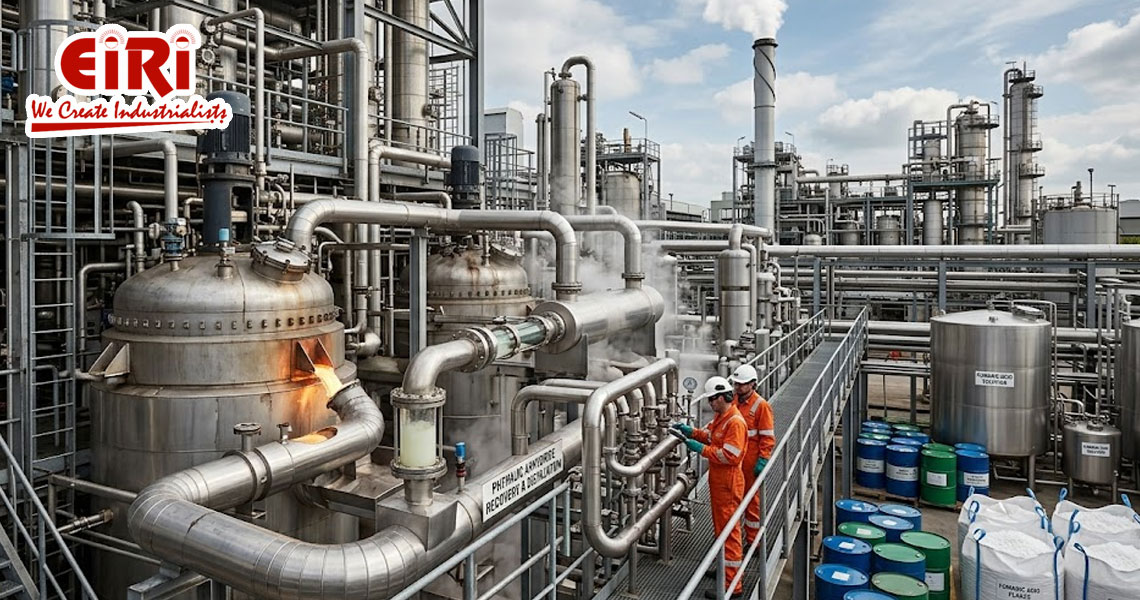
The core components of the plant include reactors, heat exchangers, condensers, distillation units, storage tanks, and material handling systems. Utilities such as power supply, water systems, and cooling towers are essential for smooth operation.
Location selection plays a crucial role in the success of the business. Proximity to raw material suppliers, industrial clusters, and transportation networks can significantly reduce logistics costs. Adequate space for expansion and compliance with industrial zoning norms are also important considerations.
Machinery and Equipment Considerations
The choice of machinery directly impacts production efficiency and product quality. High-quality reactors with reliable catalyst support systems are essential for consistent performance. Heat exchangers and condensers must be designed to handle large volumes of vapor and ensure efficient recovery of the product.
Automation plays a key role in modern chemical plants. Advanced control systems allow operators to monitor and adjust process parameters in real time, reducing the risk of errors and improving productivity. Investment in robust instrumentation and safety systems is critical for long-term operations.
Material selection for equipment is another important factor. Since the process involves high temperatures and reactive chemicals, corrosion-resistant materials must be used to ensure durability and safety.
Operational Requirements and Workforce
Running a phthalic anhydride plant requires a skilled workforce with expertise in chemical engineering, plant operations, and maintenance. Engineers oversee the production process, while technicians manage equipment and ensure smooth operation.
Training is essential to maintain high standards of safety and efficiency. Operators must be familiar with process controls, emergency procedures, and equipment handling. Maintenance teams play a critical role in minimizing downtime and ensuring continuous production.
Management must focus on optimizing production schedules, managing raw material procurement, and maintaining product quality. Efficient coordination between different departments is necessary to achieve operational excellence.
Cost Structure and Investment Outlook
The cost of setting up a phthalic anhydride manufacturing plant is relatively high due to the complexity of the process and the scale of operations. Major cost components include land, plant and machinery, installation, utilities, and initial working capital.
Raw material costs form a significant portion of operational expenses. Fluctuations in the price of ortho-xylene can impact profitability, making procurement strategy an important aspect of business planning. Energy consumption is another major cost factor, as the process requires continuous heating and cooling.
Despite the high initial investment, the business offers potential for strong returns due to steady demand and large-scale production capabilities. Economies of scale play a crucial role, as larger plants can achieve lower per-unit production costs.
Revenue Streams and Market Positioning
Revenue generation in this business depends on the ability to supply consistent quality products to industrial customers. Long-term contracts with manufacturers of plasticizers, resins, and coatings can provide stable income streams.
Market positioning is influenced by pricing, product quality, and reliability of supply. Entrepreneurs must focus on building strong relationships with buyers and maintaining a reputation for consistent performance.
Diversification into downstream products can further enhance profitability. By integrating forward into the production of resins or plasticizers, manufacturers can capture additional value and reduce dependence on external buyers.
Challenges and Competitive Landscape
The phthalic anhydride industry is highly competitive, with established players dominating the market. New entrants must compete on cost efficiency, production capacity, and supply chain management.
Technical challenges include maintaining catalyst performance, managing heat generation, and ensuring consistent product quality. Any disruption in the production process can lead to significant losses, making operational reliability a top priority.
Market competition also requires continuous monitoring of demand trends and pricing strategies. Entrepreneurs must be prepared to adapt to changing market conditions and optimize their operations accordingly.
Growth Opportunities and Expansion Potential
As industries continue to expand, the demand for phthalic anhydride is expected to grow steadily. Entrepreneurs who establish efficient production units can benefit from long-term market stability and increasing consumption.
Expansion opportunities include increasing production capacity, exploring export markets, and integrating into downstream manufacturing. Strategic partnerships with end-user industries can also provide a competitive advantage.
Technological advancements in process optimization and automation offer opportunities to improve efficiency and reduce costs. Staying updated with industry developments and adopting modern practices can enhance business performance.
Conclusion
Phthalic anhydride manufacturing presents a compelling opportunity for entrepreneurs seeking to enter the chemical industry. Its widespread applications, steady demand, and integration into key industrial sectors make it a reliable business option.
Success in this field depends on careful planning, efficient operations, and strong market positioning. While the initial investment and technical requirements are significant, the long-term potential for growth and profitability is substantial. Entrepreneurs who focus on quality, efficiency, and strategic expansion can build a sustainable and competitive business in this sector.