
Bicycle Parts Manufacturing: A Complete Guide for Entrepreneurs




The bicycle industry has evolved from a basic transportation segment into a dynamic manufacturing ecosystem driven by innovation, sustainability, and lifestyle trends. In recent years, bicycles have gained renewed importance due to increasing awareness of fitness, environmental concerns, and the need for cost-effective mobility solutions. Urban congestion and rising fuel costs have further strengthened the demand for bicycles across both developing and developed markets.
For entrepreneurs, the bicycle parts manufacturing sector offers a practical entry point into the broader engineering and automotive supply chain. Unlike complete bicycle assembly, component manufacturing allows businesses to specialize in specific parts, reduce initial complexity, and cater to multiple OEMs as well as aftermarket demand. With the right balance of technology, quality, and cost efficiency, this industry presents strong opportunities for scalable growth.
Market Potential and Industry Trends
The global bicycle market is experiencing steady growth, supported by changing consumer behavior and government initiatives promoting eco-friendly transport. In India, the demand is not only limited to traditional bicycles but is expanding into premium categories such as sports bicycles, mountain bikes, and electric bicycles. This diversification is creating a strong demand for high-quality components.
A key trend shaping the industry is the shift toward lightweight and high-performance materials. Consumers are increasingly looking for bicycles that offer better speed, durability, and riding comfort. This has driven manufacturers to adopt advanced materials such as aluminum alloys and carbon composites. Additionally, export opportunities are significant, as Indian manufacturers can leverage cost advantages to supply components to global markets.
Another important development is the rise of e-bikes, which require more advanced drivetrain and structural components. This segment is expected to grow rapidly, creating new opportunities for manufacturers who are willing to invest in technology and innovation.
Classification of Bicycle Components
Understanding the classification of bicycle components is essential for entrepreneurs planning to enter this sector. Bicycle parts can broadly be divided into structural, mechanical, and control components, each with distinct manufacturing requirements.
Structural components primarily include frames and related parts that form the backbone of the bicycle. Mechanical components consist of drivetrain systems that enable motion and power transfer. Wheel systems, including rims and spokes, play a crucial role in stability and performance. Finally, control components such as brakes and handlebars ensure safety and rider comfort.
Each category requires different production processes, levels of precision, and investment. Choosing the right segment depends on factors such as available capital, technical expertise, and target market.
Manufacturing of Bicycle Frames and Frame Parts
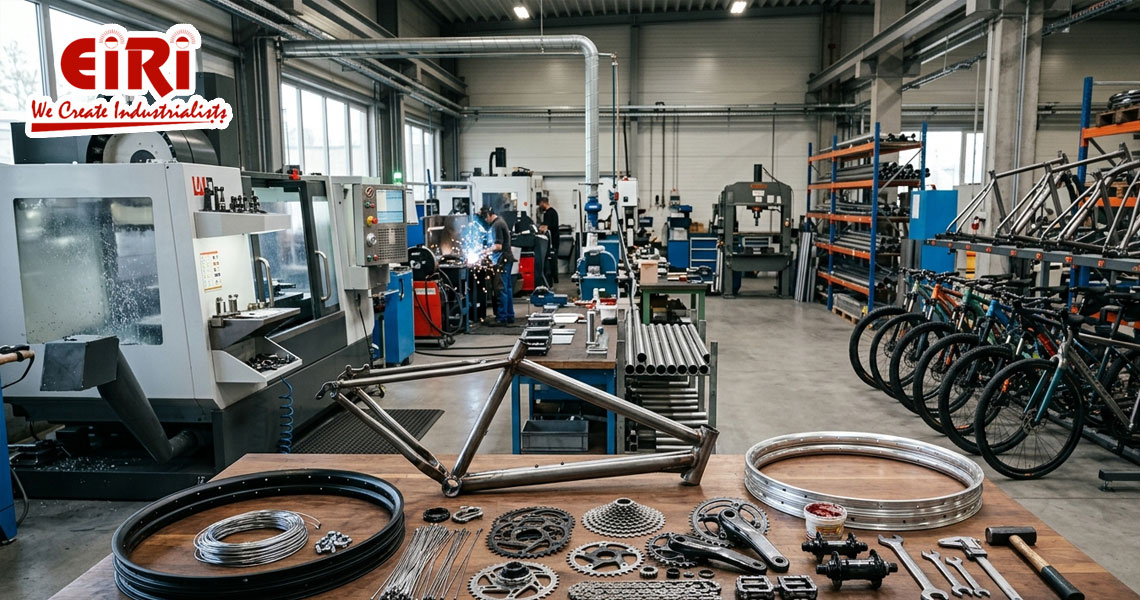
The frame is the most critical component of a bicycle, as it determines strength, weight, and overall performance. Frame manufacturing involves a combination of design engineering, material selection, and fabrication techniques. Common materials used include steel, aluminum, and increasingly, carbon fiber for high-end bicycles.
The manufacturing process begins with tube cutting and shaping, where raw material is formed into required geometries. This is followed by welding or brazing, depending on the material and design. Precision is crucial at this stage, as even minor misalignment can affect the performance and safety of the final product. Advanced manufacturers also use hydroforming techniques, especially for aluminum frames, to achieve complex shapes and improved strength-to-weight ratios.
After fabrication, frames undergo surface finishing processes such as grinding, polishing, and painting. Powder coating and anodizing are commonly used to enhance corrosion resistance and aesthetic appeal. Quality checks are conducted to ensure that the frame meets strength and durability standards, making it suitable for long-term use.
Frame parts such as forks, seat stays, and chain stays are also manufactured using similar processes, often requiring additional reinforcement depending on their function.
Manufacturing of Drivetrain Components
The drivetrain system is responsible for converting rider effort into motion, making it one of the most technically demanding areas of bicycle manufacturing. It includes components such as cranksets, chains, cassettes, and derailleurs, all of which must operate with high precision and minimal friction.
Drivetrain components are typically manufactured using processes like forging, machining, and heat treatment. Forging is commonly used for cranksets to achieve high strength, while CNC machining ensures accuracy in gears and sprockets. Heat treatment processes such as hardening and tempering are applied to improve wear resistance and extend component life.
Chains and cassettes require extremely tight tolerances, as even slight variations can lead to inefficient power transfer or premature wear. Surface finishing techniques such as plating and coating are used to reduce friction and prevent corrosion.
Assembly of drivetrain components involves careful alignment and testing to ensure smooth operation. Manufacturers must focus on consistency and precision, as these parts directly influence the riding experience. Investing in advanced machinery and quality control systems is essential for success in this segment.
Manufacturing of Wheels, Rims, and Spokes
Wheel systems are fundamental to bicycle performance, affecting speed, balance, and rider comfort. The manufacturing of wheels involves the production of rims, spokes, and hubs, followed by precise assembly.
Rims are typically made from aluminum alloys, although steel and carbon fiber are also used in specific applications. The manufacturing process includes extrusion, rolling, and welding to form the circular shape. Machining operations are then carried out to create spoke holes and ensure uniform thickness. Surface treatments such as anodizing improve durability and appearance.
Spokes are manufactured from high-tensile steel wires, which are cut, threaded, and shaped to precise specifications. The strength and flexibility of spokes are critical, as they distribute loads and maintain wheel integrity under stress. Proper tensioning during assembly is essential to prevent deformation and ensure long-term performance.
Hubs, which house the bearings and connect the wheel to the frame, are produced using machining and casting processes. High-quality bearings are used to minimize friction and enhance efficiency.
Wheel assembly is a specialized process that involves lacing the spokes between the hub and rim, followed by tensioning and truing. This ensures that the wheel rotates smoothly without wobbling. Manufacturers must pay close attention to balancing and alignment, as these factors directly impact ride quality and safety.
Manufacturing of Braking and Control Components
Braking and control components are essential for rider safety and must meet strict performance standards. These include brake levers, calipers, discs, handlebars, and stems.
Brake systems can be mechanical or hydraulic, each requiring different manufacturing approaches. Mechanical brakes involve cable-operated systems, while hydraulic brakes use fluid pressure for improved performance. Components such as calipers and discs are typically produced using casting and machining processes, followed by surface finishing to enhance durability.
Brake pads are manufactured using specialized friction materials that provide consistent stopping power under different conditions. Precision in design and material selection is crucial to ensure reliability and safety.
Control components such as handlebars and stems are usually made from aluminum or steel, using processes like forging and bending. These parts must offer a balance between strength and weight, while also providing ergonomic comfort to the rider.
Quality testing for braking and control components is rigorous, as these parts directly affect user safety. Manufacturers must ensure that their products meet industry standards and perform reliably under various operating conditions.
Challenges in Bicycle Parts Manufacturing
Despite its potential, the bicycle parts manufacturing industry comes with several challenges. One of the primary issues is intense competition, both from domestic players and low-cost international manufacturers. Price sensitivity in markets like India makes it difficult to maintain high margins while ensuring quality.
Consistency in production is another challenge, especially for components that require high precision. Even small defects can lead to product failures, affecting brand reputation. Maintaining quality across large production volumes requires strict process control and skilled labor.
Fluctuations in raw material prices, particularly metals like steel and aluminum, can significantly impact production costs. Supply chain disruptions, whether due to global events or logistical issues, further add to the complexity of operations.
Future Opportunities and Innovation
The future of bicycle parts manufacturing is closely tied to innovation and technological advancement. The rapid growth of electric bicycles is opening new avenues for manufacturers, as these vehicles require more advanced components and higher precision.
Lightweight materials and aerodynamic designs are becoming increasingly important, especially in the premium segment. Manufacturers who invest in research and development can gain a competitive edge by offering high-performance products.
Customization is another emerging trend, with consumers seeking bicycles tailored to their specific needs. This creates opportunities for small and medium manufacturers to differentiate themselves through flexible production capabilities.
Integration of smart technologies, such as sensors and connectivity features, is also expected to shape the future of the industry. As bicycles become more technologically advanced, component manufacturers will need to adapt to new requirements and standards.
Conclusion
Bicycle parts manufacturing offers a promising opportunity for entrepreneurs looking to enter the manufacturing sector with a scalable and sustainable business model. By focusing on specific components such as frames, drivetrain systems, or wheels, businesses can build expertise and gradually expand their operations.
Success in this industry depends on a combination of quality, cost efficiency, and adaptability to market trends. While challenges exist, the growing demand for bicycles, driven by health, environmental, and economic factors, ensures a strong long-term outlook.
For aspiring manufacturers, this sector provides not only business potential but also the chance to contribute to a more sustainable and eco-friendly future.