
Rice Husk to Value: A Practical Guide for Entrepreneurs and New Manufacturers









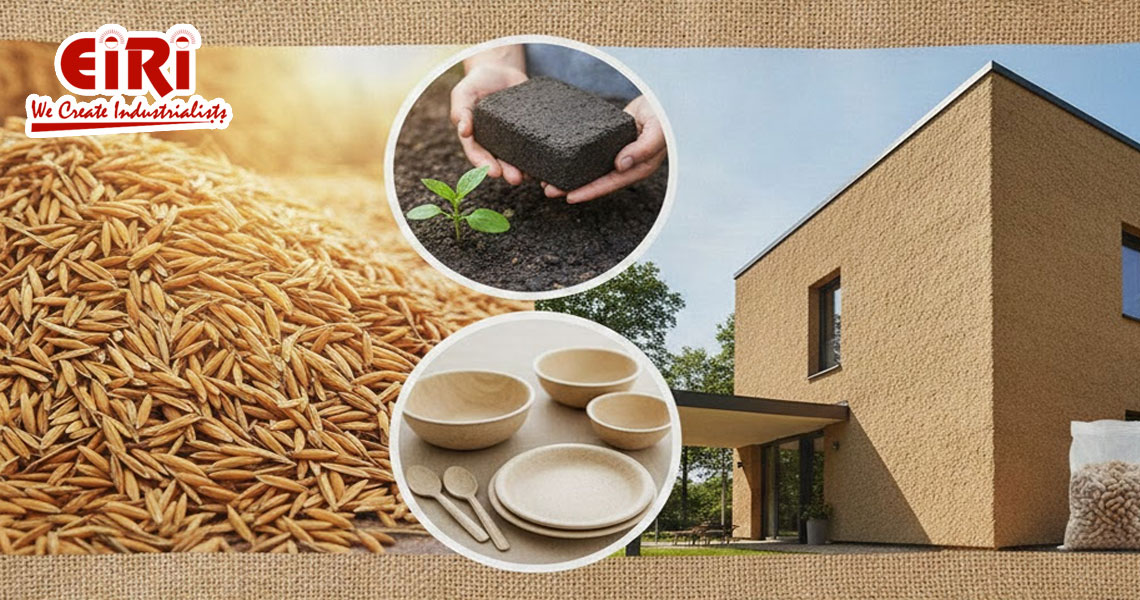
Rice husk is no longer seen only as an agricultural residue that needs disposal. For many decades, it was openly burned, dumped near rice mills, or used in a limited way as a low-grade fuel. This approach created pollution and wasted a valuable resource. Today, the situation has changed. Rice husk and rice husk ash (RHA) are now recognized as strategic industrial raw materials used across construction, chemicals, energy, agriculture, and emerging material applications.
What makes rice husk attractive for entrepreneurs is its practical value rather than any technical novelty. It is available in large quantities wherever rice is processed, it is usually low-cost or free at the source, and it aligns well with sustainability and circular economy goals. A single raw material can be converted into multiple products depending on processing route, which allows flexible business planning. Despite this potential, many rice husk–based ventures fail.
What makes rice husk special for entrepreneurs is simple:
- It is abundantly available
- It is low-cost or free at source
- It fits perfectly into sustainability and circular economy goals
- It can generate multiple products from one raw material
Many business ideas around rice husk fail not because the technology is weak, but because entrepreneurs do not understand material behavior, supply stability, processing limits, and market fit. This guide focuses on closing that gap.
Rice Husk Fundamentals: Understanding the Material Before Investing
Rice husk is the outer protective shell removed during rice milling. For every one tonne of rice milled, around 200 to 220 kilograms of husk is generated. India alone produces more than 30 million tonnes of rice husk each year, with major concentration in states such as Punjab, Haryana, West Bengal, Andhra Pradesh, Telangana, Tamil Nadu, Odisha, and Uttar Pradesh. Because rice milling is a continuous activity, the supply of husk is steady throughout the year, which makes long-term industrial planning possible.
Unlike many agricultural residues, rice husk has a predictable composition. It contains a high amount of silica, degrades very slowly, and behaves consistently across regions when sourced from similar rice varieties. This consistency allows rice husk to be processed through mechanical, thermal, or chemical routes with reliable results. Industries prefer rice husk over many other crop wastes because its performance does not vary sharply from batch to batch.
Rice Husk Products: Current Market Overview and Future Prospects
Rice husk products are gaining strong global demand as industries shift toward sustainable and low-carbon materials. Once treated as agricultural waste, rice husk is now widely used in construction, silica production, agriculture, energy, and specialty materials. Rice husk ash plays a key role due to its silica content and performance in concrete, rubber, ceramics, and chemicals. Growth is driven by green building practices, policy support, and cost advantages. While challenges exist in quality control and logistics, improved processing technologies are helping producers access higher-value markets. Overall, rice husk offers entrepreneurs a flexible and scalable platform for long-term business growth.
Rice Husk Products: Current Market Overview and Future Prospects
Rice husk products are gaining strong global demand as industries shift toward sustainable and low-carbon materials. Once treated as agricultural waste, rice husk is now widely used in construction, silica production, agriculture, energy, and specialty materials. Rice husk ash plays a key role due to its silica content and performance in concrete, rubber, ceramics, and chemicals. Growth is driven by green building practices, policy support, and cost advantages. While challenges exist in quality control and logistics, improved processing technologies are helping producers access higher-value markets. Overall, rice husk offers entrepreneurs a flexible and scalable platform for long-term business growth.
- Rice husk is shifting from waste material to industrial raw material
- Rice husk ash demand is led by construction and infrastructure sectors
- Sustainable building regulations are boosting RHA adoption
- Rice husk–based silica is growing in rubber and specialty chemicals
- Biochar and carbonized husk support sustainable agriculture trends
- Small-scale biomass power projects show steady regional demand
- Ethanol and biofuels require high capital and policy backing
- Quality consistency remains a key market challenge
- Asia-Pacific leads due to rice availability and industrial growth
- Entrepreneurs can scale from basic products to high-value materials
Forms of Rice Husk Used in Industry
The form in which rice husk is used directly affects its value, logistics, and end use. Loose rice husk is the cheapest form but has very low bulk density, which increases storage and transport costs. Briquettes and pellets are processed forms that offer better handling and are widely used in boilers and gasifiers. Carbonized rice husk is produced through controlled heating and serves as the base material for activated carbon and biochar. Rice husk ash is the final form obtained after combustion or gasification and is rich in silica, making it suitable for construction and chemical applications.
Each of these forms serves a different market and requires a different business approach. Entrepreneurs often face losses when they try to supply multiple markets without proper planning, as each form demands its own quality control, storage system, and customer base.
Composition and Properties: Why Rice Husk Behaves Differently
Rice husk contains both organic and inorganic components. The organic part consists mainly of cellulose and lignin, while the inorganic part is dominated by silica. This silica is not present as loose particles like sand; it is embedded within the plant structure. This unique structure is what makes rice husk processing different from handling other biomass materials.
Several physical properties of rice husk have direct business implications. Its low bulk density means that larger storage space is required. Its abrasive nature leads to faster wear of handling and combustion equipment if unsuitable materials are used. The high ash content makes it attractive for ash-based products, while its poor digestibility limits its use as animal feed. Entrepreneurs who understand these properties at the design stage can avoid costly equipment failures and operational inefficiencies later.
Processing, Handling, and Safety: Hidden Business Risks
Rice husk absorbs moisture very easily, which creates problems during storage and handling. When husk becomes wet, its fuel value drops, fungal growth may start, and feeding systems in boilers or gasifiers begin to malfunction. These issues are often ignored in early project planning. Simple measures such as covered storage sheds, raised flooring, and controlled ventilation significantly improve raw material quality and reduce downtime. These solutions are low-cost compared to the losses caused by poor storage.
Health and safety risks are another area that needs attention. Fine rice husk dust can cause respiratory problems for workers and increases the risk of fire or dust explosions in enclosed systems. Basic dust collection units, proper grounding of equipment, and regular housekeeping reduce these risks. In addition, these measures help in meeting pollution control norms and create a safer working environment, which is increasingly important for regulatory approvals.
Rice Husk Ash (RHA): From Waste to High-Value Input
Rice husk ash is generated after combustion or gasification of husk. Its quality depends strongly on the burning temperature and combustion method. Controlled burning at lower temperatures produces ash with a high percentage of amorphous silica, which is reactive and suitable for industrial use. Uncontrolled burning at high temperatures converts silica into crystalline form, which has lower reactivity and fewer applications.
This difference in ash quality plays a critical role in pricing and market acceptance. High-quality RHA can be sold at a premium for construction and chemical applications, while poor-quality ash often becomes a disposal problem. Entrepreneurs who invest in controlled combustion systems gain a clear advantage.
Industrial Applications of RHA
In the construction sector, rice husk ash is widely used in cement blending, concrete blocks, hollow bricks, and precast products. Its benefits come from improved long-term strength and better particle packing rather than immediate strength gain. Local construction practices and acceptance play a bigger role than laboratory test results. Selling RHA-based products close to the production site reduces transport cost and improves market penetration.
Rice husk ash–derived silica is also used in rubber compounding, ceramic products, filtration systems, and water purification. These industries value consistency and performance more than low price. Smaller plants that maintain strict quality control often perform better in these markets than larger plants with uncontrolled processes.
Silica and Silicon Products: Moving Up the Value Chain
Precipitated silica produced from rice husk ash is one of the most stable business opportunities in this sector. Raw husk costs remain low, chemical consumption is predictable, and demand from rubber, footwear, and toothpaste industries is steady. Entrepreneurs who integrate ash generation with silica extraction reduce dependence on external suppliers and improve raw material security.
Advanced products such as nano-silica, silicon polymers, and electronic-grade silicon represent higher value but also higher risk. Nano-silica is finding applications in concrete and coatings, while silicon-based polymers are used in sealants. Silicon wafers require very high capital and technical expertise. These areas are better treated as expansion opportunities after achieving stability in basic operations.
Activated Carbon and Biochar: Two Different Markets
Activated carbon produced from rice husk is widely used in water treatment, air purification, gold recovery, and industrial effluent treatment. Success in this segment depends on controlled activation, strict testing, and certification. While profit margins are attractive, technical discipline is essential to meet buyer expectations.
Biochar targets a different market focused on soil improvement, carbon storage, and sustainable agriculture. Its processing cost is lower, but demand depends on farmer awareness, government programs, and carbon credit mechanisms. Biochar projects perform best when linked with agricultural clusters rather than operating as isolated units.
Energy and Biofuels: Power with Purpose
Rice husk–based power generation supports rural employment, reduces dependence on coal, and improves local energy access. Small-scale gasifiers ranging from 100 kilowatts to 2 megawatts are often more viable than large plants because they reduce fuel transport distance and allow better supply control. In addition to power, these systems produce ash that can be sold, improving overall project economics.
Cellulosic ethanol production from rice husk is technically feasible but requires high capital investment, advanced process control, and strong policy support. These projects are better suited for large integrated bio-refineries rather than small or standalone units.
Building Materials, Boards, and Other Products
Rice husk and rice husk ash are widely used in cement blends, lime-based products, gypsum boards, and particle boards. These products suit MSMEs well because demand is steady and closely linked to local construction activity. Low-cost housing programs further strengthen demand for husk-based blocks and panels.
Rice husk is also used in specialty papers, packaging boards, and molded packaging products. Chemical products such as oxalic acid can be produced from rice husk, offering moderate demand and export potential, though they require strict safety and process control. In these segments, consistent operation matters more than plant size.
Business, Economics, and Policy Considerations
Prices of rice husk–based products depend more on consistency, location, and end-use industry than on global commodity trends. Many projects fail due to underestimation of utility costs, poor ash handling design, and lack of working capital. A realistic break-even analysis is far more valuable than optimistic return projections.
In India, strong policy support exists through MSME schemes, renewable energy incentives, pollution control benefits, and carbon credit opportunities. Entrepreneurs who align their projects with these policies face fewer regulatory hurdles and achieve better long-term stability.
Quality, Safety, and the Road Ahead
Quality control has become a basic requirement rather than an option. Buyers expect compliance with BIS, ASTM, or ISO standards, along with batch consistency and traceability. Future growth areas include green construction materials, energy storage additives, and carbon-negative products. Rice husk is steadily moving from waste-based thinking to material-based thinking.
Final Thoughts for Entrepreneurs
Rice husk should not be seen as a single-product business. It is a flexible industrial platform. Long-term success comes from choosing a clear product pathway, maintaining control over raw material quality, designing operations around local markets, planning safety and compliance from the start, and keeping room for future expansion. Entrepreneurs who respect the material itself, rather than focusing only on its low cost, are the ones who build scalable and lasting businesses.