
Top 10 Future-Oriented Manufacturing Units for 2030 - Industries That Will Shape the Next Industrial Decade







The manufacturing sector is entering a new phase. Traditional factories based only on volume production are being replaced by industries driven by technology, sustainability, domestic production capacity, supply chain security, and long-term consumption demand. By 2030, manufacturing will not only be about producing goods, but about building systems that support food security, energy transition, healthcare access, infrastructure growth, environmental protection, and economic resilience.
Future-oriented manufacturing units are those that are consumption-linked, policy-supported, export-capable, technology-driven, and structurally essential to national development. These industries will not depend on short-term market cycles. Instead, they will grow steadily with population growth, urbanization, infrastructure development, digitalization, sustainability regulations, and global trade restructuring.
The following ten manufacturing sectors represent the strongest industrial opportunities for 2030 and beyond. These are not trend-based industries. These are foundation industries that will define industrial growth for decades.
1. Agro-Processing & Food Manufacturing
Future Scope: Very High
Agro-processing and food manufacturing will remain one of the strongest pillars of industrial growth. Food is a permanent demand sector. It is consumption-driven, population-linked, export-oriented, and recession-resistant. As urban lifestyles increase and food habits change, the demand for processed, packaged, preserved, and value-added food products will rise continuously.
This sector includes food processing units, edible oil manufacturing, dairy processing plants, grain milling, flour production, dehydrated foods, frozen foods, spice processing, millet-based food production, nutraceutical foods, and beverage manufacturing. Future food manufacturing will not focus only on basic staples. It will shift toward health foods, fortified foods, functional foods, ready-to-eat products, convenience foods, and long-shelf-life products.
Urbanization, working populations, nuclear families, and changing consumption habits are reshaping food demand. At the same time, food security, export demand, and supply chain integration are creating strong structural growth. Agro-processing also supports farmers by improving income stability, reducing wastage, and creating rural industrialization.
By 2030, food manufacturing will not just be an industry—it will be a strategic sector linked to nutrition, national security, exports, employment generation, and rural development.
2. Pharmaceutical, Healthcare & Medical Manufacturing
Future Scope: Very High
Healthcare manufacturing is a permanent-growth sector. Demand for healthcare never declines. Population growth, aging populations, lifestyle diseases, urban healthcare access, medical tourism, and rising health awareness ensure continuous demand growth.
This sector includes pharmaceutical formulations, API manufacturing, medical devices, diagnostics equipment, hospital equipment, surgical instruments, nutraceuticals, herbal medicines, and ayurvedic products. Manufacturing is shifting toward domestic production due to supply chain security, import substitution policies, and national healthcare strategies.
Future healthcare manufacturing will not be limited to medicines. It will include diagnostic systems, wearable health devices, digital healthcare equipment, home-care medical products, and preventive healthcare solutions. The integration of biotechnology, automation, and digital health will create new product categories and new manufacturing ecosystems.
Healthcare manufacturing is structurally protected from economic downturns. It is driven by necessity, not luxury. By 2030, this sector will be one of the most stable industrial segments with long-term investment security.
3. Renewable Energy & Clean Energy Manufacturing
Future Scope: Structural Growth Industry
Renewable energy manufacturing represents one of the most powerful long-term industrial transformations in history. This sector is policy-driven, sustainability-driven, and infrastructure-linked. It includes solar panel manufacturing, EV components, battery systems, bioenergy systems, hydrogen equipment, energy storage systems, recycling plants, and clean energy hardware manufacturing.
Governments worldwide are committing to carbon neutrality targets, fossil fuel reduction, and clean energy transitions. This makes renewable energy manufacturing a structural industry, not a cyclical one. It will grow regardless of economic cycles because it is policy-supported and infrastructure-mandated.
Clean energy manufacturing also creates strong backward and forward linkages with metals, chemicals, electronics, logistics, construction, and digital systems. It creates complete industrial ecosystems, not isolated factories.
By 2030, clean energy manufacturing will not be optional—it will be a core industrial requirement for national development.
4. Metals, Minerals & Advanced Metal Processing
Future Scope: High
Every industrial sector depends on metals. Infrastructure, transport, construction, energy, defense, manufacturing equipment, electronics, and renewable energy systems all require advanced metal processing.
This sector includes steel processing, aluminum manufacturing, copper processing, specialty alloys, rare earth processing, metal recycling, metal fabrication, and precision component manufacturing. The future is not only about producing metals but about value-added metal processing, high-strength alloys, precision engineering, and advanced material manufacturing.
With infrastructure expansion, EV production, renewable energy installations, smart cities, industrial automation, and defense manufacturing, the demand for advanced metals will increase continuously.
Metal recycling and circular metal economy models will also grow strongly due to sustainability regulations and resource security needs. By 2030, advanced metal processing will be one of the most strategically important industrial sectors.
5. Specialty Chemicals & Industrial Chemical Manufacturing
Future Scope: Very High
Specialty chemicals are high-margin, export-oriented, and deeply integrated with all manufacturing sectors. This industry includes specialty chemicals, industrial chemicals, construction chemicals, coatings, adhesives, battery chemicals, agrochemicals, and electronic-grade chemicals.
Unlike bulk chemicals, specialty chemicals are application-specific, performance-driven, and technology-based. They replace traditional raw materials with higher-performance alternatives and support advanced industries like electronics, EVs, semiconductors, aerospace, construction, and high-performance manufacturing.
This sector benefits from strong export demand, domestic manufacturing growth, and technology integration. Specialty chemicals also play a critical role in sustainability through green chemistry, recyclable materials, and eco-friendly formulations.
By 2030, chemical manufacturing will shift from volume-based production to knowledge-based manufacturing.
6. Agricultural Equipment & Farm Machinery Manufacturing
Future Scope: High
Agricultural mechanization is essential for food security, productivity, and rural development. This sector includes tractors, farm implements, irrigation systems, post-harvest machinery, cold storage equipment, and food processing machines.
As labor availability declines and farming becomes more technology-driven, mechanization will increase. Rural industrialization and agri-logistics development will further strengthen demand.
Future farm machinery will include smart equipment, precision farming tools, IoT-enabled irrigation systems, automated harvesting machines, and post-harvest processing systems.
By 2030, agriculture will function as an integrated industrial system rather than a traditional farming activity.
7. Packaging & Sustainable Materials Manufacturing
Future Scope: Very High
Packaging is no longer a support industry—it is a core manufacturing sector. It includes biodegradable packaging, paper packaging, glass packaging, compostable materials, recyclable packaging, and industrial packaging systems.
This sector is driven by FMCG, pharma, food, e-commerce, retail, and sustainability regulations. Plastic replacement, eco-friendly materials, and circular economy models are reshaping packaging manufacturing.
Future packaging will focus on smart packaging, biodegradable polymers, compostable materials, lightweight packaging, and sustainable supply chains.
By 2030, sustainable packaging will be a regulatory requirement, not a market choice.
8. Construction Materials & Infrastructure Manufacturing
Future Scope: High
Urbanization and infrastructure development make this a permanent-growth sector. It includes cement products, precast structures, tiles, pipes, insulation materials, green building materials, and modular construction systems.
Future construction will focus on faster building technologies, prefabrication, modular systems, and sustainable materials. Infrastructure manufacturing will integrate digital construction, smart materials, and energy-efficient systems.
This sector supports housing, transport, logistics, industrial parks, smart cities, and industrial corridors. It will remain one of the strongest demand-driven manufacturing segments.
9. Battery, Energy Storage & Recycling Manufacturing
Future Scope: Very High
This sector supports EVs, renewable energy, telecom, industry, data centers, and backup power systems. It includes lithium batteries, sodium-ion batteries, industrial batteries, battery recycling plants, energy storage systems, and power storage infrastructure.
Energy storage is becoming as important as energy generation. Without storage, renewable energy systems cannot function efficiently. Battery manufacturing will become a backbone industry for clean energy transition.
Recycling will also become critical due to raw material security and sustainability regulations. Circular battery economy models will dominate future manufacturing strategies.
10. Water, Waste & Environmental Manufacturing
Future Scope: High
Environmental manufacturing will define urban and industrial sustainability. This sector includes water treatment plants, filtration systems, desalination units, solid waste processing systems, sewage treatment equipment, recycling plants, and waste-to-energy systems.
Urban growth, industrial water demand, and environmental regulations are driving this sector. Water scarcity, pollution control, and waste management are becoming national priorities.
Environmental manufacturing is not a support industry anymore—it is becoming a core infrastructure industry essential for sustainable growth.
Conclusion: Manufacturing Vision for 2030
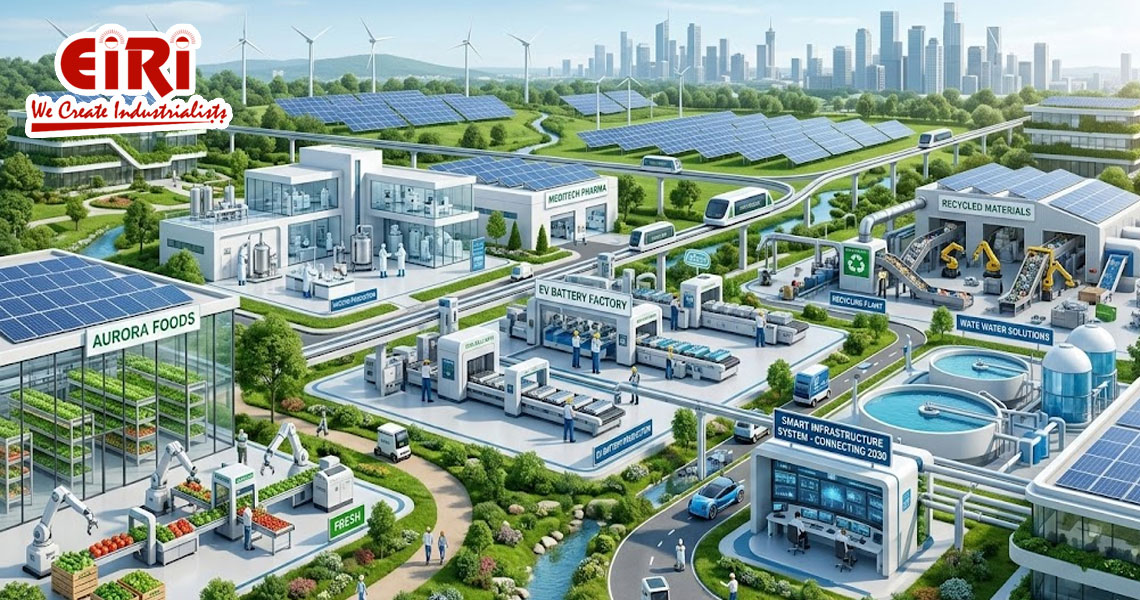
The future of manufacturing is not about isolated factories. It is about building industrial ecosystems. Future-oriented manufacturing units are those that connect with food security, healthcare systems, energy transition, infrastructure growth, environmental sustainability, and technological development.
These ten sectors are not speculative industries. They are structural industries that will shape economic growth, employment generation, export strength, and national resilience.
By 2030, successful manufacturing will be defined by:
- Sustainability integration
- Technology adoption
- Policy alignment
- Export readiness
- Supply chain resilience
- Circular economy models
- Domestic capacity building
For entrepreneurs, investors, industrial planners, and policymakers, these industries represent not just business opportunities, but nation-building opportunities. Manufacturing is no longer only about production. It is about building the future economy.