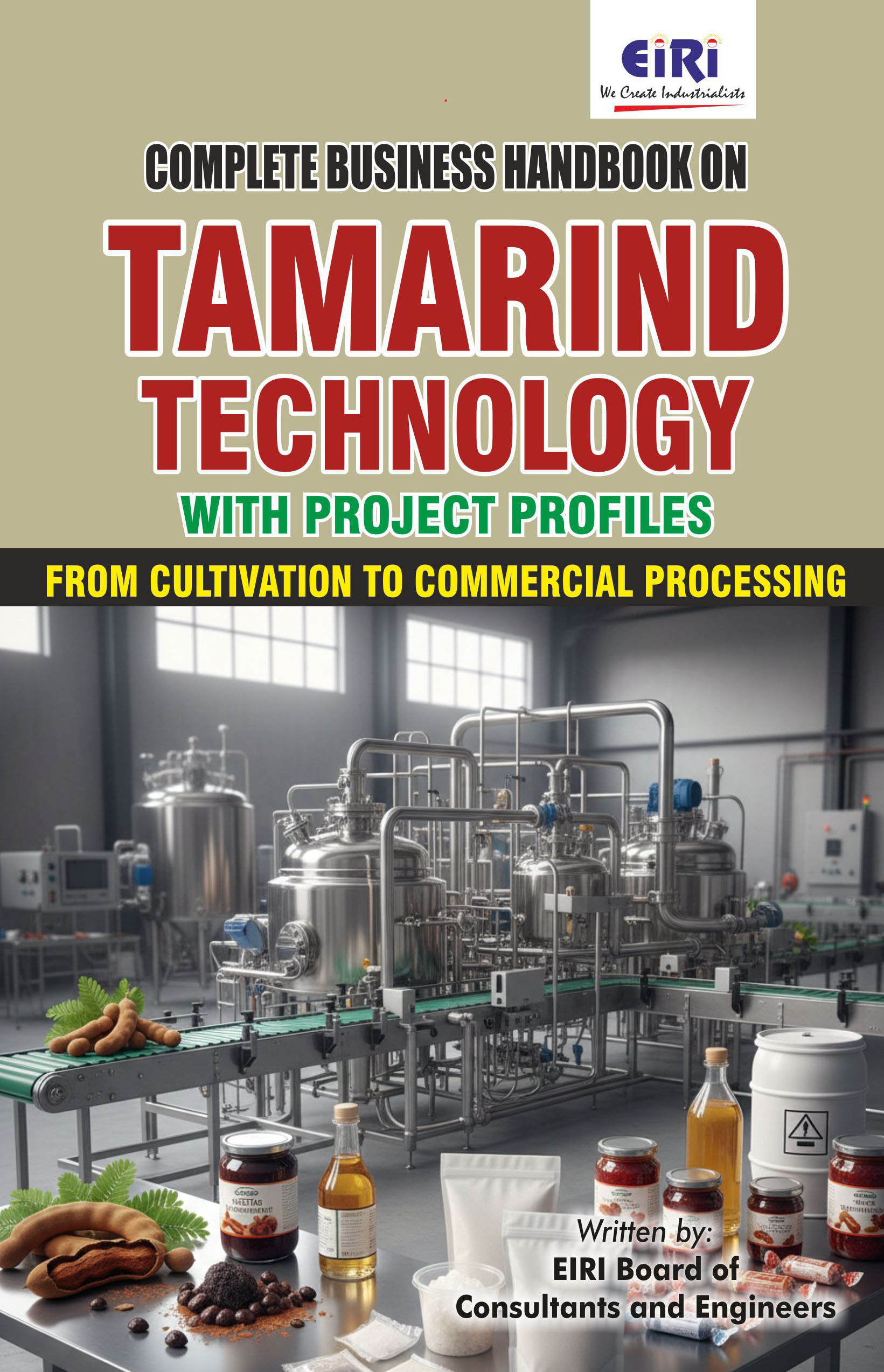
Complete Business Handbook on Tamarind Technology with Project Profiles (From Cultivation to Commercial Processing)
Why Choose Us
- More than 45 years of experience
- Managed by expert industrial consultants
- ISO 9001-2015 Certified
- Registered under MSME, UAM No: DL01E0012000
How We Work
- 24/5 Research Support Get your queries resolved from an industry expert. Ask before you purchase.
- Custom Research Service Speak to our consultants to design an exclusive study for your needs.
- Quality Assurance All reports are prepared by qualified consultants & verified by experts.
- Information Security Your personal & confidential information is always safe and secure.
Description
Complete Business Handbook on Tamarind Technology with Project Profiles (From Cultivation to Commercial Processing)
isbn: 9788193971376
Tamarind is one of the most versatile and widely used tropical fruits, valued for its unique sweet-sour taste, nutritional richness, and diverse industrial applications. From traditional culinary uses to modern food processing, pharmaceuticals, and export-oriented value addition, tamarind holds significant commercial importance in both domestic and global markets.
This book has been written with the objective of providing a comprehensive understanding of tamarind processing—from raw material sourcing and post-harvest handling to value-added product manufacturing and industrial-scale processing techniques. It covers essential aspects such as grading, deseeding, pulp extraction, concentration, drying, preservation, packaging, quality control, storage, and by-product utilization. Emphasis has also been placed on hygiene standards, regulatory compliance, machinery selection, plant layout, and economic feasibility to support entrepreneurs and food technologists.
With increasing demand for natural ingredients, convenience foods, and export-ready agro-products, tamarind processing presents promising opportunities for farmers, startups, and established food processors alike. This book aims to serve as a practical guide for entrepreneurs, technologists, students, researchers, and investors seeking to establish or upgrade tamarind processing units.
It is hoped that this publication will contribute meaningfully to the growth of agro-processing industries and encourage sustainable value addition in the tamarind sector.
Book contains Part I: Introduction to Tamarind - Introduction: The Origin and Importance of Tamarind, Botanical and Agricultural Profile of Tamarindus indica, Engineering Properties and Physical Characteristics, Chemistry and Nutritional Composition of Tamarind, Part II: Cultivation, Harvesting & Post-arvest Management - Tamarind Cultivation Practices and Agronomy, Flowering, Pollination, and Fruit Development, Genetic Improvement and High-Yield Varieties, Harvesting Techniques and Maturity Indicators, PostHarvest Handling and Storage Techniques, Recent Advances in Post-Harvest Technology, Part III: Processing Technologies - Drying of Whole and Dehulled Tamarind , Primary Processing and Dehulling, Mechanization in Tamarind Processing, Tamarind Decorticating and Cleaning Equipment, Packaging Techniques for Tamarind and Its Products, Part IV: Value Addition & Product Development - Tamarind Pulp-based Products, Tamarind Juice Powder and Concentrate, Tamarind Seed Powder and Derivatives, Extraction of Starch from Tamarind Seeds, Carboxy Methyl Tamarind Kernel Powder (CMTKP), Tamarind Seed Gum and Oil Extraction, By-products: Tartaric Acid, Food Colour, Pectin, and Essential Oils. Processed Product Innovation: Functional Foods & Nutraceuticals, Part V: Business, Market & Startup Guidance - Global and Domestic Market Potential of Tamarind Products, Business Models: Co-operatives, Contract Farming, D2C, B2B, Licensing, Food Safety, and Regulatory Compliance (FSSAI, APEDA, etc.), Branding.
PART I: INTRODUCTION TO TAMARIND
Chapter-1
INTRODUCTION: THE ORIGIN AND IMPORTANCE OF TAMARIND
- Introduction
- Origin
- Importance and uses
- Uses
- Medicinal uses
- Industrial uses
- Tamarind Kernel Powder (TKP)
- Pectins
- Tamarind Juice Concentrate (TJC)
- Tamarind pickle
- Other uses
Chapter-2
BOTANICAL AND AGRICULTURAL PROFILE OF TAMARINDUS INDICA
- Botanical profile
- Botanical Description
- Agricultural Profile
- Plant
- Leaves
- Flowers and flowering phenology
- Pollen and pollination
- Fruit set, breeding and mating system
- Fruits and seeds
- Fruit development and ripening
Chapter-3
ENGINEERING PROPERTIES AND PHYSICAL CHARACTERISTICS
- Physical properties of tamarind
- Moisture content
- Dimensions of tamarind
- Bulk density and True density
- Angle of repose
- Coefficient of friction
- Physical Properties of Tamarind Fruit
- Size of Fruit
- Length of Fruit
- Breadth of Fruit
- Thickness of Fruit
- Volume of fruits
- Shape of Fruit
- Weight of Seed and Pulp
- Engineering Properties of Fruit
- Bulk density
- Coefficient of friction
- Angle of repose
Chapter-4
CHEMISTRY AND NUTRI-TIONAL COMPOSITION OF TAMARIND
- Gas Chromatography-Mass spectrometry (GC-MS)
- Conventional digestion method (CDM)
- Nutritional Value of Tamarind
- Properties of Tamarind
PART II: CULTIVATION, HARVESTING &
POST-HARVEST MANAGEMENT
Chapter-5
TAMARIND CULTIVATION PRACTICES AND AGRONOMY
- Introduction
- Varieties
- Climate
- Soil
- Propagation
- Planting
- Harvesting and yield
- Plant protection
- Agronomy
- Propagation
- Seed Propagation
- Vegetative Propagation
- Cuttings
- Budding and grafting
- Layering
- Micro propagation
- Field Establishment
- Direct seedling
- Transplanting
- Field spacing
- Time of planting
- Pruning and Training
- Intercropping
- Irrigation
- Genetic Resources and Improvement
- Genetic resources and diversity
- Improvement strategies and methods
- Potential for future development
- Research & Technology Needs
- Cultivation and growth
- Pest and disease management
- Processing and value addition
Chapter-6
FLOWERING, POLLINATION, AND FRUIT DEVELOPMENT
- Flowering
- Bud to bloom
- Flowering period
- Flower development and characteristics
- Flowering period and pollination
- Fruit set
- Pollination
- Pollinators
- Pollination process
- Pollination ecology
- Breeding system
- Breeding system
- Fruit Development
- Fruit development stages
- Harvesting and processing
- Harvesting tips for getting more fruit yield
- Pruning and training to maintain tree shape and fruit growth
- Nutrition management for better growth
- Intercultural improves crop growth
- Irrigation for tree growing faster and better
- Plant protection for more yield
Chapter-7
GENETIC IMPROVEMENT AND HIGH-YIELD VARIETIES
- Genetic Improvement
- Selection
- Hybridization
- Key findings and strategies
- Key advances in tamarind genetic improvement
- Genetic Resources and Crop Improvement
- Improvement approaches
- Challenges and future direction
- High yielding tamarind varieties
- Introduction
- Goma Prateek
- PKM 1
- Urigam
- Pratisthan
- Tamarind 263
- Ajanta
- Yogeshwari
- DTS 1
- DTS 2
- Other notable varieties
Chapter-8
HARVESTING TECHNIQUES AND MATURITY INDICATORS
- Harvesting Techniques
- Land Preparation
- Soil Type
- Climate
- Propagation
- Seed propagation
- Major Cultivars
- Vegetative propagation
- Tissue culture
- Orchard establishment
- Irrigation
- Manuring
- Use of biofertilizers
- Pruning and training
- Weed management
- Flowering, pollination and fruit set
- Floral biology
- Fruit Growth and Development
- Harvesting
- Common Diseases
- Integrated Pest Management (IPM) for tamarind
- Cultural controls
- Biological controls
- Chemical controls
- Monitoring and inspection
- Maturity index
- Maturity Indicators – Ripe Pods
- Maturity Indicators – Immature Pods (Vegetable Use)
- Harvesting Method – Mature Pods
- Harvesting Method – Immature Pods
- Handling
- Key maturity indicators
- Important considerations
Chapter-9
POST-HARVEST HANDLING AND STORAGE TECHNIQUES
- Postharvest handling practices
- Harvest operations
- The traditional method of tamarind processing
- Harvesting and initial drying
- Processing the pulp
- Storage and preservation
- Common challenges and solutions
- Mechanization
- Tamarind dehuller
- Tamarind deseeder
- Hammering mechanism
- Storage techniques
- Short-term storage
- Long-term storage
- Traditional/dried storage
- Mean value of moisture content (per cent wet basis) of stored tamarind
- Effect of storage period on titratable acidity of tamarind during storage at room temperature and at low temperature
Chapter-10
RECENT ADVANCES IN POST-HARVEST TECHNOLOGY
- Post-Harvest Management
- Harvest operations
- Packing-house practices
- Control of ripening and senescence
- Recommended storage and shipping conditions
- Processing
- Processing of tamarind pulp
- Processing of tamarind seed
- Processing & Value Addition
- Post-harvest processing steps
- Storage and preservation
- Effect of different packaging materials
- Effect of different storage temperature
- Interaction effect of additives, packaging materials and storage conditions
- Value-added products
- Importance of technology
- Post-harvest utilization
- Storage of Fruits
- MANUFACTURING PROCESS OF THE TAMARIND SAUCE
- Types of machinery used in tamarind processing
PART III: PROCESSING TECHNOLOGIES
Chapter-11
DRYING OF WHOLE AND DE-HULLED TAMARIND
- Engineering Properties of Tamarind
- Design of the Tamarind Dryer
- Drying Operation
- Moisture content
- Evaluation of Drying Rate
- Evaluation of Dryer Efficiency
- Statistical Analysis
- Mechanical drying
- Drying unit
- Blower unit
- Heating unit
- Procedure
- Dehydration process
- Main considerations
Chapter-12
PRIMARY PROCESSING AND DEHULLING
- Processing Methods
- Whole tamarind seed (Control)
- Drying
- Autoclaving
- Boiling
- Roasting
- Analysis of physical (Colour) properties of tamarind seed powder
- Primary processing steps
- Mechanical vs. Traditional methods
- Spray-dried tamarind juice concentrate (TJC) powder
- Traditional methods
- Mechanical methods
- The overall process
Chapter-13
MECHANIZATION IN TAMARIND PROCESSING
- Tamarind Processing
- Tamarind Dehulling Machine
- Main mechanized steps in tamarind processing
- Benefits of mechanization
- Description of Tamarind Processing Machine
- End Products of Tamarind Processing Machine
- TAMARIND PASTE – FLOW SHEET
- Tamarind deseeding and pulping machine
- Tamarind Fruit (Aatty Imali) - Process flow diagram of tamarind brick preparation
- Process flow diagram of tamarind candy preparation
- Tamarind juice extracting unit
- Tamarind pulp/juice evaporator
- Tamarind pulp/juice sterilizer and filling machine
- Machinery Supplier
Chapter-14
TAMARIND DECORTICATING AND CLEANING EQUIPMENT
- Pre-treatment and preparation
- Mechanical deseeding
- Post-decortication
- Tamarind Decorticator Machine
- Functionality and design
- Benefits
- Machinery Supplier
- Tamarind seed processing
- Automatic Tamarind Seed Removal Machine
- 20kg/hr Tamarind Seed Removal Machine
- Oscillating type tamarind seed separator
- Operation of oscillating type seed separator
- Moisture Content
- Weight
- Tamarind De-huller Machine Manufacturer and Exporters in India
Chapter-15
PACKAGING TECHNIQUES FOR TAMARIND AND ITS PRODUCTS
- Tamarind Pulp (Seedless)
- Tamarind Concentrate/Paste
- Value-Added Products
- Main Considerations
- Bulk Packing Seedless Tamarind
- Natural Seedless Tamarind
- Seedless Tamarind Slabs
- Seed less Imli
- Tamarind Seed Kernel Powder
- Tamarind Juice Concentrate
- Tamarind Extract / Concentrate
- Seedless Imli Concentrate
- Tamarind Concentrate in bulk packing
- Tamarind Concentrate in Consumer Packing
- Depectinised Tamarind Concentrate
- Tamarind Paste Puree
- Tamarind, Packaging Type : Plastic Packet
- Full Automatic Play Dough Extrusion & Packing Line CB-350XLS
- Imli Pouch Packing Machine
PART IV: VALUE ADDITION & PRODUCT DEVELOPMENT
Chapter-16
TAMARIND PULP-BASED PRODUCTS
- Uses of Tamarind Pulp
- Common tamarind pulp products
- Forms of tamarind pulp products
- Tamarind Paste and Concentrate
- Tamarind Preparation
- Tamarind Chutney
- Ingredients
- Tamarind Powder
- Instant Pulihora (Tamarind Rice) Powder
- Tamarind Juice
- Tamarind Candy
- Main considerations
- Flowchart for Candy Preparation
- Tamarind Pulp Cakes
- Ingredients
- Flowchart for Pickle Preparation
- Tamarind-based preserves and jams
- Formulation examples
- Preparation method
- Process Flow Diagram for Tamarind Jam Production
- Process Flow Diagram for Tamarind Jelly Production
- Manufacturing Flow chart of The Tamarind Sauce
Chapter-17
TAMARIND JUICE POWDER AND CONCENTRATE
- Concentrate
- Tamarind pulp powder
- Tamarind Juice Powder
- Tamarind Juice Concentrate
- Both forms
- Tamarind juice concentrate (liquid) formulation
- Tamarind juice powder (spray-dried) formulation
- Factors to consider
- The CFTRI technology for tamarind juice concentrate
- Standard manufacturing process
- Alternative enzymic process
- Key benefits
- Standard Industrial Formulation
- Key Properties:
- Ready-to-Drink Beverage Formulation
- Simple Home Preparation
- Ingredients
- Preparation of tamarind RTS juice
- 18. TAMARIND SEED POWDER AND DERIVATIVES
- Market overview and applications
- Key market drivers
- Production and supply chain
- Tamarind seed powder
- Tamarind seed powder derivatives
- Key properties and advantages of derivatives
- Tamarind Kernel Powder Properties
- Technical Specifications
- Packaging Details
- Uses
- Physical and Chemical Characteristics
- Preparation of TKP
- Food Industries
- Pharmaceutical Industries
- Textile Industries
- Other Applications
Chapter-19
EXTRACTION OF STARCH FROM TAMARIND SEEDS
- Tamarind seed powder
- Step 1: Prepare the seeds
- Step 2: Extract the starch
- Step 3: Purify and dry the starch
- Extraction of starch
- Extraction of Tamarind Seed Starch Using Distilled Water Method
- Extraction of Tamarind Seed Starch Using Alkali Method
- Functional Properties of Tamarind Seed Starch
- WAC and OAC
- Swelling index and Solubility
- Morphological Analysis
- Scanning Electron Microscopy (SEM)
- Chemical composition and characteristics
- Degree of Polymerization
- Gelatinization
- Retrogradiation
- Extraction of starch
- Conventional techniques
- Solvent extraction
- Sedimentation method
- Centrifugation method
- Microwave extraction
- PEF
- Tamarind starch properties
- Physical properties
- Rheological properties
- Gelling properties:
- Stabilization and emulsification properties
- Appications of Tamarind Seed Strach
- Food Industry
- Pharmaceutical industry
- Key Steps in Tamarind Seed Starch Production
- Seed Preparation
- Decortication & Grinding
- Starch Extraction
- Drying
- Variations & Enhancements
Chapter-20
CARBOXY METHYL TAMARIND KERNEL POWDER (CMTKP)
- Market Drivers and Trends
- Major Players
- Market Challenges
- Applications
- Uses Of Carboxymethyl Tamarind:
- Safety Profile Of Carboxymethyl Tamarind:
Chapter-21
TAMARIND SEED GUM AND OIL EXTRACTION
- Tamarind seed gum extraction
- Tamarind oil extraction
- Extraction of tamarind gum
- Seed
- Flow chart of extraction method from Tamarind seeds
- Extracted Tamarind Gum
- Purity of tamarind gum
- Alkaloid test
- Carbohydrate test
- Tamarind seed oil extraction process
- Extraction Method
- Leaf sample
- Seed sample
- Process flow chart
Chapter-22
BY-PRODUCTS: TARTARIC ACID, FOOD COLOUR, PECTIN, AND ESSENTIAL OILS
- Extraction of Tartaric Acid from Tamarind Pulp
- Modification for recovery of tartaric acid:
- Percolation Process
- Product Analysis Instrumentation
- Calculations
- Key Aspects of Tartaric Acid from Tamarind
- Main Aspects of Tartaric Acid in Tamarind
- Food Colour
- Sources of Color
- Extraction & Application
- Extaction of Pectin from Tamarind
- Key Extraction Steps
- Pretreatment
- Acid Extraction (Hydrolysis)
- Filtration & Concentration
- Optimization Factors
- Tamarind as a Source
- Extraction of pectin from Tamarind Pulp
- Analysis of Acid Composition
- Extraction of Essential Oils from Tamarind
- Extracting oil from tamarind, usually seeds, involves
- Common Extraction Methods
- Steps & Considerations
- Resulting Oil
Chapter-23
PROCESSED PRODUCT INNO-VATION: FUNCTIONAL FOODS & NUTRACEUTICALS
- Functional Components & Benefits
- Nutraceutical Applications
- Bioactive Compounds
- Antidiabetic and Hypolipidemic Activity
- Antioxidant activity
- Hepatoprotective Activity
- Anti-Inflammatory Activity
- Analgesic Activity
- Wound Healing Activity
- Fever and malaria
- Effect on Cardiovascular System and Blood
PART V: BUSINESS, MARKET & STARTUP GUIDANCE
Chapter-24
GLOBAL AND DOMESTIC MARKET POTENTIAL OF TAMARIND PRODUCTS
- Tamarind Extract Market – Significant Growth Factors
- Several key players in India specialize in production and export
- Growing Demand for Tamarind Extract in Ethnic Cuisines in the USA
- Tamarind extract Global Footprints in Other Emerging Markets
- Tamarind Extract Still Not a Staple in Many Countries
- The domestic market potential
- Key Drivers
- Market Segments
- Growth Opportunities:
- Challenges
- Prospects for Manufacturing Businesses
- Tamarind Pulp
- Tamarind Extract
- Tamarind Powder
- Powdered tamarind seed
Chapter-25
BUSINESS MODELS: CO-OPERATIVES, CONTRACT FARMING, D2C, B2B
- Co-operatives
- Core Functions of Tamarind Co-operatives
- Operational Models
- Financial and Economic Benefits
- Sustainability Focus
- Contract farming in the tamarind sector
- Aspects of Tamarind Contract Farming Models
- Business Operations & Value Addition
- Key Players and Regional Focus
- Direct-to-Consumer (D2C) and Business-to-Business (B2B)
- D2C (Direct-to-Consumer) Model
- B2B (Business-to-Business) Model
- Hybrid Approach
- Main Considerations for Both Models
Chapter-26
LICENSING, FOOD SAFETY, AND REGULATORY COMPLIANCE (FSSAI, APEDA, ETC.)
- Licenses
- Main Licenses & Registrations (India)
- Certifications & Standards
- Export Requirements
- Main Considerations
- To Start
- Food Safety
- Key Considerations for Tamarind:
- Regulatory Compliance (FSSAI, APEDA, etc.)
- FSSAI Registration for Tamarind Pulp
- Types & Eligibility for FSSAI Licence for Tamarind Pulp
- FSSAI Basic License
- FSSAI State License
- FSSAI Central License
- Stepwise Process of FSSAI Registration for Tamarind Pulp
- Documents of FSSAI Registration for Tamarind Pulp
- Basic Fssai License
- State FSSAI License
- Central FSSAI License
- Fees of FSSAI Registration for Tamarind Pulp
Chapter-27
BRANDING, PACKAGING, AND MARKETING STRATEGIES FOR TAMARIND-BASED PRODUCTS
- Branding for tamarind products
- Mian Branding Strategies
- Branding Elements
- Target Audiences & Products
- Packaging for tamarind products
- Common Packaging Types by Product Form
- Main Considerations
- Marketing Strategies
- Strategies by Product Type
- Marketing Tactics
- Marketing strategy for tamarind sauce
Chapter-28
FINANCIAL FEASIBILITY, BREAK-EVEN ANALYSIS, AND RISK MANAGEMENT
- Financial Feasibility
- Financial Feasibility in Cultivation
- Financial Feasibility in Processing (Value Addition)
- Investment and Operating Costs
- Main Market Factors
- Break-even Analysis
- Findings in Tamarind Processing Break-Even Analysis
- Components of Tamarind Break-Even Analysis
- Key Metrics from Studies
- Break-Even Formulas to Apply
- Key Factors Affecting Profitability
- Risk Management
- Risks and Mitigation Strategies in the Tamarind Business
- Risk Management for Specific Business Models
- Tamarind Plant Capacity
- Tamarind Plant Profit Margins
- Tamarind Plant Cost Analysis
- Financial Projection
- Major Applications
- Leading Tamarind Processors
- How to Setup a Tamarind Processing Plant?
- Project Economics
- Capital Expenditure (CapEx) and Operational Expenditure (OpEx) Analysis:
PART VI: PROJECT PROFILES AND INVESTMENT OPPORTUNITIES
Chapter-29
PLANT ECONOMICS OF GUM FROM TAMARIND SEED
- Plant Economics
- Land & Building
- Plant & Machinery
- Fixed Capital
- Working Capital Requirement/Month
- Total Capital Investment
- Turn Over/Annum
Chapter-30
PLANT ECONOMICS OF TAMARIND JUICE POWDER
- Plant Economics
- Land & Building
- Plant & Machinery
- Fixed Capital
- Working Capital Requirement/Month
- Total Capital Investment
- Turn Over/Annum
Chapter-31
PLANT ECONOMICS OF TAMARIND SEED POWDER
- Plant Economics
- Land & Building
- Plant & Machinery
- Fixed Capital
- Working Capital Requirement/Month
- Total Capital Investment
- Turn Over/Annum
Chapter-32
PLANT ECONOMICS OF TARTARIC ACID FROM TAMARIND LEAVES
- Plant Economics
- Land & Building
- Plant & Machinery
- Fixed Capital
- Working Capital Requirement/Month
- Total Capital Investment
- Turn Over/Annum
ANNEXURES
A. LIST OF MACHINERY SUPPLIERS
B . SAMPLE DPR (DETAILED PROJECT REPORT) TEMPLATE
- Detailed Project Assumptions
- Fixed Capital Investment
- Machinery and Equipment
- Other Costs
- Other Fixed Assets
- Pre-operative expenses
- Total Project Cost and Means Of Finances
- Means of finance
- Manpower Requirements
- Break even analysis
- Limitations of the DPR
- Guidelines for the entrepreneurs
C. EXPORT GUIDELINES AND DOCUMENTATION
- Registrar of Companies (RoC)
- Apply For DIN
- MOA and AOA of a Company under Companies Act:
- Opening a Bank Account
- Obtaining Importer-Exporter Code (IEC)
- Procedure of IEC Code Registration Steps for IEC Registration Process:
- Benefits of IEC
- When you require IEC
- Needs of IEC
- Main Registrations & Licenses (India Example)
- Main Export Guidelines
- Register Your Business
- Register for Taxpayer Identification Number (TIN)
- Export License from MCI
- Certificate of Origin
- Customs Clearance
- Essential Documentation
- Quality & Compliance
- Key Markets (India Exports)
D. REFERENCE STANDARDS (FSSAI, CODEX, ETC.)