









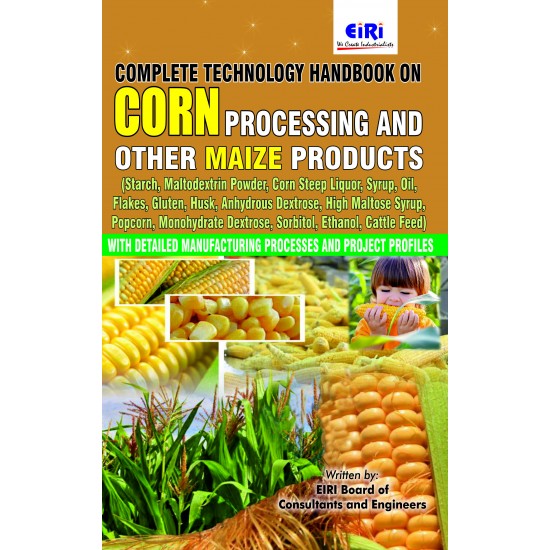
Complete Technology Handbook on Corn Processing and other Maize Products (Starch, Maltodextrin Powder, Husk, Anhydrous Dextrose, High Maltose, Monohydrate Dextrose, Sorbitol, Ethanol) with Detailed Manufacturing Processes and Project Profiles
- More than 45 years of experience
- Managed by expert industrial consultants
- ISO 9001-2015 Certified
- Registered under MSME, UAM No: DL01E0012000
- 24/5 Research Support
Get your quesries resolved from an industry expert. Ask your queries before report or book purchase. - Custom Research Service
Speak to the our consultant to design an exclusive study to serve your research needs. - Quality Assurance
All reports are prepared by highly qualified consultants & verified by a panel of experts. - Information Security
Your personal & confidential information is safe & secure.

ISBN: 9788189765910
Brand: EIRI
Welcome to the "Complete Technology Handbook on Corn Processing and Other Maize Products." This comprehensive guide takes you on a journey through the fascinating world of maize, exploring its taxonomy, origin, and evolution, and delving deep into its diverse applications, from corn starch to ethanol production and cattle feed. This handbook is designed to provide valuable insights into the various aspects of maize and its versatile derivatives, offering a wealth of information for both newcomers and industry professionals.
Maize, or corn, is a staple crop with a rich history that spans generations. In this handbook, you will embark on an educational voyage that unveils its taxonomy, origin, and evolutionary journey. You will gain a deeper understanding of maize, from the early stages of its life cycle – emergence, leaf collars, and silking – to the fascinating botanical features that make it such a unique and adaptable crop.
As you turn the pages, you'll discover the intricate aspects of floral biology, mating systems, and the different types of corn, including Dent Corn, Flint Corn, Sweet Corn, Flour Corn, and more. You'll delve into the complex world of pollination and fertilization, learning how corn seeds are dispersed and their crucial role in nutrition, embryo growth, and the anthesis-silking interval.
This handbook also equips you with practical insights into starting a maize unit. It covers the market potential, selection of milling equipment, and the business licensing process, ensuring you're well-prepared to enter the maize industry. Additionally, it highlights the importance of choosing the right maize seeds, milling equipment, and factory layout for a successful venture.
In this book, you'll explore post-harvest handling, including safe maize storage practices. From using silos to categorizing kernels based on quality and protecting against pests like the maize weevil and moths, this chapter provides essential guidance for preserving your maize harvest. It also delves into the dynamic world of maize market analysis and segmentation, reflecting the ever-evolving nature of this industry. The book takes you into the world of export-oriented units, providing a step-by-step guide for those looking to expand their reach beyond borders. It outlines the process of starting exports, from organization establishment to finding buyers and navigating customs procedures.
The subsequent chapters each focus on specific aspects of maize, ranging from classification and hybrid seed production to processing technologies for products like corn oil, corn starch, corn syrup, dextrose, sorbitol, and more. These chapters offer a deep dive into the processes, applications, and benefits associated with maize and its derivatives.
Each chapter within this handbook is an exploration of a different facet of maize's journey – from the fields to our tables, industries, and beyond. This knowledge is a valuable resource for entrepreneurs, farmers, agricultural enthusiasts, and industry professionals. It empowers you to understand, engage with, and contribute to the maize industry at various levels.
We believe that the information you'll find here will not only expand your knowledge but also ignite your curiosity about the boundless potential of maize. Whether you're interested in improving agricultural practices, developing new maize-based products, or simply gaining a deeper appreciation for this remarkable crop, you'll find inspiration within these pages.
This handbook is a gateway to unlocking the diverse possibilities of maize and the opportunities it presents for agriculture, industry, and innovation. We invite you to journey through these pages with an open mind and a thirst for knowledge. As you explore each chapter, may you uncover the wealth of potential and possibilities that maize holds, not only as a vital crop but as a catalyst for innovation and positive change.
The book covers a wide range of topics connected to Maize Products, as well as their manufacturing processes. It also includes contact information for machinery suppliers, as well as images of equipments. The book contains chapters : Introduction, How to Start Maize Unit?, Outlook and Feature, Export Oriented Unit, Maize Classification, Maize Hybrid Seed Production Technology, Maize Seed Production Technique, Improved Technologies to Produce Higher Maize Production, Corn Oil Production, Corn Starch Technology, Corn Steep Liquor (CSL) Manufacture, Corn Syrup (High Fructose Corn Syrup - HFCS) Technology, Cornick (Corn Nut) Technology, Cornmeal Manufacture Technology, Cornstalk Fiddle Technology, Hominy Corn Production, Popcorn Manufacture, Corn Flakes Manufacturing Technology, Maize Gluten Technology, Corn Silk Manufacture, Corn Husk Production, Anhydrous Dextrose Production, High Maltose Syrup Production, Maltodextrin Powder Manufacture, Monohydrate Dextrose (DMH), Sorbitol 70%, Vitamin C, Ethanol Production Using Corn, Cattle Feed from Corn, Methods of Preparing Compost, Sweet Corn Packaging, Plant Economics of Corn Dry Milling Plant, Plant Economics of Corn Grits, Plant Economics of Grain Based (Maize, Wheat) Ethanol Plant, Plant Economics of Maize/Corn and its By-products like Starch, Corn Oil, Corn Syrup, Dextrose Mono-hydrate, Dextrin, Maltodextrin, Maize Germ, Sorbitol Powder, High Fructose Corn Syrup, Gluten, Animal Feed, Plant Economics of Maize Starch Processing Plant, Plant Economics of Roasted and Non-roasted Corn Flakes Manufacturing Unit, Plant Economics of Sorbitol 70% Manufacturing Unit, Plant Economics of Starch to Sweeteners (Maltodextrin, DE40 Syrup, Maltitol, Dextrose Monohydrate), Plant Economics of Wheat and Corn Milling.
We hope this handbook enriches your understanding of maize and the maize processing industry. May it serve as an essential resource in your exploration of this remarkable and ever-evolving world of maize.
Chapter 1
Introduction
- Taxonomy, Origin and Evolution
- Taxonomy
- Origin and Evolution
- Developmental Stages (Life Cycle)
- VE – Emergence
- V1 – First leaf collar
- V3 – Third leaf collar
- V7 – Seven leaf collar
- V10 – Ten leaf collar
- VT – Tasseling
- R1 – Silking
- R6 – Physiological Maturity
- Botanical features
- Floral Biology
- Mating Systems
- Type of corn
- Dent Corn
- Flint Corn
- Flour Corn
- Sweet Corn
- Popcorn
- Pod Corn
- Waxy corn
- High-amylose corn
- Pollination and Fertilization
- Seed Dispersal
- Corn seed anatomy
- Function
- Protective Features
- Nutrition
- Embryo
- Growth
- Anthesis-Silking Interval
- Flour Corn
- Sweet Corn
- High-amylose corn
Chapter 2
How to Start Maize Unit?
- Market Potential
- Find the Right Location
- Get Custom Business Plan
- Prepare Factory Place and Corresponding Equipment
- Getting Business License and Permits
- Identify Your Suppliers
- Choose the Correct Milling Machine
- Register Your Business
- Market and Launch Your Product
- Determine the Corn Seeds Sources for Flour Mill Production
- Choose the Most Suitable Maize Milling Equipment, Process Design and Best Facotry Layout
Chapter 3
Outlook and Feature
- Post-Harvest Handling and Supply Chain Scenario
- Storing of maize – Best practices for safer and longer maize post harvest storage
- The silo (storing bins) should meet certain specifications
- Place only healthy grains in the silo
- Categorize the kernels based on quality
- Chemical protection
- Regular inspections
- Maize Weevil
- Lesser grain borer
- Moths like Sitotroga cerealella
- Red rust flour beetle
- Demand & Consumption Trends
- Maize Market Analysis
- Maize Industry Segmentation
- Maize Market Trends
- Increase in Demand for Animal-based Protein Sources
- North America to Dominate the Global Maize Market
- Maize Market: Key Drivers, Trends, and Challenges
- Key Maize Market Driver
- Key Maize Market Trend
- Key Maize Market Challenge
- Parent Market Analysis
- Outlook of maize R&D and policy
- R & D outlook
- Government initiatives, policies & measures
Chapter 4
Export Oriented Unit
- Introduction
- Starting Exports
- Establishing an Organisation
- Opening a Bank Account
- Obtaining Permanent Account Number (PAN)
- Obtaining Importer-Exporter Code (IEC) Number
- Registration cum membership certificate
- Selection of product
- Selection of Markets
- Finding Buyers
- Sampling
- Pricing/Costing
- Negotiation with Buyers
- Covering Risks through ECGC
- Processing an Export Order
- Customs House Agents
- Documentation
- Submission of documents to Bank
- Realization of Export Proceeds
Chapter 5
Maize Classification
- Flint Corn (Zea mays indurata)
- Dent Corn (Zea maya indentata)
- Sweet Corn (Zea mays saccharata)
- Flour Corn (Zea mays amylacea)
- Popcorn (Zea mays everta)
- Waxy Corn
- Pod Corn
- High-Lysine Corn
- High-Oil Corn
- Blue Corn
- Ornamental Corn
- Corncob Corns
Chapter 6
Maize Hybrid Seed Production Technology
- What is a maize hybrid?
- Hybrid composition
- Seed classes
- Planning seed production requirements
- Field management of hybrid seed production
- Flow diagram for seed production
- Crop establishment
- Roguing: removal of off-types
- Detasseling
- Male removal
- Inspections of the seed crop
Chapter 7
Maize Seed Production Technique
- Introduction
- Features of Quality Seed
- Importance of Good Quality Seed
- Method of Maize Seed Production
- Technical Aspects for Quality Seed Production
- Basic Knowledge for Maize Cultivation
- Climate and soil condition
- Marketing plan
- Selection of land
- Crop rotation for reducing disease and pest
- Works before Cultivation of Maize
- Selection of variety
- Land Preparation and Sowing
- Field sanitation before cultivation
- Application of FYM (Farm yard manure)
- First ploughing
- Second plowing & sowing of maize
- Sowing
- Methods of sowing seeds
- Best Fertilizer for Maize
- Nitrogen
- Phosphorus
- Potassium
- Compost manure
- Fertilizers for irrigated maize
- Application of FYM or compost
- Application
- Fertilizer for rainfed maize
- Application of fertilizer
- Pre-treatment of seeds with biofertilizer
- For Hybrid Maize fertilizers
- Organic nutrient management
- NPK fertilizer application
- NPK dose of fertilizers
- Method of fertilizer application
- Major Pest & Diseases
- Harvesting of Maize
- Irrigation in Maize Farming
- Weed control/Inter culture operations in Maize Farming
- The yield of Maize or Corn
- Post-Harvest Processing and Storage
- Drying maize properly
- Using Effective Storage Systems
- Major Actions to Be Taken by Seed Production Cooperative
- Land and variety selection
Chapter 8
Improved Technologies to Produce Higher Maize Production
- Crop establishment
- Selection of cultivar
- Sowing time
- Seed rate
- Seed treatment
- Crop geometry
- Method of planting
- Zero tillage
- Ridge/raised bed planting
- Flat sowing
- Transplanting
- Furrow planting
- Water management
- Flood irrigation
- Furrow irrigation
- Above ground drip irrigation
- Sub-surface drip irrigation
- Partial root drying irrigation
- Weed management
- Nutrient management
- Integrated nutrient management
- Fertigation
- Insect and pest management
- Integrated pest management (IPM)
- Biological pest management
Chapter 9
Corn Oil Production
- Characteristic of Corn OIl
- Application
- Health benefits of Corn oil
- Lowers cholesterol
- Healthy heart
- Maintains blood pressure
- Skin health
- Hair health
- Useful for pests
- Traditional uses
- Precautions
- Corn Oil Production Process
- Corn Oil Production Process - Kernels Preparation
- Corn Oil Production Process - Oil Pressing
- Corn Oil Production Process - Solvent Extraction
- Corn Oil Production Process - Oil Refining
- Processing Corn by Wet Milling
- Processing Corn Dry Milling
- Corn Oil Extraction Plant
- Corn oil processing technology
- Corn germ separation
- Dry method corn germ separation
- Wet method corn germ separation
- Half-wet corn germ separation
- Corn oil production process
- Corn germ pre-pressing process
- Corn oil solvent extraction
- Aqueous enzymatic corn oil making
- Corn oil refining
- Machinery & Equipment required to Setup Corn Germ Oil Mill Plant
- Corn Germ Oil Mill Plant Process
- Seed Cleaner
- Oil Expeller/Oil Press
- Filter Press with Pump
- Bucket Elevator
- Screw Conveyor
Chapter 10
Corn Starch Technology
- Origin
- Function
- Composition
- Commercial Production
- Application
- Nutrition
- Chemicals in Cornstarch
- Components of Cornstarch
- Cornstarch and Corn Flour
- Production of Cornstarch
- Uses of Cornstarch
- Corn starch process description
- Corn Cleaning and Steeping
- Milling , Germ separation and drying
- Grit milling and fiber washing
- Starch and gluten separation and starch washing
- Gluten dewatering and drying
- Starch dewatering and drying
- Centrifuge and hydrocyclones
- Starch dewatering
- Starch drying
Chapter 11
Corn Steep Liquor (CSL) Manufacture
- Appearance
- Applications
- Quality Specifications
- Chemical Properties of Corn Steep Liquor
- Uses for Corn Steep Liquor
- Amino Acids and their Function in Plants
- Agricultural Use of Corn Steep Liquor
- People Crack Corn and why we Care
- Organic Corn Steep Liquor:
- Conventional Corn Steep Liquor
- Animal Feed
- Fermentation
- Fertilizers
- Growth Factors of Corn Steep Liquor (CSL) Market
- Chemical composition of corn steep liquor (DM basis)
- Ingredients and chemical composition of the diets (DM basis)
- Chemical composition
- A multifunctional extract from corn steep liquor
- Packaging
- Key Benefits for Industry Participants & Stakeholders
Chapter 12
Corn Syrup (High Fructose Corn Syrup - HFCS) Technology
- Uses
- Commercial Preparation
- Substitutes
- Coconut sugar
- Honey, maple syrup, or agave nectar
- Raw sugars
- Muscovado sugar
- Plain white sugar
- What foods contain high fructose corn syrup?
- What is HFCS?
- Is HFCS safe?
- Foods that contain HFCS
- Where does HFCS come from?
- How much fructose is in HFCS?
- Is HFCS less safe than other sweeteners?
- High fructose corn syrup manufacturing process
- Raw Materials
- The Manufacturing Process
- Separating corn starch from corn
- Converting corn starch into corn syrup
- Converting corn syrup into high fructose corn syrup
- Quality Control
- How to make corn syrup from corn starch?
- The Manufacturing Process
- Separating corn starch from corn
- Converting corn starch into corn syrup
- Converting corn syrup into high fructose corn syrup
- The process of making corn starch syrup
- Starch mixing
- High temperature liquefaction
- High temperature liquefaction
- Decolorization
- Filter process in the process of making corn starch syrup
- Ion exchange
- Three-effect vacuum concentration
Chapter 13
Cornick (Corn Nut) Technology
- Description
- Are Corn Nuts Healthy?
- Fats
- Carbohydrates
- Fiber
- Other Nutrients
- Sodium
- Fitting Corn Nuts into Your Diet
- Corn Nuts Nutrition Facts
- Corn Nuts Nutrition Facts
- Can Corn Nuts be used in Food Preparation?
- Corn Nuts for Snacking Paradise
- Puffed Snack Food Production Line
- Features of Snack Food Processing Machinery
- Main Features of Food Extruder Machine
- Processing Equipment in Snacks Manufacturing Plant
- Puffed Snack Food Production Line Technical Parameters
Chapter 14
Cornmeal Manufacture Technology
- What Is Cornmeal?
- Corn-Based Substitutes
- Varieties of cornmeal
- Cornflour (Or Polenta Flour)
- Corn Grits
- Polenta
- Corn Flakes
- Tortilla Chips
- Masa Harina
- Hominy Grits
- Non-Corn Substitutes
- Semolina
- Ground Oats
- Wheat Flour
- Rice Flour
- Ground Flaxseed
- Cornmeal vs. Polenta vs. Corn Flour vs. Grits
- Polenta
- Grits
- Cornmeal
- Processing
- Cleaning / Pre-cleaning of raw maize
- Conditioning
- Degermination (Optional)
- Milling and sifting
- Fortification (Optional)
- Fine milling (Optional)
- Packaging
- Processing Equipment
- Maize Milling Plant (50~100 Ton/Day)
- Maize Processing Plant
- Precooked Corn Processing Plant
- Corn cleaning and peeling plant
Chapter 15
Cornstalk Fiddle Technology
- Construction
- Corn Stalk Fiber Material and Its Performance
- Materials and Equipment
- Corn Stalk
- Fibers Used for Comparison
- Asphalt
- Aggregate
- Preparation of Corn Stalk Fibers
- Oil Absorption Test
- Corn Stover Pellet Machine
- The main technical parameters
Chapter 16
Hominy Corn Production
- Hominy Corn Uses
- Production
Chapter 17
Popcorn Manufacture
- Popcorn Nutrition Facts
- Carbs
- Fats
- Nutrition Information for Toppings
- Protein
- Vitamins and Minerals
- Calories
- Health Benefits
- Help Balance Weight
- Improve Digestion
- Ward Off Disease
- Prevents Diverticulitis
- Allergies
- Popcorn antioxidants benefits
- Popcorn helps in metabolism and provides energy
- Popcorn helps to reduce depression
- Popcorn supports healthy bone function
- Popcorn controls blood sugar level
- Popcorn combats tumour cells
- Popcorn reduces craving for food
- Popcorn Prevents Aging
- Popcorn Lowers Cholesterol Levels
- Popcorn Controls Anaemia
- Popcorn helps in relieving constipation
- Manage body weight
- Uses of Popcorn
- Component of popcorn
- Popcorn Processing
- Processing of Popcorn
- Cleaning the popcorn
- Popping
- Packaging of Product
- Equipment for Popcorn Processing
- Grain Delivery
- Popcorn Making Machine
- Popcorn Caramelizing Machine
- Electricity Oven
- Popcorn Filling Machine
Chapter 18
Corn Flakes Manufacturing Technology
- Nutritional value of corn flakes
- The Objectives of this Business
- Raw Materials
- Packaging Materials
- Marketing Strategy for Corn Flakes Manufacturing Business
- Business Plan
- Product Specification
- Corn Flakes Manufacturing Process
- Step 1: Grain Cleaning
- Step 2: Corn Grit Section
- Step 3: Corn Flakes Section
- Machinery Equipment for Corn Flakes Manufacturing Business
- Health Benefits of Corn Flakes
- Increases Haemoglobin
- Rich in antioxidants
- Promotes Heart Health
- May Prevent Cancer
- May Aid in Weight Loss
Chapter 19
Maize Gluten Technology
- Features of Corn protein
- Applications of Corn protein supplies
- Specification of Corn gluten
- Functional Advantages
- Poultry Feed
- Cattle Feed
- Herbicide
- Handling and Storage
- Production
- Nutritional Attributes
- Main constituents
- Corn Gluten Feed & Meal Test
- High quality drying systems
- Drying Technology and Systems
- Rotary Drum Dryers for Biomass Products
- Tube Bundle Dryers
- Flash Tube Dryers
- Belt Dryer
- Energy Plants & Technology
- Grate-firing Systems from Büttner
- Steam Generator from Büttner
- Thermal oil heaters
Chapter 20
Corn Silk Manufacture
- Development
- Function
- Pathology
- Benefits of corn silk
- Provides antioxidants
- Has anti-inflammatory properties
- May manage blood sugar
- May lower blood pressure
- May reduce cholesterol
- Provides Vitamin C
- Reduces Blood Sugar
- Reduces Gout
- Treats Bedwetting
- Helps Cope With Kidney Problems
- Boosts Digestion
- Controls Bleeding
- Increases Urine
- Provides Nutrients
- Treats Rashes and Boils
Chapter 21
Corn Husk Production
- Description
- Applications of Corn Husk
- Production of flameretardant composites
- Corn husk in polymer matrix
- Corn husk/polyester composite
- Corn husk/polypropylene composite
- Corn husk/polyethylene composite
- Synthesis of biodegradable plastics and wood plastic composites using corn husk
- Characterization of Corn Husk Agro-Residue Samples Moisture Content
- Corn husk residue samples
- Characterization of corn husk agro-residue samples
- Moisture content
- Density
- Chemical composition
- Scanning electron microscopy (SEM)
- Thermogravimetric analysis
- X-ray diffraction (XRD) analysis
- Tensile properties
- Quality Improvement of Corn Husk as Raw Material for Textile Products
- Classification of Textile Fiber
- Natural fiber
- Synthetic Fibers
- The Characteristic and Tenacity of Fibers
- Methods
Chapter 22
Anhydrous Dextrose Production
- Introduction
- Functional Advantages
- Injectable Glucose
- Bulking Agent and Carrier
- Applications
- Oral Re-Hydrating Agent
- Saline Solution
- Food
- Beverage
- Canning
- Confectionery
- Pharmaceutical
- Fermentation industry
- Chemical Processes
- Handling and Storage
- Uses
- Key Players
- Anhydrous Glucose Production Processes
Chapter 23
High Maltose Syrup Production
- Functional Advantages Crystallising
- Functional Advantages
- Texture Enhancers
- Stabilizer
- Fermentation
- Humectants
- Handling and storage
- High-Maltose Corn Syrup vs. High-Fructose Corn Syrup
- Nutrition Facts
- High maltose corn syrup production
- Operation conditions
- The technology process in the high fructose corn syrup production plant:
- Machine type select:
- High fructose corn syrup products specifications
- Maltose Syrup Processing Machinery
- Step 1: Mixing process
- Step 2: The liquefaction process
- Step 3: The deproteinization process
- Step 4: The saccharification process
- Step 5: The decolorization process
- Step 6: The decarburization process
- Step 7: The Ion exchange process
- Step 8: The evaporation process
- Step 9: Final product storage
- Step 10: Lab
Chapter 24
Maltodextrin Powder Manufacture
- What Is Maltodextrin Made From?
- What Is Maltodextrin Used For?
- Maltodextrin Nutrition
- Take Home Message
- Maltodextrin Properties
Chapter 25
Monohydrate Dextrose (DMH)
- Applications
- Product Details
- Production process
- Uses
- Food Application
- Industrial Applications
- Benefits
Chapter 26
Sorbitol 70%
- Benefits and uses
- Applications & Liquid sorbitol uses
- Functional Advantages
- Humectants
- Emollient
- Sweetner Diet Foods
- Tobacco
- Personal care
- Bio-Fuel
- Processed Foods
- Pharmaceuticals
- Cosmetics
- Toothpaste
- Skin cream and cream foundation
- Emulsion
- Foods
- Diabetic diets
- Handling and Storage
- Sorbitol Production
- Superstructure for the renewable production of xylitol and sorbitol
- Manufacture of sorbitol from maize starch
- Conversion of Maize Starch into liquid glucose
Chapter 27
Vitamin C
- Introduction
- Chemical Structure
- Sources
- Property
- Health Benefits of Vit. C
Chapter 28
Ethanol Production Using Corn
- What is Corn Ethanol?
- Uses
- Manufacturing processes
- Industrial Ethanol Production
- Wet Milling
- Dry Grind
Chapter 29
Cattle Feed from Corn
- Introduction
- Characteristics of corn used as feed for fattening cattle
- Corn contains high energy
- The nutrient composition of corn varies greatly
- Yellow corn contains more lutein
- Diversified shapes of corn feeding cows
- Corn lacks selenium in some areas
- Corn has low saturated fatty acid content
- The best form of corn feeding cattle
- How to make cattle feed from corn maize?
- Complete maize cattle feed manufacturing process
- Whole set corn cattle feed making machines for cattle feed mill plants
- Raw materials for cattle feed making plant
- How to make cattle feed formula?
- Preparation of concentrated feed
- Recommended concentrate formula of common raw materials for beef cattle
- Corn-soybean meal-cotton seed meal type
- Corn-soybean meal-flax cake type
- Corn-soybean meal-sunflower cake type
- Corn-cottonseed mealrapeseed cake type
- Corn-cottonseed meal-flax cake type
- Corn-cottonseed mealsunflower cake type
- Cattle feeding concentrate: How to keep the quality and freshness of corn for a long time?
- Storage characteristics
- Mildew of corn
- Pests of corn
- Storage method
- Storage of corn flour
Chapter 30
Methods of Preparing Compost
- Manure (FYM)
- Introduction Farm Yard
- Properties of Farmyard Manure
- Advantages of Farmyard Manure
- Factors Affecting Nutritional Build up of FYM
- How to make Farmyard Manure
- Methods of preparation of Farmyard Manure (FYM)
- Farmyard manure preparation with Pit method
- Gathering of animals excreta
- Pit digging
- Pit filling
- Number of pits
- Farmyard manure preparation with Trench method
- Farmyard manure preparation with Heap method
- Improved Farmyard manure preparation through sunlight, rain and runoff protection
- Application of Farmyard Manure
- Uses of Farmyard Manure
Chapter 31
Sweet Corn Packaging
- Introduction
- Cereal grains
- Sweet Corn
- Packaging
- Need of packaging
- Types of Packaging
- Selection of Packaging Material
- Packaging Material
- LDPE
- PET
- Polypropylene
- Glass
- Aluminium
- Poly Vinyl Chloride (PVC)
- Some recent trends in packaging
- Modified atmosphere packaging
- Active and Intelligent Packaging
- Aspectic Packaging
- Labelling
- Packaging & Labelling Laws - FSSAI
- General requirement for packaging:
- Information
- Quality Considerations During Packing
- Packaging Machines
Chapter 32
Plant Economics of Corn Dry Milling Plant
- Introduction
- Process overview of corn dry milling
- Tempering
- Degermination
- Aspiration
- Gravity separation
- Roller milling and sifting
- Manufacturing Process
- Cleaning
- Conditioning
- Degermination
- Drying
- Cooling
- Grading
- Milling
- Process flow diagram
- Plant Economics
- Land & Building
- Plant & Machinery
- Fixed Capital
- Working Capital Requirement/Month
- Total Capital Investment
- Turn Over/Annum
Chapter 33
Plant Economics of Corn Grits
- Introduction
- Manufacturing Process
- Technological process of corn grits and flour production line
- Multifunctional Corn Grits and Corn Flour Machine Set Technological Process
- Plant Economics
- Land & Building
- Plant & Machinery
- Fixed Capital
- Working Capital Requirement/Month
- Total Capital Investment
- Turn Over/Annum
Chapter 34
Plant Economics of Grain Based (Maize, Wheat) Ethanol Plant
- Introduction
- Manufacturing process of ethanol from grain
- Liquefaction
- Fermentation
- Distillation
- Distillers Dry Grain & Solubles (Ddgs)
- Technology for Ethanol from Broken Rice or other Grain
- Acid hydrolysis of damaged rice
- Incubation at varying conditions
- Acid hydrolysis at varying temperatures
- Acid hydrolysis at varying physical treatment
- Thermo chemical process in hydrolysis
- Plant Economics
- Plant & Machinery
- Fixed Capital
- Working Capital Requirement/Month
- Raw Materials
- Total Capital Investment
- Turn Over/Annum
Chapter 35
Plant Economics of Maize/Corn and its By-products like Starch, Corn Oil, Corn Syrup, Dextrose Mono-hydrate, Dextrin, Maltodextrin, Maize Germ, Sorbitol Powder, High Fructose Corn Syrup, Gluten, Animal Feed
- Corn Wet Milling
- Various uses of corn
- Process flow diagram of wet corn milling processes
- Manufacturing process of liquid glucose
- Processing details of maize starch
- Manufactures of starch and allied products
- Maize Starch
- Manufacture of corn syrup
- Manufacture of high fructose corn syrup
- Maize Processing Process Sheet
- Manufacturing Process for Liquid Glucose
- Raw Materials
- Manufacture of dextrose monohydrate and dextrose anhydrous
- Dextrose Manufacture
- Manufacturing Diagram of Liquid Glucose
- Plant Economics
- Land & Building
- Plant & Machinery
- Manufacturing diagram of anhydrous dextrose
- Fixed Capital
- Working Capital Requirement/Month
- Total Capital Investment
- Turn Over/Annum
Chapter 36
Plant Economics of Maize Starch Processing Plant
- Consumption Pattern of Maize in India
- Method of Maize Processing
- Dry Milling Process Flow
- Wet Milling Process Flow
- Starch Manufacturing Process Flow Diagram
- Plant Economics
- Land & Building
- Plant & Machinery
- Fixed Capital
- Working Capital Requirement/Month
- Total Capital Investment
- Turn Over/Annum
Chapter 37
Plant Economics of Roasted and Nonroasted Corn F lakes Manufacturing Unit
- Introduction
- Manufacturing Process
- The Process of Corn Flakes
- Plant Economics
- Land & Building
- Plant & Machinery
- Fixed Capital
- Working Capital Requirement/Month
- Total Capital Investment
- Turn Over/Annum
Chapter 38
Plant Economics of Sorbitol 70% Manufacturing Unit
- Introduction
- Manufacturing Process
- Raw Materials
- Process Description
- Maize Storage, Maize Precleaning, Receiving and Weighing
- Maize Steeping
- Sulphur Water Generation
- Coarse Grinding and DeGermination
- Fine Milling, Fibre Washing and Drying
- Starch Separation
- Gluten Dewatering and Drying
- Liquid glucose plant and sorbitol plant
- Manufacture of Sorbitol from Maize Starch
- Conversion of Maize Starch into liquid glucose
- Plant Economics
- Plant & Machinery
- Fixed Capital
- Working Capital Requirement/Month
- Total Capital Investment
- Turn Over/Annum
Chapter 39
Plant Economics of Starch to Sweeteners (Maltodextrin, DE40 Syrup, Maltitol, Dextrose Monohydrate)
- Introduction
- Production method of glucose/corn syrup
- Block Diagram of Sweetener Plant
- Acid-catalyzed Hydrolysis
- Acid–Enzyme Processes
- Corn
- Classes
- Process flow diagram of fructose syrup
- Special grades for corn
- Manufacturing process of sorbitol
- Plant Economics
- Land & Building
- Plant & Machinery
- Fixed Capital
- Working Capital Requirement/Month
- Total Capital Investment
- Turn Over/Annum
Chapter 40
Plant Economics of Wheat and Corn Milling
- Introduction
- Production Process
- Process flow diagram for Maize processing
- Packaging
- Quality Standards
- Manufacturing Process
- Maize slection and blending
- Cleaning
- Conditioning or Tempering
- Milling
- Conveying System
- Patent Flour
How to Make Project Report?
Detailed Project Report (DPR) includes Present Market Position and Expected Future Demand, Technology, Manufacturing Process, Investment Opportunity, Plant Economics and Project Financials. comprehensive analysis from industry covering detailed reporting and evaluates the position of the industry by providing insights to the SWOT analysis of the industry.
Each report include Plant Capacity, requirement of Land & Building, Plant & Machinery, Flow Sheet Diagram, Raw Materials detail with suppliers list, Total Capital Investment along with detailed calculation on Rate of Return, Break-Even Analysis and Profitability Analysis. The report also provides a birds eye view of the global industry with details on projected market size and then progresses to evaluate the industry in detail.
We can prepare detailed project report on any industry as per your requirement.
We can also modify the project capacity and project cost as per your requirement. If you are planning to start a business, contact us today.
Detailed Project Report (DPR) gives you access to decisive data such as:
- Market growth drivers
- Factors limiting market growth
- Current market trends
- Market structure
- Key highlights
Overview of key market forces propelling and restraining market growth:
- Up-to-date analyses of market trends and technological improvements
- Pin-point analyses of market competition dynamics to offer you a competitive edge major competitors
- An array of graphics, BEP analysis of major industry segments
- Detailed analyses of industry trends
- A well-defined technological growth with an impact-analysis
- A clear understanding of the competitive landscape and key product segments
Need Customized Project Report?
- Ask for FREE project related details with our consultant/industry expert.
- Share your specific research requirements for customized project report.
- Request for due diligence and consumer centric studies.
- Still haven't found what you're looking for? Speak to our Custom Research Team
About Engineers India Research Institute:
Note: We can also prepare project report on any subject based on your requirement and country. If you need, we can modify the project capacity and project cost based on your requirement.
Our Clients

Our Approach
- Our research reports comprehensively cover Indian markets (can be modified as per your country), present investigation, standpoint and gauge for a time of five years*.
- The market conjectures are produced on the premise of optional research and are cross-accepted through associations with the business players
- We use dependable wellsprings of data and databases. What's more, data from such sources is handled by us and incorporated into the report
Why buy EIRI reports?
- Our project reports include detailed analysis that help to get industry Present Market Position and Expected Future Demand.
- Offer real analysis driving variables for the business and most recent business sector patterns in the business
- This report comprehends the present status of the business by clarifying a complete SWOT examination and investigation of the interest supply circumstance
- Report gives investigation and top to bottom money related correlation of real players/competitors
- The report gives gauges of key parameters which foresees the business execution