







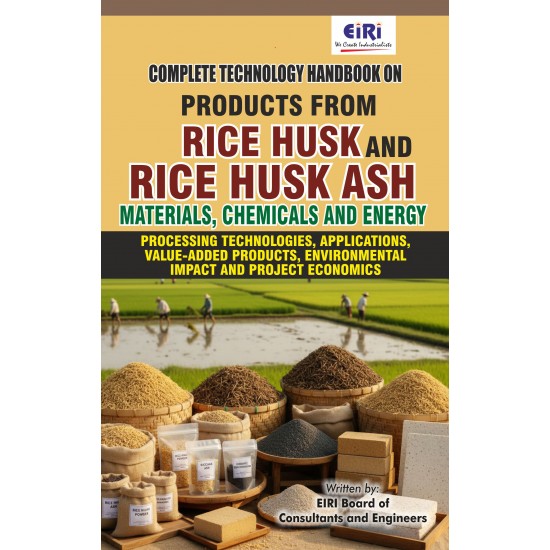
Complete Technology Handbook on Products from Rice Husk and Rice Husk Ash: Materials, Chemicals and Energy (Processing Technologies, Applications, Value-added Products, Environmental Impact and Project Economics)
- More than 45 years of experience
- Managed by expert industrial consultants
- ISO 9001-2015 Certified
- Registered under MSME, UAM No: DL01E0012000
- 24/5 Research Support
Get your quesries resolved from an industry expert. Ask your queries before report or book purchase. - Custom Research Service
Speak to the our consultant to design an exclusive study to serve your research needs. - Quality Assurance
All reports are prepared by highly qualified consultants & verified by a panel of experts. - Information Security
Your personal & confidential information is safe & secure.

Complete Technology Handbook on Products from Rice Husk and Rice Husk Ash: Materials, Chemicals and Energy
(Processing Technologies, Applications, Value-added Products, Environmental Impact and Project Economics)
isbn: 9788193971390
Rice husk, a lignocellulosic by-product generated during paddy milling, represents one of the most abundant agricultural residues in rice-producing countries. Traditionally underutilized or inefficiently disposed of, rice husk has increasingly attracted scientific and industrial attention due to its unique physicochemical composition and high silica content. Controlled thermal treatment of rice husk produces rice husk ash (RHA), a material rich in amorphous silica with significant pozzolanic reactivity and broad applicability in advanced materials research.
This book has been developed with a research-oriented perspective, focusing on the structural, chemical, and thermochemical characteristics of rice husk and its transformation into value-added derivatives. Detailed discussions are presented on biomass composition, pyrolysis kinetics, combustion behavior, phase transformation of silica, crystallinity control, and ash morphology under varying temperature regimes. Analytical techniques including X-ray diffraction (XRD), scanning electron microscopy (SEM), thermogravimetric analysis (TGA), Fourier transform infrared spectroscopy (FTIR), and surface area characterization are explored to understand material properties and performance parameters.
The publication further examines the role of RHA in cementitious systems, geopolymer technology, nano-silica extraction, adsorbent development, refractory formulations, and polymer reinforcement. Emphasis is placed on structure-property relationships, reactivity mechanisms, and performance optimization under laboratory and pilot-scale conditions. Environmental implications, carbon sequestration potential, life-cycle assessment considerations, and sustainable resource utilization models are also addressed within the broader framework of circular bioeconomy research.
Intended for researchers, material scientists, chemical engineers, environmental technologists, and postgraduate scholars, this book seeks to consolidate current knowledge while encouraging further investigation into high-value applications of rice husk and rice husk ash. It is hoped that this work will stimulate interdisciplinary research and contribute meaningfully to sustainable material innovation and biomass valorization.
Rice husk (RH) has now become a source for a number of silicon compounds, including silicon carbide, silica, silicon nitride, silicon tetrachloride, zeolite, and pure silicon. The applications of such materials derived from rice husks are very comprehensive. The methods of synthesizing these silicon-based materials from RHs and their applications are reviewed in this book.
Part I: Rice Husk: Fundamentals & Characterization -Introduction to Rice Husk and Rice Husk Ash, Rice Husk - Forms, Properties & Composition, Processing, Utilization and Handling of Rice Husk, Part II: Rice Husk Ash (RHA): Properties & Applications - Rice Husk Ash - Properties and Characterization, Industrial Applications of Rice Husk Ash, Part III: Silica & Silicon Products from Rice Husk - Precipitated Silica from Rice Husk Ash, Advanced Silica and Silicon Products, Part IV: Activated Carbon and Biochar - Activated Carbon from Rice Husk, Biochar from Rice Husk, Part V: Energy & Fuels from Rice Husk - Electricity Generation from Rice Husk, ethanol and Biofuels from Rice Husk, Part VI: Building Materials and Boards - Cement, Lime and Gypsum Products from RHA, Hardboard and Particle Board from Rice Husk, Rice Husk Bricks, Blocks and Panels, Part VII: Agricultural, Paper & Packaging Products - Paper and Pulp from Rice Husk and Rice Straw, Packaging Materials from Rice Husk-based Products, Part VIII: Chemicals from Rice Husk - Oxalic Acid from Rice Husk, Part IX: Business, Economics & Policy - Market Potential & Global Demand Analysis, Techno-Economic Feasibility and Project Costing, Plant Design, Layout and Utilities, Plant Economics of Rice Husk/Wooden Waste to Briquette, Plant Economics of Silica Recovery from Rice Husk Ash (Production Rate - 30000 Tpa), Plant Economics of Sili-con from Rice Husk (Production Rate - 30 TPD), Plant Economics of Sodium Silicate from Rice Husk Ash [Dry Basis], Plant Economics of Ultra Pure Silicon from Rice Husk, and Plant Economics of Water Bottle Plant with Packaging from Bio- Degradable Material made from Sugar-cane Baggase/Rice Husk etc.
PART I: RICE HUSK: FUNDAMENTALS & CHARACTERIZATION
Chapter-1 .
INTRODUCTION TO RICE HUSK AND RICE HUSK ASH
- Introduction
- Rice husk ash
- Importance of rice husk as an industrial raw material
- Application of rice husk
- As source of fuel
- Industrial Applications
- Importance & Benefits
- Global and Indian availability overview
- Global Availability Overview
- Indian Availability Overview
- Total Rice Husk Generation in India
- Global Rice Husk Market Overview
- Global Rice Husk Market Segmentation
- Global Rice Husk Market Analysis
- Global Rice Husk Market Growth Drivers
- Global Rice Husk Market Challenges
- Global Rice Husk Market Future Market Outlook
- Global Rice Husk Market Future Market Trends:
- Sustainability and circular economy perspective
Chapter-2
RICE HUSK - FORMS, PRO-PERTIES & COMPOSITION
- Forms & Applications
- Properties
- Composition
- Rice husk (loose form)
- Rice husk briquettes
- Rice husk pellets
- Rice husk ash
- General Specifications of Rice Husk Pellets
- Broad Application for Rice Husk Pellets
- Carbonized rice husk
- Characteristics of the rice husk
- Proximate analysis
- Typical Proximate Analysis (% by weight)
- Components & Characteristics
- Significance
- Ultimate analysis
- Organic and inorganic composition
- Organic Composition (approx. 70-80%)
- Inorganic Composition (approx. 15-25%)
- Elemental Composition (by weight)
- Physical and rheological properties of rice husk
- Physical Properties
- Rheological Properties (Behavior in Slurries/Composites)
- Impact of Treatment (e.g., Composting)
Chapter-3
PROCESSING, UTILIZATION AND HANDLING OF RICE HUSK
- Common Processing Methods
- Main Steps & Techniques
- End Products & Applications
- Utilization of the rice husk
- Options for the use of rice husk
- Energy & Fuel
- Construction & Materials
- Agriculture & Horticulture
- Other Value-Added Products
- Composting process of rice husk
- Key Steps
- Tips
- Advantages of compost:
- Limitations of compost:
- Temperature variation during composting
- Temperature Phases & Variations
- Factors Influencing Temperature
- Stress–strain behavior of rice husk
- Key Stress-Strain Characteristics
- Behavior in Different Matrices
- Factors Influencing Behavior
- Application of husk as supplemental construc-tion material
- Hardening properties
- Tensile strength
- Workability
- Durability
- Water absorption
- Flexural strength
- Main Applications & Benefits
- How it Works
- Storage and handling practices
- Main Storage Principles
- Storage Methods
- Considerations
- Fully Open Storage with boundary walls
- Open Storage without separating fines
- Open Storage with fines partially separated by cyclone
- Common open storage of husk and rice bran fines
- Partially covered storage using fencing
- Covered storages
- Handling of Rice Husk
- From de-husker machine to storage
- Using blowers
- Using Conveyor-belt system & Cyclones for dust extraction
- Handling during loading for transportation and selling
- Handling of rice husk fired boiler ash
- Health and safety considerations
- Health and Safety Considerations
- Safe Handling Practices
PART II: RICE HUSK ASH (RHA): PROPERTIES & APPLICATIONS
Chapter-4
RICE HUSK ASH - PROPERTIES AND CHARACTERIZATION
- Physical properties
- Chemical Composition of Rice Husk Ash
- Index properties of clay and RHA
- Rice Husk Ash - Properties and Characterization
- Microstructure and reactivity of rice husk ash
- Microstructure
- Reactivity (Pozzolanic Activity)
Chapter-5
INDUSTRIAL APPLICATIONS OF RICE HUSK ASH
- Cement & Concrete Industry
- Fiber Cement Industry
- Manufacturing refractory Bricks
- Lightweight construction materials
- Silicon Chips in Semiconductor devices manufacture
- Fertilizer Application
- Refractory bricks
- Key Benefits
- How it Works
- Applications
- Vulcanized rubber
- How it Works
- Key Findings & Effects
- Water purification
- How it Works (Mechanisms)
- Applications & Methods
- Benefits
- Flue gas desulphurization
- How it Works
- Benefits
- Preparation Variables (Key Factors)
- Applications
- Ceramics and RH silica applications
- Ceramic Applications
- RHA Silica (Extracted/Derived) Applications
- Benefits
PART III: SILICA & SILICON PRODUCTS FROM
RICE HUSK
Chapter-6
PRECIPITATED SILICA FROM RICE HUSK ASH
- Manufacturing Process
- Process Flow Diagram
- Precipitation
- Digestion
- Typical Properties
- Physico-Chemical Characteristics of Precipitated Silica
- Uses & Applications
- Uses of Precipitated silica in products
- Rubber Grade Specification
- Non Rubber Grade
- Pesticide Grade
- Paint Grade
- Toothpaste Grade
- Micronised Silica
- Other Suggestive Applications
- Adhesive
- Footwear
- Conveyor Belt and Transmission Belt
- PVC Sheets
- Railway Pads
- Rice Rollers and Rubber Rollers
- Rubber Products and Rubber Hoses
- Silicon Tubes
- Rubber and Solid Tyres
- Textile Cots And Aprons
- Non Rubber Grade Silica Applications
- Pesticides
- Printing Ink
- Tooth Paste and Tooth Powder
- Salt
- Coatings
- Fire Extinguishing Powders
- Precipitation
Chapter-7
ADVANCED SILICA AND SILICON PRODUCTS
- Advanced silica from Rice Husk Ash (RHA)
- Methods
- Silicon Products
- Key Silicon Products from RHA
- Processing Methods
- Nano-silica from rice husk ash
- Methods
- Key Steps in Synthesis
- Characteristics & Benefits
- Thermal treatment
- Extraction of silica
- Preparation of nanosilica
- Acidity measurement
- Lime reactivity
- Morphology of nanosilica
- Silica aerogels
- Process Steps
- Properties & Applications
- Silicon-based polymers
- Processes and materials
- Applications
- Silicon wafer production
- Main Steps in the Process
- Emerging applications in electronics and energy
- Electronics Applications
- Type of Gasifier
- System of Rice Husk Gasifier Structure
- Energy Applications
- Rice husk processing plant technical proposal
- PART IV: ACTIVATED CARBON AND BIOCHAR
Chapter-8
ACTIVATED CARBON FROM RICE HUSK
- Introduction
- Preparation methods
- Common Preparation Methods
- Key Steps & Considerations
- Activation process of Rice Husk Carbon
- Forms of activated carbon
- Activation Methods (Determines Form & Properties)
- Key Features of Rice Husk AC
- Specifications of activated carbon
- Factors Influencing Specs
- Common Characterization Techniques
- Applications of activated carbon
- Environmental & Water Treatment
- Energy & Electronics
- Industrial & Chemical
- Advantages of Rice Husk AC
- Technology benefits of activated carbon
- Benefits
- Specific Applications
Chapter-9
BIOCHAR FROM RICE HUSK
- Pyrolysis and carbonization technologies
- Conventional Carbonization (Pyrolysis)
- Hydrothermal Carbonization (HTC)
- Advanced & Activated Technologies
- Key Factors Influencing Biochar Properties
- Agricultural applications
- Rice Husk Biochar as an Adsorbent
- Adsorption of Heavy Metals in Water
- Adsorption of Organic Matter in Water
- Rice Husk Biochar as a Soil Conditioner
- Effect on Soil pH
- Effect on Soil Cation Exchange
- Effect on Soil Microorganisms
- Effect on Heavy Metals in Soil
- Effect on Organic Pollutants in Soil
- Effect on Plant Growth
- Key Agricultural Applications
- How it Works (Mechanism)
- Carbon sequestration potential
- Benefits & Potential
- Factors Influencing Potential
- Practical Impact
- Comparison with activated carbon
- Rice Husk Biochar (RHB)
- Activated Carbon (AC) (Often from Rice Husk)
- Rice Husk Biochar (RHB) vs. Activated Carbon (AC)
- Production & Cost
- Properties
- Performance & Applications
- Key Comparison
PART V: ENERGY & FUELS FROM RICE HUSK
Chapter-10
ELECTRICITY GENERATION FROM RICE HUSK
- Introduction
- Biomass energy routes
- Procedure of Electricity Generation from Rice Husk
- Thermochemical Routes
- Biotechnological Routes
- Products & Applications
- Key Considerations
- Gasification technologies
- Key Technologies & Processes
- Common Reactor Implementations
- Challenges & Solutions
- Power/electricity generation systems
- Energy Conversion Technologies
- System Types & Applications
- Key Benefits
- Examples & Innovations
- Challenges
- Co-generation
- Benefits
- Applications
- Social impact
- Implementation Examples
Chapter-11
ETHANOL AND BIOFUELS FROM RICE HUSK
- Introduction
- Main Steps in the Process
- Uses of Ethanol
- Window Cleaner and Glass Cleaner
- Removes Grease and Stains
- Used as an Anti-Bacterial Cleaner
- Heating
- Sanding
- Pest Control
- Remove Mould
- Remove Sticky Residue
- Saccharification and Fermentation (SSF)
- Filtration and Distillation Process Filtration and Distillation Process
- Analytical Methods
- Dinitrosalicylic acid Test
- Cellulosic EthanolCellulosic Ethanol
- Cellulosic Ethanol Process
- Steps in Production
- Advantages of Using Rice Husk
- Challenges & Research Focus
- Potential Yields
- Ethanol purification
- Fermentation by-products
- Purification techniques
- Distillation
- Adsorption
- Ethanol grades and uses
- Grades of Rice Husk Ethanol
- Uses of Rice Husk Ethanol
PART VI: BUILDING MATERIALS AND BOARDS
Chapter-12
CEMENT, LIME AND GYPSUM PRODUCTS FROM RHA
- Types of Cement Products Using RHA
- Manufacturing Process
- Cement Raw Materials
- Cement Manufacturing Process
- Non-Hydraulic Cement
- Hydraulic Cement
- Mixing
- Burning
- Upper Part
- Central Part
- Lower Part
- Grinding
- Storage
- Lime Production
- Collection of Lime Stones
- Calcination of Lime Stones
- The burning of lime stones
- Clamps
- Production of Gypsum Products
- Microstructure of ground RHA
- Microstructural Features
- Impact on Cementitious Materials:
- Effect of Grinding
Chapter-13
HARDBOARD AND PARTICLE BOARD FROM RICE HUSK
- Particle board manufacturing
- Raw Material Requirement
- Manufacturing Process
- Flow Chart of Manufacturing Process
- Hardboard manufacturing process
- Manufacturing Steps
- Main Features & Uses
- Adhesives and bonding agents
- Formaldehyde condensation resins
- Aminoplastic resins
- Melamine-formaldehyde resins
- Phenolic formaldehyde resins
- Adhesive PreparationAdhesive Preparation
- Methods for preparing the surface before gluing
- Adhesives – classification, raw materials and production
- Cyanoacrylate adhesives
- Acrylic adhesives
- Polyurethane adhesives
- Silicone adhesives
- Epoxy adhesives
- Testing of particle board
- Water Apsorptivity Test
Chapter-14
.RICE HUSK BRICKS, BLOCKS AND PANELS
- Product Types
- Hollow blocks from rice husk ash
- Benefits
- Manufacturing (General Process)
- Testing details
- Compressive strength test:
- Water absorption test:
- Mix design and strength analysis
- Mix Design Principles
- Strength Analysis (Key Findings)
- Water Absorption
- Quality of Bricks Using RHA
- Applications in low-cost housing
- Benefits for Affordability & Sustainability
- How It’s Used
- Low cost building blocks
- Refractory Bricks
- Lightweight Construction Materials
- Insulating Material
- Soil Improvement
- Steel Industry
PART VII: AGRICULTURAL, PAPER & PACKAGING PRODUCTS
Chapter-15
PAPER AND PULP FROM RICE HUSK AND RICE STRAW
- Pulping processes
- General Process Steps
- Paper types and applications
- Applications
- Waste Paper Pulping
- Repulping
- Vertical HC paper pulper
- Vertical LC paper pulper
- Drum pulper
Chapter-16
PACKAGING MATERIALS FROM RICE HUSK-BASED PRODUCTS
- Types of packaging materials
- Types of Rice Husk Packaging Materials
- Wood
- Metals (steel, tin, aluminum)
- Glass
- Wood, cardboard and papers
- Industrial packaging
- Flexible Industrial Packaging - Paper and Plastic
- Rigid Industrial Packaging - Wooden, Metal, Plastic
- Main Types & Applications
- Manufacturing Process (General)
- Advantages
- Labelling requirements
- Rice Husk as Food Packaging Material
- Rice Husk as an Ingredient in Animal Feed
- Rice Husk as a Raw Industrial Material (e.g., for Particle Board, Silica)
PART VIII: CHEMICALS FROM RICE HUSK
Chapter-17
OXALIC ACID FROM RICE HUSK
- Properties
- Oxalic acid PropertiesOxalic acid Properties
- Manufacturing processes
- Key Manufacturing Steps (Nitric Acid Oxidation Method)
- Key Parameters & Considera-tions
- Alternative/Emerging Methods
- Safety and storage
- Safety Precautions
- Storage Requirements
- Uses
- How it Works (Modification Process)
PART IX: BUSINESS, ECONOMICS & POLICY
Chapter-18
MARKET POTENTIAL & GLOBAL DEMAND ANALYSIS
- Indian and global market overview
- Rice Husk Products: Current Market Overview and Future Prospects
- Rice Husk Products: Current Market Overview and Future Prospects
- Global Rice Husk Ash Market Dynamics
- Global Rice Husk Ash Market Ecosystem Analysis
- MIDDLE EAST & AFRICA region holds the largest share of the Rice Husk Ash Market
- Global Rice Husk Market Analysis
- Global Rice Husk Market Growth Drivers:
- Key Market Players
- Price trends
- Key Price Trend Drivers
- Price Variations & Factors
- Market Growth Projections (RHA Focus)
- Global Rice Husk Market Segmentation
- Export opportunities
- Key Export Opportunities
- Market Trends & Drivers
- Leading Players & Destinations
Chapter-19
TECHNO-ECONOMIC FEASI-BILITY AND PROJECT COSTING
- Capital investment
- Main Cost Components
- Cost Breakdowns (Indicative) Example
- Key Considerations for Cost Management
- Operating cost analysis
- Main Operating Cost Components
- Project Examples & Findings
- Operating Cost Categories
- Factors Influencing Operating Costs
- Break-even and ROI
- Factors Influencing ROI and Break-Even
- Example Metrics from Research and Industry
- Next Steps for a Prospective Entrepreneur
Chapter-20
PLANT DESIGN, LAYOUT AND UTILITIES
- Plant layout planning
- Rice Husk Biochar Plant: A Step-by-Step Guide
- Understanding the Basics of Rice Husk Biochar
- Choosing the Right Equipment
- Setting Up the Plant Layout
- Raw Material Sourcing: Rice Husk Procurement
- Setting Up the Pyrolysis Process
- Environmental Considerations and Compliance
- Utility System Technologies
- Starting Your Rice Husk Project (Steps)
- Optimal Design Goal
- Essential Equipment and Machinery
- Optimal Placement of Equipment
- Safety Measures to Keep in Mind while Designing the Layout
- Material flow and storage
- Material Flow Process
- Storage Considerations
- Material Handling Systems
- Material flow and storage
- Storage Requirements
- Rice Husk Ash (RHA)
- Material Flow
- Storage Requirements
- Utility Requirements
- Layout and Design Considerations
- Specific Plant Utility Requirements
- Rice Milling Plant
- Rice Husk Power (Cogeneration) Plant
Chapter-21
PHOTOGRAPHS OF PLANT AND MACHINERY WITH SUPPLIERS CONTACT DETAILS
- Biomass Pellet Making Machines
Chapter-22
ENVIRONMENTAL IMPACT AND CARBON CREDITS
- Environmental Impacts of Rice Husk
- Carbon Credits from Rice Husk Applications
- How it Works (Simplified)
- Life cycle assessment
- Key Findings from Rice Husk LCAs
- Main Environmental Impacts
- Carbon footprint reduction
- What is Carbon Footprint?
- Rice husks – a biomass solution for a lower carbon footprint
- Key highlights of rice husks
- Applications of rice husk in carbon emission mitigation
- Environmental Impacts & Carbon Reduction
- Key Processes for Carbon Reduction
- Negative Impacts (If Unmanaged)
- Carbon credit potential
- Aspects of Carbon Credit Potential
- Factors Influencing Potential & Value
- How Rice Husk Generates Carbon Credits
- Market & Potential
Chapter-23
GOVERNMENT POLICIES, SUBSIDIES AND INCENTIVES
- Why Choose this Sector for your Startup
- Central Government Schemes
- State-Level Incentives (Vary by State)
- Types of Rice Husk Projects Eligible
- How to Access
- Renewable energy incentives
- Solar Energy Focused
- Manufacturing & Technology
- Other Renewable Sources
- Infrastructure & Integration
- Pollution control regulations
- Regulatory Bodies
- Key Regulatory Mechanisms
PART X: QUALITY, SAFETY & FUTURE TRENDS
Chapter-24
QUALITY CONTROL, TESTING AND STANDARDS
- Rice husk ash (RHA) characterisation details
- Rice husk ash characterisation
- BIS / ASTM / ISO standards
- ASTM Standards
- BIS Standards
- ISO Standards
- Testing procedures
- Key Testing Procedures
Chapter-25
SAFETY, HEALTH AND RISK MANAGEMENT
- Risk Management
- The Importance of Good Risk Management
- Reasons Risk Management is Important
- Risk Management Steps (HIRARC)
- Control Measures
- Management Focus
- Dust explosion hazards
- Understanding Dust Explosion Hazards
- Sources
- Factors in Rice Husk Dust Explosions:
- Case Studies Highlighting Dust Explosion Hazards
- Emission Management
- Aspiration Equipment
- Controls to Prevent Dust Explosions
- Fire and occupational safety
- Fire
- Explosion
- Electrocution
- First aid measures
- Fire Fighting Measures
- Need of establishing a fire fighting group
- Inspection
- Procedure for extinguishing fire
- Fire-fighting with water
- Sources of water for fire fighting
- Fire-fighting with fire extinguishers
- Fire Safety Requirements
- Fire Escapes or External Stairs:
- Spiral Stairs
- Staircase Enclosures
- Ramps
- Occupational safety
- Purpose of occupational safety
- Factors & Hazards in Factories
- Core Elements of a Safety Program
- Essential Practices
- Legal Framework (India Example)
Chapter-26
CASE STUDIES AND COMMER-CIAL SUCCESS STORIES
- Indowood Polymers (Indo NFC)
- NFC Decking: A Sustainable Solution for Outdoor Spaces
- Flutes: Adding Depth and Character to Interiors and Exteriors
- NFC Jalli: Redefining Elegance and Functionality in Design
- Transforming Outdoor Spaces with NFC Innovations
- KRBL Limited (Khushi Ram Behari Lal Limited)
- History & Scale
- Market Position
- Usher Agro Ltd.
- International examples
- Solvay Chimica Italia
- Yihai Kerry Investments (China)
Chapter-27
FUTURE TRENDS AND RE-SEARCH DIRECTIONS
- Advanced material applications
- Future perspective
- Energy storage and green technologies
- Applications in Green Technology & Energy Storage:
- Environmental and Economic Impact
- Challenges and Solutions
Chapter-28
PLANT ECONOMICS OF RICE HUSK/WOODEN WASTE TO BRIQUETTE
- Plant Economics
- Land & Building
- Plant & Machinery
- Fixed Capital
- Working Capital Requirement/Month
- Total Capital Investment
- Turn Over/Annum
Chapter-29
PLANT ECONOMICS OF SILICA RECOVERY FROM RICE HUSK ASH (PRODUCTION RATE - 30000 TPA)
- Plant Economics
- Land & Building
- Plant & Machinery
- Fixed Capital
- Working Capital Requirement/Month
- Total Capital Investment
- Turn Over/Annum
Chapter-30
PLANT ECONOMICS OF SILI-CON FROM RICE HUSK
(PRODUCTION RATE - 30 TPD)
- Plant Economics
- Land & Building
- Plant & Machinery
- Fixed Capital
- Working Capital Requirement/Month
- Total Capital Investment
- Turn Over/Annum
Chapter-31
PLANT ECONOMICS OF SODIUM SILICATE FROM RICE HUSK ASH [DRY BASIS]
- Plant Economics
- Land & Building
- Plant & Machinery
- Fixed Capital
- Working Capital Requirement/Month
- Total Capital Investment
- Turn Over/Annum
Chapter-32
PLANT ECONOMICS OF ULTRA PURE SILICON FROM RICE HUSK
- Plant Economics
- Land & Building
- Plant & Machinery
- Fixed Capital
- Working Capital Requirement/Month
- Total Capital Investment
- Turn Over/Annum
Chapter-33
PLANT ECONOMICS OF WATER BOTTLE PLANT WITH PACKAGING FROM BIO-DEGRADABLE MATERIAL MADE FROM SUGAR-CANE BAGGASE/RICE HUSK ETC.
- Plant Economics
- Land & Building
- Plant & Machinery
- Fixed Capital
- Working Capital Requirement/Month
- Total Capital Investment
- Turn Over/Annum
How to Make Project Report?
Detailed Project Report (DPR) includes Present Market Position and Expected Future Demand, Technology, Manufacturing Process, Investment Opportunity, Plant Economics and Project Financials. comprehensive analysis from industry covering detailed reporting and evaluates the position of the industry by providing insights to the SWOT analysis of the industry.
Each report include Plant Capacity, requirement of Land & Building, Plant & Machinery, Flow Sheet Diagram, Raw Materials detail with suppliers list, Total Capital Investment along with detailed calculation on Rate of Return, Break-Even Analysis and Profitability Analysis. The report also provides a birds eye view of the global industry with details on projected market size and then progresses to evaluate the industry in detail.
We can prepare detailed project report on any industry as per your requirement.
We can also modify the project capacity and project cost as per your requirement. If you are planning to start a business, contact us today.
Detailed Project Report (DPR) gives you access to decisive data such as:
- Market growth drivers
- Factors limiting market growth
- Current market trends
- Market structure
- Key highlights
Overview of key market forces propelling and restraining market growth:
- Up-to-date analyses of market trends and technological improvements
- Pin-point analyses of market competition dynamics to offer you a competitive edge major competitors
- An array of graphics, BEP analysis of major industry segments
- Detailed analyses of industry trends
- A well-defined technological growth with an impact-analysis
- A clear understanding of the competitive landscape and key product segments
Need Customized Project Report?
- Ask for FREE project related details with our consultant/industry expert.
- Share your specific research requirements for customized project report.
- Request for due diligence and consumer centric studies.
- Still haven't found what you're looking for? Speak to our Custom Research Team
About Engineers India Research Institute:
Note: We can also prepare project report on any subject based on your requirement and country. If you need, we can modify the project capacity and project cost based on your requirement.
Our Clients

Our Approach
- Our research reports comprehensively cover Indian markets (can be modified as per your country), present investigation, standpoint and gauge for a time of five years*.
- The market conjectures are produced on the premise of optional research and are cross-accepted through associations with the business players
- We use dependable wellsprings of data and databases. What's more, data from such sources is handled by us and incorporated into the report
Why buy EIRI reports?
- Our project reports include detailed analysis that help to get industry Present Market Position and Expected Future Demand.
- Offer real analysis driving variables for the business and most recent business sector patterns in the business
- This report comprehends the present status of the business by clarifying a complete SWOT examination and investigation of the interest supply circumstance
- Report gives investigation and top to bottom money related correlation of real players/competitors
- The report gives gauges of key parameters which foresees the business execution












-250x250h.jpg "hand book of spices and packaging with formulaes")