
Bamboo Pellet Manufacturing from Bamboo Waste: A Sustainable Business Opportunity for Entrepreneurs









The global shift toward clean and renewable energy has opened new avenues for manufacturing-based businesses, especially in the biomass energy sector. Among various biomass fuels, bamboo pellets have emerged as a promising alternative due to their high energy efficiency, abundant availability, and eco-friendly nature. For entrepreneurs looking to enter the manufacturing space, bamboo pellet production offers a compelling combination of sustainability, scalability, and profitability.
Bamboo is one of the fastest-growing plants in the world and is widely available across many regions. In India, bamboo processing industries generate significant quantities of waste in the form of dust, chips, shavings, and offcuts. Traditionally, this waste has been underutilized or disposed of inefficiently. However, with the right technology and process, this biomass can be converted into high-density fuel pellets that serve as a substitute for coal and firewood.
This article provides a comprehensive understanding of bamboo pellet manufacturing from bamboo waste, focusing on the technical, economic, and market aspects relevant to entrepreneurs planning to start a new manufacturing business.
Understanding Bamboo Waste as a Resource
Bamboo waste is generated at multiple stages of processing, especially in industries involved in furniture manufacturing, handicrafts, flooring, paper production, and construction materials. The most common forms of bamboo waste include fine dust, small chips, shavings, and irregular offcuts. In addition, bamboo leaves and smaller branches from plantations also contribute to the biomass pool.
One of the key advantages of bamboo waste is its consistent availability in regions where bamboo cultivation and processing are well established. Instead of treating this waste as a disposal problem, it can be viewed as a valuable raw material for energy production. The energy content of bamboo is relatively high compared to many agricultural residues, making it suitable for pelletization.
Bamboo is one of the fastest-growing renewable resources, making it highly suitable for biomass fuel production.
- High calorific value compared to many residues
- Abundant availability in many regions
- Generates significant processing waste
- Ideal for continuous industrial supply
Improper disposal of bamboo waste can lead to environmental concerns such as air pollution from open burning and land degradation. Converting this waste into pellets not only addresses these issues but also creates a revenue-generating opportunity. For entrepreneurs, securing a reliable supply of bamboo waste from nearby processing units can significantly reduce raw material costs and ensure steady production.
Bamboo waste is generated from multiple industries and can be efficiently converted into pellets.
- Bamboo dust and powder
- Chips and shavings
- Furniture and handicraft offcuts
- Leaves and small branches
What Are Bamboo Pellets
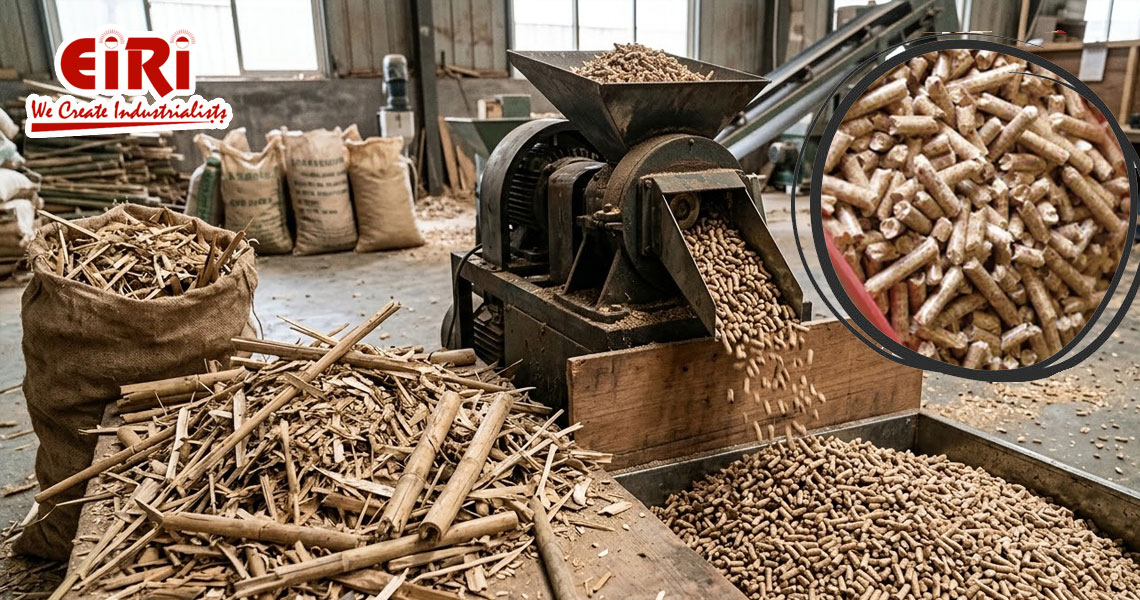
Bamboo pellets are small, cylindrical, compressed units made from finely processed bamboo biomass. These pellets are typically uniform in size, which makes them easy to handle, transport, and store. The production process involves compressing the bamboo material under high pressure, which activates natural binding properties present in the biomass.
The density of bamboo pellets is much higher than raw bamboo waste, which enhances their energy efficiency. They have a relatively low moisture content, usually maintained within a controlled range to ensure optimal combustion. As a result, bamboo pellets burn more efficiently and produce less smoke compared to traditional fuels like firewood.
In terms of energy output, bamboo pellets offer a competitive calorific value, often comparable to other biomass pellets and significantly better than unprocessed agricultural waste. This makes them suitable for a wide range of applications, including industrial boilers, thermal power plants, and heating systems in commercial establishments.
The uniformity and consistency of pellets allow for automated feeding systems in industrial applications, improving operational efficiency. This characteristic makes bamboo pellets an attractive fuel option for industries seeking to transition away from fossil fuels.
Advantages of Bamboo Pellets
Bamboo pellets offer several advantages that make them a preferred choice in the biomass energy market. One of the most significant benefits is their environmental friendliness. As a renewable energy source, bamboo pellets contribute to reducing carbon emissions. The carbon dioxide released during combustion is largely offset by the carbon absorbed by bamboo during its growth cycle, making it a relatively carbon-neutral fuel.
From an economic perspective, bamboo pellets provide a cost-effective alternative to conventional fuels. Industries that switch to biomass pellets often experience reduced fuel expenses, especially in regions where bamboo waste is readily available. For manufacturers, the use of low-cost raw materials enhances profit margins while maintaining competitive pricing in the market.
Operationally, bamboo pellets are easy to handle and store due to their uniform shape and size. They occupy less space compared to loose biomass and have a longer shelf life when stored properly. Their consistent quality ensures stable combustion, which is crucial for industrial applications that require controlled heat output.
Another important advantage is the reduction in ash content compared to some other biomass fuels. Lower ash generation simplifies maintenance and reduces downtime in industrial equipment. Additionally, bamboo pellets produce fewer pollutants, contributing to cleaner air and compliance with environmental regulations.
Raw Materials and Their Preparation
The primary raw material for bamboo pellet manufacturing is bamboo waste in various forms. However, not all waste can be directly used for pellet production without proper preparation. The quality of raw material plays a crucial role in determining the efficiency of the pelletization process and the quality of the final product.
The first step in raw material preparation involves collection and sorting. Bamboo waste should be free from contaminants such as stones, metals, and plastic materials, as these can damage machinery and affect pellet quality. Once sorted, the material is subjected to drying to reduce its moisture content to an optimal level. Excess moisture can hinder the pelletization process and result in weak or brittle pellets.
Drying can be achieved through natural methods such as sun drying or through mechanical systems depending on the scale of operation. After drying, the material undergoes size reduction to achieve a uniform particle size. This step is essential for ensuring smooth operation of the pellet mill and producing dense, high-quality pellets.
Proper storage of prepared raw material is also important. It should be protected from moisture and environmental exposure to maintain consistent quality. Entrepreneurs should focus on establishing an efficient raw material supply chain and storage system to ensure uninterrupted production.
Bamboo Pellet Manufacturing Process
The manufacturing of bamboo pellets involves a series of well-defined steps that transform raw bamboo waste into a high-density fuel product. Each stage of the process plays a critical role in ensuring the quality and performance of the final pellets.
- The process begins with the collection and transportation of bamboo waste from various sources. Efficient logistics are essential to minimize costs and ensure timely availability of raw materials. Once the material reaches the production facility, it is subjected to drying to achieve the desired moisture content.
- After drying, the bamboo waste is processed through size reduction equipment to produce fine particles. This step ensures uniformity and enhances the efficiency of the pelletization process. The prepared material is then fed into a pellet mill, where it is compressed under high pressure.
- During pelletization, the natural lignin present in bamboo acts as a binding agent, eliminating the need for external additives. The combination of pressure and heat softens the lignin, allowing the particles to bond together and form solid pellets. This is a key advantage of bamboo as a raw material.
- Once the pellets are formed, they are typically hot and soft, requiring cooling to stabilize their structure. Cooling helps in hardening the pellets and reducing their temperature, making them suitable for handling and storage. After cooling, the pellets are screened to remove fines and ensure uniform size before being packed for distribution.
The entire process can be optimized through proper control of parameters such as moisture content, temperature, and pressure. Entrepreneurs should focus on maintaining consistent operating conditions to achieve high productivity and quality.
Market Potential and Demand
The demand for biomass pellets, including bamboo pellets, has been steadily increasing due to the global emphasis on sustainable energy solutions. In India, the push toward reducing dependence on fossil fuels has created a favorable market environment for biomass-based fuels.
One of the major drivers of demand is the use of biomass pellets in industrial boilers and thermal power plants. Many industries are actively seeking alternatives to coal to reduce their carbon footprint and comply with environmental regulations. Bamboo pellets, with their high calorific value and low emissions, are well suited for these applications.
The growing adoption of biomass co-firing in power generation further enhances the market potential. Industries such as food processing, textiles, and chemicals are also exploring biomass pellets as a reliable and cost-effective fuel source. This creates a diverse customer base for pellet manufacturers.
In addition to domestic demand, there is also potential for export to international markets where biomass fuels are widely used. Entrepreneurs can explore opportunities in regions with strong renewable energy policies and established biomass consumption patterns.
To succeed in this market, manufacturers need to focus on consistent product quality, reliable supply, and competitive pricing. Building long-term relationships with industrial buyers can help ensure steady demand and business growth.
Challenges in Bamboo Pellet Manufacturing
Despite its potential, bamboo pellet manufacturing comes with certain challenges that entrepreneurs need to address. One of the primary issues is the availability and consistency of raw material supply. Seasonal variations and competition from other industries can impact the availability of bamboo waste.
Moisture control is another critical factor that requires careful management. Variations in moisture content can affect the efficiency of the pelletization process and the quality of the final product. Implementing effective drying and storage systems is essential to overcome this challenge.
Market-related challenges include price fluctuations and competition from other biomass fuels such as rice husk and wood pellets. Entrepreneurs need to position their product effectively by highlighting its advantages and ensuring consistent performance.
Technical challenges related to machinery operation and maintenance can also arise, especially for new entrants. Adequate training and regular maintenance are necessary to ensure smooth operations and avoid downtime.
Future Scope and Opportunities
The future of bamboo pellet manufacturing looks promising, driven by the increasing demand for renewable energy and sustainable industrial practices. As governments and industries continue to focus on reducing carbon emissions, the adoption of biomass fuels is expected to grow significantly.
Bamboo, with its rapid growth and wide availability, offers a sustainable raw material base for large-scale pellet production. Entrepreneurs can explore opportunities to integrate pellet manufacturing with existing bamboo processing units, creating a circular economy model that maximizes resource utilization.
There is also potential for innovation in pellet production technologies to improve efficiency and reduce costs. Advancements in drying, pelletizing, and handling systems can enhance productivity and product quality.
Rural and semi-urban areas present significant opportunities for setting up pellet manufacturing units, as they are often closer to raw material sources. This can reduce transportation costs and support local economic development.
As awareness about clean energy continues to rise, bamboo pellet manufacturing is likely to become an important segment of the biomass energy industry. For entrepreneurs, this presents an opportunity to build a sustainable and profitable business while contributing to environmental conservation.
Conclusion
Bamboo pellet manufacturing from bamboo waste represents a unique opportunity at the intersection of sustainability and industrial growth. By converting low-value waste into a high-demand energy product, entrepreneurs can create a business that is both economically viable and environmentally responsible.
The success of this venture depends on careful planning, efficient resource management, and a clear understanding of market dynamics. With the right approach, bamboo pellet manufacturing can serve as a strong foundation for long-term growth in the renewable energy sector.
For those looking to enter the manufacturing industry, this business offers a practical and future-ready option that aligns with global trends and local opportunities.