
Introduction to Plastics Manufacturing and Moulding Fundamentals









Plastics manufacturing has become one of the most important pillars of modern industry, supporting sectors ranging from automotive and electronics to healthcare and consumer goods. At the heart of this vast ecosystem lies moulding—a process that enables the mass production of complex, precise, and cost-effective components. Understanding how moulds work and how moulding processes are structured is essential for anyone looking to enter or grow within this field.
A mould can be described as a specially designed tool used to shape material into a desired form. In plastics manufacturing, moulds are typically made from hardened steel or aluminium and are engineered to withstand repeated cycles of high pressure and temperature. The mould contains cavities that define the shape of the final product, and when molten plastic is introduced into these cavities, it cools and solidifies into the intended form. This process is known as moulding.
- Plastics manufacturing is a backbone industry across multiple sectors
- Moulding enables high-volume, precise, and cost-effective production
- A mould shapes molten plastic into final product form
- Injection moulding is the most widely used process
- Additive Manufacturing complements traditional moulding methods
Moulding itself is not a single technique but a family of processes, each suited to different materials, geometries, and production requirements. Among these, injection moulding is the most widely used, especially for producing high-volume, high-precision plastic components. However, other methods such as blow moulding and compression moulding also play critical roles in specific applications. Alongside these traditional techniques, newer approaches like Additive Manufacturing are reshaping how products are designed and prototyped, offering flexibility and speed that complement conventional mould-based production.
Fundamentals of Injection Moulding
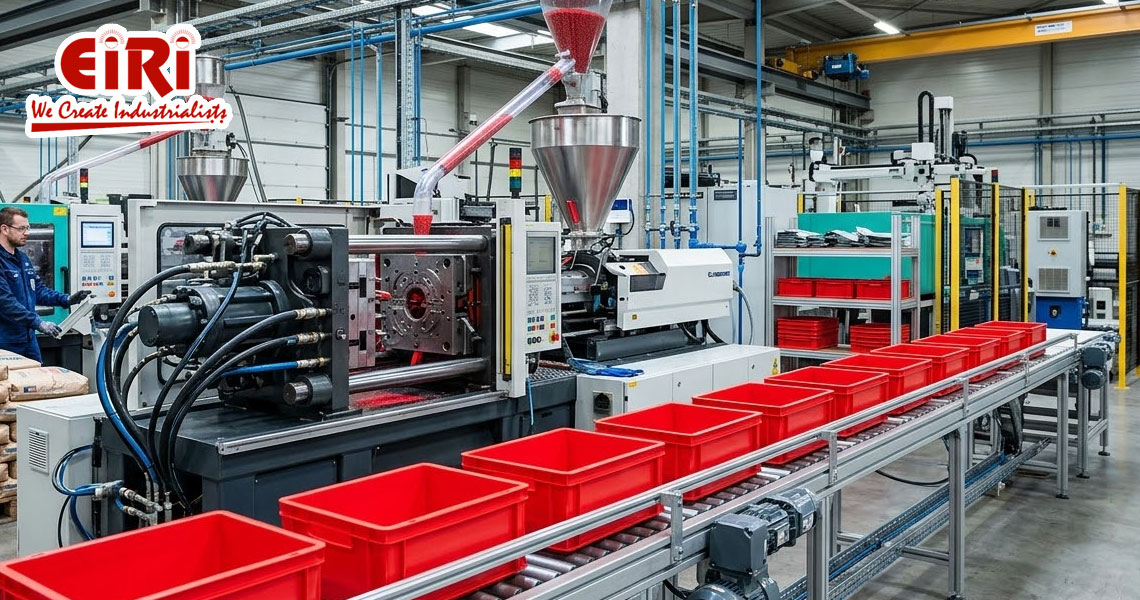
Injection moulding is a manufacturing process in which molten plastic is injected into a closed mould cavity under high pressure. Once inside, the material cools, solidifies, and takes the shape of the cavity. The mould then opens, and the finished part is ejected. This cycle repeats rapidly, making injection moulding highly efficient for mass production.
The process begins with plastic granules, which are fed into a heated barrel where they are melted and homogenized. A screw mechanism then pushes the molten plastic forward and injects it into the mould through a nozzle. The design of the mould plays a critical role in ensuring that the material flows smoothly and fills the cavity completely. Any imbalance or inefficiency in this flow can lead to defects such as short shots, air traps, or uneven cooling.
One of the defining features of injection moulding is its ability to produce parts with excellent surface finish and tight dimensional tolerances. This makes it suitable for industries where precision is critical, such as medical devices and electronics. Additionally, the process supports a wide range of materials, from commodity plastics like polypropylene and polyethylene to high-performance polymers used in demanding environments.
- Involves melting, injecting, cooling, and ejecting plastic
- High-pressure injection ensures accurate shape formation
- Process efficiency depends on proper material flow
- Capable of producing complex and high-precision components
- Ideal for large-scale manufacturing
Basic Elements of an Injection Mould
To understand moulding in depth, it is important to become familiar with the core components of a mould. At its most basic level, a mould consists of two halves: the core and the cavity. When the mould closes, these two halves come together to form the shape of the final product.
The sprue is the primary channel through which molten plastic enters the mould from the injection machine. From the sprue, the material flows into runners, which distribute it to different parts of the mould. Gates are the final entry points that allow the material to flow into the actual cavity. The design and placement of these elements are crucial for achieving balanced flow and minimizing defects.
Another essential feature is the cooling system, which regulates the temperature of the mould. Cooling channels are strategically placed within the mould to remove heat from the molten plastic, ensuring uniform solidification. Efficient cooling not only improves part quality but also reduces cycle time, making the process more economical.
Ejection mechanisms are used to remove the finished part from the mould after it has solidified. These can include ejector pins, plates, or more advanced systems depending on the complexity of the part. Proper ejection design is necessary to prevent damage to the part and ensure smooth operation.
Comparison of Moulding Processes
While injection moulding is the most versatile and widely used process, it is not always the best choice for every application. Blow moulding, for instance, is specifically designed for creating hollow objects such as bottles and containers. In this process, a heated plastic tube is inflated داخل a mould to form the desired shape. This makes it highly efficient for packaging applications.
Compression moulding, on the other hand, involves placing a pre-measured amount of material into a heated mould and applying pressure to shape it. This method is often used for thermosetting plastics and composite materials, where high strength and durability are required. It is commonly found in automotive and electrical applications.
In contrast, Additive Manufacturing operates without the need for a mould. Instead, parts are built layer by layer directly from digital designs. While this approach offers unmatched flexibility and is ideal for prototyping or low-volume production, it currently cannot match the speed and cost efficiency of injection moulding for large-scale manufacturing. As a result, these processes are often used in combination rather than as direct replacements.
Importance of Product Design in Moulding
The success of any moulding operation is heavily influenced by the design of the product itself. Designing for manufacturability means creating parts that are not only functional but also easy and cost-effective to produce. Factors such as wall thickness, draft angles, and material selection must be carefully considered during the design phase.
Uniform wall thickness is essential to ensure even cooling and prevent defects like warping or sink marks. Features such as ribs and bosses are used to add strength without increasing material usage, but they must be designed properly to avoid creating stress concentrations. Draft angles are incorporated to facilitate easy removal of the part from the mould, reducing the risk of damage during ejection.
Modern design practices also emphasize the use of simulation tools to predict how a part will behave during moulding. Software solutions like Autodesk Moldflow allow engineers to analyze material flow, cooling patterns, and potential defects before the mould is even manufactured. This significantly reduces trial-and-error, saving both time and cost.
- Good design reduces manufacturing cost and defects
- Uniform wall thickness prevents warpage
- Ribs and bosses enhance strength efficiently
- Draft angles help in smooth ejection
- Simulation tools like Autodesk Moldflow reduce trial-and-error
Role of Materials in Moulding
Material selection is another critical aspect of plastics manufacturing. Different plastics exhibit different properties in terms of strength, flexibility, thermal resistance, and chemical stability. Choosing the right material depends on the intended application as well as the processing conditions.
Commodity plastics are widely used for everyday products due to their low cost and ease of processing. Engineering plastics offer enhanced mechanical and thermal properties, making them suitable for more demanding applications. High-performance polymers take this a step further, providing exceptional resistance to extreme temperatures and harsh environments.
In addition to traditional materials, there is a growing emphasis on sustainable options. Bioplastics and recycled materials are gaining popularity as industries seek to reduce their environmental impact. These materials present new challenges in terms of processing and performance, but they also open up opportunities for innovation.
Manufacturing, Automation and Industry Evolution
The plastics manufacturing industry is undergoing a significant transformation driven by advancements in automation and digital technologies. Modern injection moulding machines are equipped with sensors and control systems that enable real-time monitoring and optimization of the process. This level of precision helps maintain consistent quality and reduces waste.
Automation plays a key role in improving efficiency and reducing labour dependency. Robots are commonly used for tasks such as part removal, assembly, and inspection. Vision systems can detect defects with high accuracy, ensuring that only quality products reach the market.
These developments are part of a broader shift towards Industry 4.0, where machines, systems, and processes are interconnected through digital networks. This enables data-driven decision-making, predictive maintenance, and enhanced productivity.
Industrial Applications and Market Perspective
The versatility of moulding processes makes them indispensable across a wide range of industries. In the automotive sector, plastic components are used extensively to reduce weight and improve fuel efficiency. In healthcare, precision-moulded parts are essential for devices such as syringes and diagnostic equipment. Packaging relies heavily on moulding techniques to produce lightweight, durable containers.
The demand for plastic products continues to grow globally, driven by urbanization, technological advancements, and changing consumer lifestyles. In emerging markets, including India, there is significant potential for expansion due to increasing industrialization and infrastructure development. This creates opportunities not only for large manufacturers but also for small and medium enterprises looking to enter the field.
At the same time, the industry faces challenges related to sustainability, regulatory compliance, and material innovation. Addressing these issues will require a combination of technological advancement, responsible practices, and strategic planning.
- Widely used in automotive, medical, and packaging industries
- Demand is growing due to technological and economic factors
- Emerging markets offer strong business opportunities
- Sustainability and regulations are key challenges
- Innovation is driving future growth
Conclusion
Plastics manufacturing and moulding form the backbone of modern production systems, enabling the creation of a vast array of products that define everyday life. From the basic concept of a mould to the complexities of injection moulding and advanced automation, the field encompasses a wide range of knowledge and skills.
Understanding the fundamentals of moulds and moulding processes provides a strong foundation for exploring more advanced topics such as design optimization, material science, and smart manufacturing. As the industry continues to evolve, driven by innovations like Additive Manufacturing and Industry 4.0, the importance of staying informed and adaptable cannot be overstated.
For anyone interested in entering this domain, whether as an engineer, entrepreneur, or enthusiast, gaining a clear and structured understanding of these concepts is the first step toward success.