







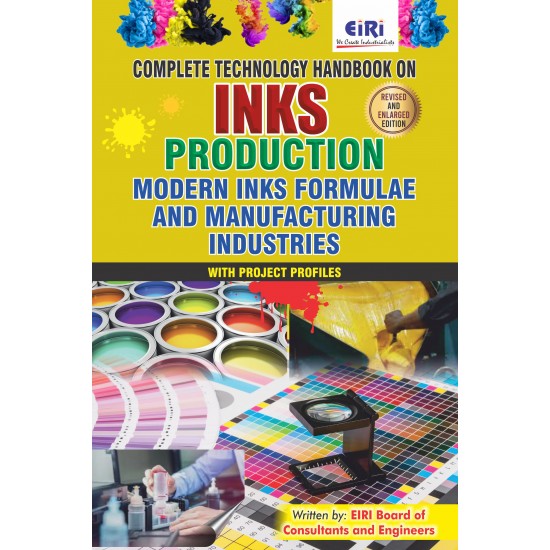
Complete Technology Handbook on Inks Production (Modern Inks Formulae and Manufacturing Industries Hand Book)
- More than 45 years of experience
- Managed by expert industrial consultants
- ISO 9001-2015 Certified
- Registered under MSME, UAM No: DL01E0012000
- 24/5 Research Support
Get your quesries resolved from an industry expert. Ask your queries before report or book purchase. - Custom Research Service
Speak to the our consultant to design an exclusive study to serve your research needs. - Quality Assurance
All reports are prepared by highly qualified consultants & verified by a panel of experts. - Information Security
Your personal & confidential information is safe & secure.

Complete Technology Handbook on Inks Production (Modern Inks Formulae and Manufacturing Industries Hand Book)
Book Contains Chapters on Introduction, Colour Matching, Raw Materials, Waxes and Additives, Typographic Inks, Printing Inks, Formulations, Publication Inks, Cork tipping Inks, Carton Inks and their Formulations, Photogravure Inks for Three- and Four-colour Reproduction, Screen Process Inks, Ball-Point Pen Inks, Testing of Finished Inks, Flexography, Lithographic Inks, Melamine Laminate Inks, Fluorescent Inks, Textile Inks, Water-based Inks, Non-Impact Printing, Electrostatic Imaging, Inks for jet Print-ing, Speciality Screen Inks, Inks for the Electronics Industry, Offset Printing Inks, Stamp Pad Inks, Rotogravure Printing Ink , Printing Inks (Flexographic Ink), Duplicating Ink, Ball Pen Refill Ink, Plastic Ink (Flexographic & Rotogravure Ink) and Golden Silver Paste, Printing Machine Roller, Testing of Printing Inks, Printing Inks and Allied Products Standards List, Plant Economics of Ball Point Pen, Refills & Ink, Plant Economics of Digital Inks, Plant Economics of Industrial Paint and Inks (Various Types), Plant Economics of Offset Printing Inks (Coloured), Plant Economics of Printing Inks (Flexo Graphic), Plant Economics of Printing Inks (Flexo, Roto, Offset and Screen), Plant Economics of Printing Inks on HDPE Laminated or Unlaminated Bags, Plant Economics of Rotogravure Printing (For Flexible Packaging), Plant Economics of Screen Printing Inks.
CHAPTER 1
Introduction
- Elements of Ink
- The nature of Printing Inks
- Visual characteristics of inks
- The colour of inks
- The transparency and opacity of printing inks
- The gloss of printing inks
- Flexographic and Gravure Inks
- Lithographic and letterpress inks
- The Drying Characteristics
- Absorption during
- Oxidation drying
- Evaporation drying
- Chemical drying
- The adhesive nature of printing inks
- The resistance properties of printing inks
- Light fastness
- Heat resistance
- Abrasion resistance
- Product resistance
- Radiation induced drying
CHAPTER 2
Colour Matching
- Introduction
- Practical Procedure in Colour Matching
- The operation of printing
- Ink
- Paper
- Printing Surface
- Printing Conditions
- Colour Pattern
- The Pattern
- Wet Ink Samples
- Printed Pattern
- Matching Procedure
- Limitations
- Tests on the pattern
- Matching Details
- Final Adjustments
CHAPTER 3
Raw Materials
- Pigments
- Yellow pigments
- Diarylide Yellows
- Ironoxide yellows
- Tartrazine yellow lake
- Chrome yellows
- Cadmium yellows
- Fluorescent yellow
- Orange Pigments
- DNA Orange
- Pyrazolone orange
- Diarylide orange
- Fast Orange F2G
- Benzimidazolone Orange HL
- Ethyl Lake Red C
- Red Pigments
- Para Reds
- Toluidine Red
- Carmine F.B.
- Naphthol Reds and Rubines
- Permanent Red FRR
- Bordeaux FRR
- Rubine Reds
- Lithol Reds
- BON Red
- Lithol Rubine 4B
- BON Maroon
- Rhodamine 6G
- Lake Red C
- BON Arylamide Red
- Quinacridone Magentas
- Copper Ferrocyanide Pink
- Benzimidazolone Carmines and Reds
- Azo Magenta G
- Anthraquinone Scarlet
- Madder Lakes
- Pigment Blue
- A Brief Introduction
- Types Of Blue Pigments Available
- Pigment Blue 15.0 (Alpha Blue)
- Pigment Blue 15.1 (Alpha Blue)
- Pigment Blue 15.2
- Pigment Blue 15.3
- Pigment Blue 15.4
- Green Pigments
- Phthalocyanine Greens
- PMTA Greens
- Violet pigment
- Brown pigments
- Diazo Brown
- Benzimidazolone Brown HFR
- Fluorescent Pigment Colors
- Black Pigments
- White Pigments and Extenders
- White Pigments
- Extender
- Pearlescent Materials
- Fluorescent Pigments
- Dyestuffs
- Acid Dyes
- Basic Dye
- Auramine
- Diarylmethyaniline Yellow
- Uses
- Rhodamine 6G
- Rhodamine B
- Victoria Blue
- Uses
- Methyl Violet
- Solvent Dyes
- CI Solvent Yellow 19 No. 13900:1
- Manufacturing Methods
- Uses
- Derivation
- CI Solvent Orange 45 No. 11700: 1
- Manufacturing Methods
- Uses
- Derivation
- CI Solvent Red 8 No. 12715
- Manufacturing Methods
- Induline (spirit soluble)
- Uses
- Manufacturing Methods
- Properties and Applications
- Nigrosine (spirit soluble)
- Properties
- Manufacturing Methods
- Properties and Applications
- Uses
- Nigrosine (free base)
- Properties
- Uses
- Disperse Dyes
- C1 Disperse Yellow 3 No. 11855
- Properties
- Uses
- Structure
- CI Disperse Red 4 No. 60755
- Properties
- Uses
- Structure
- CI Disperse Blue 3 No. 61505
- Properties
- Uses
- Structure
- CI Disperse Red
- No. 6075
- Properties
- Uses
- Oils
- Drying Vegetable Oils
- Linseed oil
- Tung oil (China wood oil)
- Oiticica oil
- Dehydrated castor oil
- Other oils
- Segregated oils
- Marine oils
- Semi-drying oils
- Soya bean oil
- Non-drying oils
- Mineral oils
- News ink oils
- Non-drying vegetable oils
- Natural Resins
- Rosin
- Natural Resin
- Shellac
- The formula of shelloic acid
- Manila copal
- Asphalts
- Starch and dextrin
- Gum Arabic
- Synthetic Resin
- Pure phenolic resins
- Rosin-modified phenolic resins
- Application & Uses
- Pigment interactions
- Hard resin interactions
- Film-forming properties
- Hydrocarbon resins
- Polystyrene resins and copolymers
- Terpene resins
- Silicone resins
- Alkylated urea formaldehyde resins
- Alkylated melamine formaldehyde resins
- Polyamide resins
- Poly (amide imide) resins
- Chlorinated rubber
- Cyclised rubber (isomerised rubber) (Resiprene)
- Application fields
- Vinyl resins
- Polyvinyl alcohol
- Ketone resins
- Acrylic resins
- Epoxide resins
- Polyurethane resin
- Phenolic resin
- Polyisocyanates and polyurethanes
- Nitrocellulose, N/C (Cellulose nitrate CN)
- Ethyl cellulose
- Ethyl hydroxyethyl cellulose (EHEC)
- Cellulose acetate propionate (CAP)
- Cellulose acetate butyrate (CAB)
- Sodium carboxymethyl cellulose (CMC)
- Solvents
- Types of Solvent
- Hydrocarbon Solvents
- Low boiling petroleum distillate-alipatic
- White spirt
- Uses of white spirit
- Paraffin oil (kerosene)
- Examples of Solvent
- The Solution, Solubility and Solvation
- Uses of Solvent
- High boiling petroleum distillates-aliphatic
- Hydrocarbon solvents-naphthenic
- Aromatic hydrocarbons
- Toluene (toluol)
- Xylene (xylol)
- High boiling aromatic solvents
- Alcohols
- Glycol Ethers
- Ketones
- Boiling Points and Solubility
- Plasticisers
- Waxes
- Fully refined paraffin wax
- Petrolatum or petroleum jelly
- Microcrystalline waxes
- Ceresin wax
- Montan wax
- Formulation and mechanisms of waxes in coatings
- Drier
- Paste Driers
- Miscellaneous additives
- Chelating Agents
- Antioxidants
- Surfactants
- Anionic surfactants
- Cationic surfactants
- Non-ionic surfactants
- Amphoteric surfactants
- Deodorants and Reodorants
CHAPTER 4
Waxes and Additives
- Introduction
- Generic wax materials
- Natural Waxes
- Beeswax
- Carnauba Wax
- Lanolin
- Miscellaneous Natural Waxes
- Petroleum waxes
- Micro-crystalline waxes
- Mineral Waxes
- Ceresin Wax
- Ozokerite
- Synthetic Waxes
- Polyethylene Waxes
- Polyethylene Glycols
- Halogenated Hydrocarbon Waxes
CHAPTER 5
Typographic Inks
- Harder-drying book and periodical inks, Jobbing inks
- Platen Inks
- Inks for cylinder machines
- Jobbing Inks
- Quick-setting Inks
- Inks for process coated paper
- Inks for banks, bonds, grease-proof papers, carton boards
- Process Inks
- Print down yellow
- Transparent yellow
- Magenta (Red)
- Black
- Cyan four-colour blue
- Three-colour blue
CHAPTER 6
Printing Inks
- General Requirements
- Manufacturing Process
- Mixing
- Milling
- Filtration
- Ink Properties
- Types of printing inks
- Quick-Set Inks
- Heatset inks
- Moisture-Set Inks
- Radiation-Curing Inks
- High-Gloss Inks
- Metallic Inks
- Magnetic Inks
- Fluorescent Inks
- Scuff-Resistant Inks
- Printing Requirements
- Letterpress
- Offset Lithography
- Flexography
- Gravure
- Ink-Jet Printing
- Copperplate and Die Stamping
- Electrostatic Printing
- Ink is manufactured in two stages
- Step 1 - Varnish manufacture
- Oleoresinous varnish manufacture
- Non-oleoresinous varnish manufacture
- Step 2 - Pigment dispersal
- Three roll mills
- Bead Mills
- Cavitation Mixers
- Composition of inks
- Letterpress ink for newspaper
- Lithographic ink for paper
- U.V. curing lithographic ink for paper
- The manufacture of oleo-resinous systems
- Varnish manufacture
- Flow pattern in practical terms
- Deaeration and potting
- The manufacture of polymer/solvent systems
- Varnish manufacture
- Cavitation mixer
- Rotor/stator mixer
- Storage and handling
- Manufacture of additives
- Liquid ink manufacture
- Ball mills
- Bead Mills
- Chips
- Pigment ‘chip’ manufacture
- Pigment Production Technology
- Manufacture of dye-based inks
- Mixing Equipment
- Butterfly mixers (Change pan)
- Rotor and stator high speed mixers
- High-speed impeller mixers
- High Speed Mixers
- The ‘star’ impeller type
- The high-speed disperser
- The fixed or on-line mixer
- High-speed mixing
- Typical uses and applications
- Milling Equipment
- Three-roll mills
- Construction
- Development of single cast rollers
- Bead mills or stirred ball mills
- Ball Mill
- Vertical Bead Mill
- Pin Type Bead Mill
- Turbo Bead Mill
- Disc Type Bead Mill
- Open sieve mill
- Closed sieve mill (Dupont and Draiswerke)
- Developed by Herr Durr and Herr Engels of Draiswerke GmbH, this major
- John mill (Netzsch GmbH)
- Tex mill (Draiswerke GmbH) (see Fig. 12.23)
- Dyno mill (Willy A Bachofen Ag)
- STS mill (Draiswerke GmbH)
- Boa 500 mill (Buhler Brothers Ltd)
- Co-ball mill (Fryma Ag)
- Manufacture of Newspaper Inks
- Oil handling
- Production method
- Handling and Storage of Inks
- Ink Cartridge Handling Precautions
- Handling precautions for replacing ink cartridges
- Consumption of ink
CHAPTER 7
Formulations
- Considerations governing Choice of Pigments
- Choice of Pigments
- The Role of Water
- Ink Vehicles
- Linseed Oil based Black Offset Litho
- Soap Carbon Printing Yellow Offset Litho
- General Purpose Hard Drying Red Offset Litho
- Summary of general consideration
- Damping Water and the Ink
- Ink Consistency
- Ink Drying
- Drier Absorption
- Letterpress Ink Formulation
- Platen ink for absorbent papers
- Cylinder press ink for uncoated papers
- Quick-set inks for coated paper
- Letterpress ink drying by oxidation
- Water-reducible inks
- Process inks
- Process magenta letterpress
- Newspaper coloured inks
- Rotary black inks for newspapers
- Formula A: General-purpose low mist black
- Formula B: Ink rail
- Formula C: Page-Pak
- Formula D: Keyless inking (indirect flexo)
- Formula E: Flat-bed rotary
- Formula F
- Use of refined oils
CHAPTER 8
Publication Inks, Cork tipping Inks, Carton Inks and their Formulations
- Paper in publication printing
- Gloss and absorbency
- Formulation requirements
- Easily dispersible pigments for publication gravure inks
- Inks for catalogue printing
- Typical formulation of a catalogue ink
- Packaging inks for paper and board Labels
- Typical fast-drying formula for labels
- Typical formula of a chip-based non-curl label ink
- Typical co-solvent polyamide ink
- Metallic label inks Formula
- Bronze ink
- Paper wrapper inks
- Inks for cork tipping
- Carton Inks
- Heat-resistant carton ink Formulation
- Heat seal resistant varnish Formulation
- Metallic bronze gravure ink for cartons
- Foil inks
- Virgin foil
- Formulation for lightweight aluminium foil
- Foil laminates
- Foil board laminates
- Inks for polyethylene film
- Ink based on co-solvent polyamide resin
- Ink based on alcohol-soluble polyamide resin:
- Inks for treated polypropylene films
- White ink for treated side of co-extruded polypropylene:
- Red ink for pearlisedopp
- Coated polypropylene films
- Yellow ink for printing on coated polypropylene film
- Cellulose films
- Main application
- White ink for surface printing on N/C coated films
- Polyester films
- Red ink for reverse print and lamination on uncoated polyester film
- Nylon films
- Vinyl films
- Metallised films
- Wall coverings
- Inks for paper
- Typical formula for a gravure wallpaper ink
- Vinyl coated wallcoverings
- Typical formula of a vinyl wallcovering gravure ink
- Typical gravure/flexo wall-covering ink
- Expanded polyethylene
- Decorative wall panels
CHAPTER 9
Photogravure Inks for Three and Four colour Reproduction
- Introduction
- Black Inks
- Coloured and Extender Inks
- Metallic Gravure Inks
- Gravure Overprint Varnishes
CHAPTER 10
Screen Process Inks
- Introduction
- Poster Inks
- Gloss Poster Inks
CHAPTER 11
Ball-Point Pen Inks
- Ink Components
- Innovations in Ink
- Additive Assistants
- Raw Materials
- The Manufacturing Process
- Making the ink
- Stamping and forming
- Molding the housing
- Ink filling and assembly
- Final assembly, packaging and shipping
CHAPTER 12
Testing of Finished Inks
- Short Term Tests
- Longer Term Tests
- Short Term Tests
- Consistency (Letterpress and Litho Inks)
- Dispersion
- Scale Comparisons of Grinding Gauges
- Hue and Strength
- Short Term Tests on Other Types of Inks
- Liquid Inks
- News Inks
- Silk Screen and Die-stamping Inks
- Longer Term Tests
- Drying Time
- Automatic Drying Time Testers
- Skinning time
- Setting Time
- Strength (Concentration of pigment)
- Hue: Instrumental Measurements
- Gloss
- Density and Specific Gravity
CHAPTER 13
Flexography
- Ink Fountain
- Printing Unit
- Plates
- Rubber Plates
- Outfeed Section
- Inks and Substrates
- Paper and Paperboard
- Non-Paper Substrates
- Press Configurations
- Sheetfed Flexography
- Hybrid Flexographic Presses
- Flexo Gravure
- Offset Flexo
- Advantages
- Disadvantages
- Designing for Flexography
- The Flexo-printing Process
- Platemaking
- Printing
- Understanding the key flexographic label printing press components
- Feed & Unwind Station
- Printing station
- Drying Station
- Die Cutting & Converting
- Outfeed and Rewind
- Types of flexographic label press
- In-Line Press
- Central Impression Press
- Stack Press
CHAPTER 14
Lithographic Inks
- Nature of the process
- Formulation of Lithographic ink
- Characteristics of Litho Inks
- Film thickness considerations
- Drying Mechanisms
- Restrictions of the process
- Penetration
- Oxidation
- Quickset mechanism
- Physical Properties
- Viscosity
- Solvents
- Formula
- Formulating Principles
- Formula for lithographic offset printing ink
- Lithographic Inks
- Violets
- Greens
- White
- Extenders
- Typical inks and varnishes
- Inks and varnishes for sheet-fed paper printing
- Sheet-fed label inks
- Metallic inks
- Small-offset
- Inks and varnishes for sheet-fed carton board printing
- Ink for sheet-fed impervious substrate printing
- Formulation
- Inks for web-offset paper printing
- Coldset
- Heatset
- Ink-related problems and their possible solutions
- Step-by-Step Troubleshooting Guide:
- Check for Physical Damage
- Clean the Pump:
- Verify Ink Levels
- Inspect Tubing
- Address Unusual Noises
- Tighten Connections
- Address Leaks
- Perform Test Prints
- Consult Technical Documentation
- Seek Professional Help
- High Dot Gain
- Piling
- Setoff
- Poor Ink Mileage
- Litho problems
- Rheology problems
- Tack problems
- Setting and drying problems
- Appearance problems
- Dot reproduction
- Poor Lay
- Problem
- Problem
- Problem
- Problem
- Problem
- Recent and future trends
- 3D Printing Will Penetrate Into Different Sectors
- Expertise In IT Will Be Key
- Sheet Fed Digital Printing
- Print Security Spending Will Be Fuelled by IoT
- Cost Effective Printing Is Of Prime Demand
- Security Printing
- Cloud Printing
- The Role of Automation and Artificial Intelligence
- The Personalisation and Customisation Trend
CHAPTER 15
Melamine Laminate Inks, Fluorescent Inks, Textile Inks, Water-based Inks, Non-Impact Printing, Electrostatic Imaging, Inks for jet Print-ing, Speciality Screen Inks
- Stamps
- Speciality systems
- Metallic inks
- Colors and Types
- Metallic Ink Screenprinting
- The Benefits
- Bronze inks for film
- Aluminium-based inks
- Typical formula - vinyl wallcovering simulated gold
- Pearlescent inks
- Typical formula of pearlescent ink for wall covering
- Fluorescent inks
- Textile Inks
- Reactive Ink
- Disperse Ink
- Water-based Inks
- Acid Inks
- Sublimation Inks
- Pigment Inks
- Non-Impact Printing
- Electrostatic imaging
- Inks for jet printing
- Water-based continllous jet ink
- Drop-an-demand (impulse) system
- Speciality Screen Inks
- Encapsulated perfume inks
- Thermochromic inks
- Phosphorescent inks
CHAPTER 16
Inks for the Electronics Industry
- Printed circuit products
- Alkali-soluble rich resist
- Two-pack epoxy solder resist
- UV solder resist
- Thermal-curing notation ink
- Membrane switches
- Inks for laminated plastics
- Inks for wallcoverings
- Water-based flexowallcovering ink
- H/C free flexolgravure vinyl wallcovering ink
- Textile transfer inks
- Flexo water-based heat transfer ink
- Sterilisation Inks
- One-pack steam sterilisation ink
- Other colour change and security inks
- Security Ink Technologies
- Biometric Taggants
- Erasable Ink
- Coin Reactive Ink
- Bleeding Ink
- UV Invisible Fluorescent Ink
- Thermochromic Ink
- Fugitive Ink
- Chemical Reactive Inks
- Optically Variable Ink
- Magnetic Ink
- Penetrating or Indelible Ink
- Pen Reactive Ink
- Secondary Fluorescing Ink
- Photochromic Ink
- Visible Infrared Ink
- Adhesion Promotion Varnish
- Security Ink Applications
- Bank Notes
- Textiles
- Packaging
- Official Documents
- Labels
- Pharmaceuticals
- Handbags and Cosmetics
- Concert, Sports and Lottery Tickets
CHAPTER 17
Offset Printing Inks
- Product Introduction of Colour Printing Ink
- Properties and Characteristics
- B.I.S. Specification
- Principles of ink formulation
- Offset printing inks (coloured)
- Formulae
- Blue Plate Inks
- Flexographic Inks
- Gravure Ink
- Automatic Press Red
- Manufacture of Offset Printing Inks
- Steps to Formulate Offset Printing Inks
- Inspect Incoming Ink
- Agree on a Specification
- Define the Target Color
- Measure the Print Substrate
- Define the Ink Film Thickness or Anilox Roller
- Formulate of Recipe
- Create a Drawdown
- Measure the Drawdown
- Save the Recipe
- Evaluate Results
- Resolve On-Press Issues
- Special offset printing inks
- Thermochromic inks
- Metallic inks
- Mirror inks
- Pearlescent inks
- Watermark imitation inks
- Scented inks
- Scratch-off inks
- Magnetic inks
- Luminescent inks
CHAPTER 18
Stamp Pad Inks
- Introduction
- B.I.S. specification of ink, stamp pad
- Process of manufacture
- Glycerine based
- Purpal colour (Oil Based)
- Procedure
- Blue Ink
- Procedure
- Red Inks
- Procedure
- Method of manufacture for stamp pad ink
- Formula
- Flowchart
CHAPTER 19
Rotogravure Printing Ink
- Formulations
- Flexographic inks
- Formulation-1
- Formulation-2
- Formulation-3 (Bright blue ink)
- Formulation-4 (Green ink)
- Formulation-5 [Flexographic (Nitro cellulose base) Ink]
- Formulation-6 (For Paper, Carton Board, Foil, Cellophone, Cellulose Acetate Film and Other Plastic Films)
- Manufacturing process of flexographic ink
- Gravure Inks Formulation
- Manufacturing process of gravure printing ink
- Manufacturing process of vehicle
- Dispersion of Pigments
CHAPTER 20
Printing Inks (Flexographic Ink)
- Introduction
- Formulations
- Flexographic Inks
- Formulation 1
- Formulation-2
- Formulation-3 (Bright blue ink)
- Manufacturing process of flexographic ink
- Gravure Inks Formulation
CHAPTER 21
Duplicating Ink
- Introduction
- Uses and Application
- Properties
- Raw Materials
- Formulations
- Formulation-1
- Formulation-2
- Formulation-3
- Manufacturing Process
CHAPTER 22
Ball Pen Refill Ink
- Ball pen inks formulations and processes
- formulation - Cold Climate Ball Pen Ink
- Temperature Climate Ball Pen Ink Formulation
- Tropical Climate Ball Pen Ink Formulation
CHAPTER 23
Plastic Ink (Flexographic & Rotogravure Ink) and Golden Silver Paste
- Introduction
- Flexography
- Gravure
- Flexographic Inks
- Gravure Inks
- Uses and Application
- BIS Specification
- Formulations
- Flexographic Inks
- Formulation-1
- Formulation-2
- Formulation-3 (Bright blue ink)
- Formulation-4 (Green ink)
- Formulation-5 (Flexographic (Nitro cellulose base) ink]
- Formulation-6 (For Paper, Carton Board, Foil, Cellophone, Cellulose Acetate Film and Other Plastic Films)
- Formulation-7 (For Plastic Packaging Film)
- Flexographic Ink Formulation
- Process
- Flexographic Ink
- Flexographic Ink
- Process of Manufacture
- Manufacturing process of flexographic ink
- Gravure Inks Formulation
- Manufacturing process of gravure printing ink
- Manufacturing process of vehicle
CHAPTER 24
Printing Machine Roller
- Detailed description of the preferred embodiments
- Working principle of three roll mill
- How to choose a three roll mill
- The quality of the roller
- Roller size
- Feeding method
- Influence of parameter setting on grinding effect
- Pressure
- Temperature
- Blade
- Tips for finding the best device
CHAPTER 25
Testing of Printing Inks
- The Importance of Ink Testing
- Methods of Ink Testing for Commercial Printing
- Specific Gravity
- The Effect of temperature on Viscosity
- The effect of ink viscosity on quality
- Viscosity Measurement
- Viscosity
- Penetration
- Refraction
- Evaporation
- Acid Number
- Ink Absorbency
- Various tests can determine the ink absorbency of a paper
- Tung Oil
- Detection of Resin
- Detection of Rosins
- Testing of Pigments
- Do organic pigments contain chlorinated aromatics?
- Can pigments be a source of cyanide?
- Can certain pigments produce aromatic amines?
- Solid Prints/Side-by-Side comparisons of Batches
- Pigment Strength & Transfer (Wedge Prints)
- Dry Rub Resistance
- % Volatiles
- % Trap
- Water Pickup & Contamination
- Brookfield Viscosity
- Duke Viscosity
- Fineness of Grind
- Ink Mileage
CHAPTER 26
Printing Inks and Allied Products Standards List
CHAPTER 27
Plant Economics of Ball Point Pen, Refills & Ink
- Land & Building
- Plant & Machinery
- Fixed Capital
- Working Capital Requirement/Month
- Total Capital Investment
- Turn Over/Annum
CHAPTER 28
Plant Economics of Digital Inks
- Land & Building
- Plant & Machinery
- Fixed Capital
- Working Capital Requirement/Month
- Total Capital Investment
- Turn Over/Annum
CHAPTER 29
Plant Economics of Industrial Paint and Inks (Various Types)
- Land & Building
- Plant & Machinery
- Fixed Capital
- Working Capital Requirement/Month
- Total Capital Investment
- Turn Over/Annum
CHAPTER 30
Plant Economics of Offset Printing Inks (Coloured)
- Land & Building
- Plant & Machinery
- Fixed Capital
- Working Capital Requirement/Month
- Total Capital Investment
- Turn Over/Annum
CHAPTER 31
Plant Economics of Printing Inks (Flexo Graphic)
- Land & Building
- Plant & Machinery
- Fixed Capital
- Working Capital Requirement/Month
- Total Capital Investment
- Turn Over/Annum
CHAPTER 32
Plant Economics of Printing Inks (Flexo, Roto, Offset and Screen)
- Land & Building
- Plant & Machinery
- Fixed Capital
- Working Capital Requirement/Month
- Total Capital Investment
- Turn Over/Annum
CHAPTER 33
Plant Economics of Printing Inks on HDPE Laminated or Unlaminated Bags
- Land & Building
- Plant & Machinery
- Fixed Capital
- Working Capital Requirement/Month
- Total Capital Investment
- Turn Over/Annum
CHAPTER 34
Plant Economics of Rotogravure Printing (For Flexible Packaging)
- Land & Building
- Plant & Machinery
- Fixed Capital
- Working Capital Requirement/Month
- Total Capital Investment
- Turn Over/Annum
CHAPTER 35
Plant Economics of Screen Printing Inks
- Land & Building
- Plant & Machinery
- Fixed Capital
- Working Capital Requirement/Month
- Total Capital Investment
- Turn Over/Annum
How to Make Project Report?
Detailed Project Report (DPR) includes Present Market Position and Expected Future Demand, Technology, Manufacturing Process, Investment Opportunity, Plant Economics and Project Financials. comprehensive analysis from industry covering detailed reporting and evaluates the position of the industry by providing insights to the SWOT analysis of the industry.
Each report include Plant Capacity, requirement of Land & Building, Plant & Machinery, Flow Sheet Diagram, Raw Materials detail with suppliers list, Total Capital Investment along with detailed calculation on Rate of Return, Break-Even Analysis and Profitability Analysis. The report also provides a birds eye view of the global industry with details on projected market size and then progresses to evaluate the industry in detail.
We can prepare detailed project report on any industry as per your requirement.
We can also modify the project capacity and project cost as per your requirement. If you are planning to start a business, contact us today.
Detailed Project Report (DPR) gives you access to decisive data such as:
- Market growth drivers
- Factors limiting market growth
- Current market trends
- Market structure
- Key highlights
Overview of key market forces propelling and restraining market growth:
- Up-to-date analyses of market trends and technological improvements
- Pin-point analyses of market competition dynamics to offer you a competitive edge major competitors
- An array of graphics, BEP analysis of major industry segments
- Detailed analyses of industry trends
- A well-defined technological growth with an impact-analysis
- A clear understanding of the competitive landscape and key product segments
Need Customized Project Report?
- Ask for FREE project related details with our consultant/industry expert.
- Share your specific research requirements for customized project report.
- Request for due diligence and consumer centric studies.
- Still haven't found what you're looking for? Speak to our Custom Research Team
About Engineers India Research Institute:
Note: We can also prepare project report on any subject based on your requirement and country. If you need, we can modify the project capacity and project cost based on your requirement.
Our Clients

Our Approach
- Our research reports comprehensively cover Indian markets (can be modified as per your country), present investigation, standpoint and gauge for a time of five years*.
- The market conjectures are produced on the premise of optional research and are cross-accepted through associations with the business players
- We use dependable wellsprings of data and databases. What's more, data from such sources is handled by us and incorporated into the report
Why buy EIRI reports?
- Our project reports include detailed analysis that help to get industry Present Market Position and Expected Future Demand.
- Offer real analysis driving variables for the business and most recent business sector patterns in the business
- This report comprehends the present status of the business by clarifying a complete SWOT examination and investigation of the interest supply circumstance
- Report gives investigation and top to bottom money related correlation of real players/competitors
- The report gives gauges of key parameters which foresees the business execution